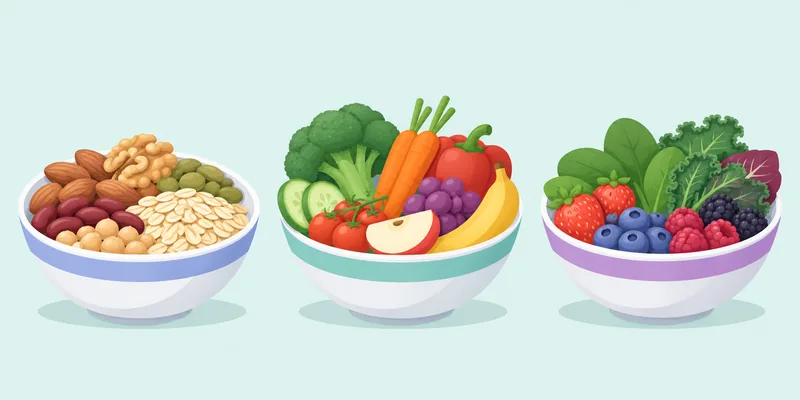
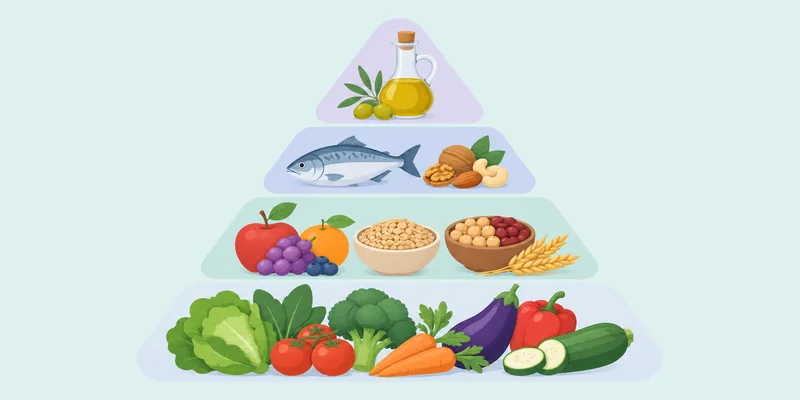
Plant-based diets are among the best-supported ways of eating for heart health, but "plant-based" covers a very wide range, from a strict vegan or whole-food plant-based no-oil (WFPBNO) program to a Mediterranean pattern that is mostly plants plus fish, olive oil and a little dairy. The group's admins, especially Louis Nervegna, hold that the broad evidence for plant-based eating is strong while some of the specific claims made for the strictest versions, particularly that they "cure" heart disease, are not backed by high-quality trials.12
In short: a well-built plant-based diet very probably lowers cardiovascular risk. The two best-known programs for people who already have heart disease, those of Dean Ornish and Caldwell Esselstyn, have real success stories behind them, but the formal evidence is thinner than their reputations suggest. Ornish ran one small randomized trial. Esselstyn has published case series. Larger randomized trials of Mediterranean and DASH-style diets, which are plant-heavy but not vegan, produced results that were comparable or better.1345
This article walks through what each approach is, what the trials and cohort studies show, the main controversies, and what the group's admins suggest in practice.
Key terms and the main programs
Plant-based is an umbrella word. The group's posts distinguish several patterns:
- Vegan: no animal foods at all.
- Vegetarian: no meat; in the Adventist data this is split into lacto-ovo-vegetarian (dairy and eggs allowed) and pesco-vegetarian (fish allowed, no other meat).1013
- WFPBNO (whole-food plant-based, no oil): the pattern associated with Esselstyn and, in its original form, Ornish. Louis uses this term throughout.49
- Mediterranean and DASH diets: mostly plant-based patterns that still include fish, some poultry, and low-fat or fermented dairy. The JACC: CardioOncology review quoted in the group describes them as predominantly whole-food plant-based patterns that include these foods in moderation.14
The Ornish program
Dean Ornish's Lifestyle Heart Trial combined a very low-fat vegetarian diet with stress management, moderate exercise and stopping smoking. Even this program was not strictly vegan: Louis notes that it allowed egg whites, non-fat yogurt and non-fat milk.68 Cleveland Clinic's comparison, shared in the group, describes the Ornish diet as primarily vegan with very limited fat, whereas the traditional Mediterranean diet permits extra virgin olive oil, nuts, seeds, avocado, skinless poultry, limited unprocessed red meat, egg yolks, fermented dairy and fish.15
The Esselstyn program
Caldwell Esselstyn's program is a whole-food plant-based diet with no added oil, which also excludes olive oil. His published results come from patients with established coronary disease. Louis characterizes those publications as case reports and case series.13
The programs side by side
| Ornish | Esselstyn | Mediterranean | DASH | |
|---|---|---|---|---|
| Diet | Very low-fat vegetarian, primarily vegan; egg whites and non-fat yogurt and milk allowed815 | Whole-food plant-based, no added oil, including no olive oil1 | Mostly plants plus extra virgin olive oil, nuts, fish, skinless poultry and fermented dairy15 | Mostly plants plus fish, some poultry and low-fat dairy14 |
| Nuts | Now a limited amount of select nuts and seeds16 | Argued against for people with heart disease, according to Louis17 | Included15 | Included5 |
| Main evidence | One small randomized trial, 28 vs 20 patients, lifestyle program not diet alone9 | Case series, most patients on statins3 | Four large randomized trials (meta-analysis)4 | Randomized plaque trial (DISCO)6 |
What the evidence shows
The Lifestyle Heart Trial (Ornish)
One group post summarizes the original trial as follows: percent diameter stenosis (narrowing) went from 40% to 37.8% after one year in the intervention group, while usual care patients progressed from 42.7% to 46.1%, with greater regression and fewer cardiac events at five years.8 The Lancet paper, as described in the link metadata, assigned 28 patients to the experimental group and 20 to controls.8
Show data
| Baseline | After 1 year | |
|---|---|---|
| Lifestyle program | 40% | 37.8% |
| Usual care | 42.7% | 46.1% |
The five-year follow-up (JAMA, 1998) reported 25 cardiac events in 28 intervention patients versus 45 events in 20 controls (risk ratio for any event for controls 2.47, 95% confidence interval 1.48 to 4.20).9 Louis stresses what the trial did not show: among the 28 patients who stuck with the program for five years there were still 2 heart attacks, 8 angioplasties, 2 bypass operations, 23 cardiac hospitalizations and 2 deaths. Only angioplasties, hospitalizations and total events were statistically significantly lower than in controls; heart attacks, bypass surgery and deaths were not, and there were 2 deaths in the diet group versus 1 in controls. He also notes that this was a comprehensive lifestyle program, not diet alone.918
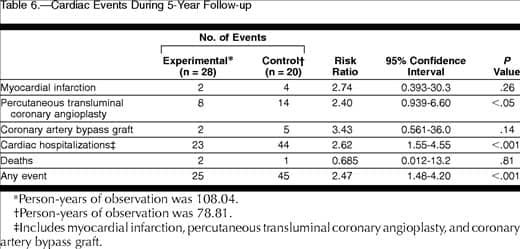
Louis's conclusion is that the results were good but no better than those of large randomized trials of the traditional Mediterranean diet, and that the trial was very small. One post describes it as having only 26 people including controls, while the paper quotes elsewhere in the group count 28 plus 20; either way, it is tiny next to trials with thousands of participants.149
Other early diet trials with plaque regression
The same group post that summarizes the Lifestyle Heart Trial also lists an open two-year trial of a plant-based diet, exercise and stress management (the Mount Abu Open Heart Trial, 123 patients), which reported a 6.1% average reduction in diameter stenosis, 18.2% regression in the most adherent third and roughly four-fold fewer cardiac events than the least adherent (11 vs 38). It also lists a two-year vegetarian-diet cohort of 39 patients (Leiden Intervention Trial) with no lesion progression in 18 patients but no regression, and the STARS trial (90 patients, 39 months) in which narrowing progressed in 15% and 12% of the two diet groups versus 46% with usual care.8 Gokhan Can, who wrote that summary, says plant-based diets have stronger evidence for reversing heart disease than low carb, but that he personally could not sustain such a diet beyond a few weeks.8
Six randomized diet trials of plaque reversal
Louis repeatedly cites six randomized controlled trials (RCTs) in which diet reversed arterial plaque: the Lifestyle Heart Trial (1990, Ornish diet), STARS (1992, AHA diet), SCRIP (1994, AHA diet), PREDIMED (2013, Mediterranean), CORDIOPREV (2021, Mediterranean) and DISCO (2021, DASH-style).567 His point is that all were primarily plant-based but none used a pure vegan diet, and that the shared themes were:
- Emphasized: fruits and vegetables, legumes, whole grains, yogurt and some other dairy, unsaturated fats, nuts, olive oil, fish and seafood, and some eggs and poultry.
- Limited in every trial: junk food, refined grains, sugary foods and drinks, large amounts of butter, fatty red meat and large amounts of alcohol.67
He adds that three trials of higher-fat Mediterranean or DASH diets with nuts and avocado showed reversal, so the claim that nuts, olive oil and avocado prevent regression is wrong in his view.519 The paper links for these trials are in the group: for example the Lifestyle Heart Trial in JAMA, STARS in The Lancet90863-X/fulltext) and CORDIOPREV in Stroke.7
Diet is not the only lever. Louis lists six strategies that have reversed plaque in human RCTs: major weight loss (about 30 lb), a traditional Mediterranean or DASH diet, LDL-lowering drugs, colchicine, exercise and high-dose EPA from fish oil.2021 The 2-year DIRECT-Carotid trial, which compared low-fat, Mediterranean and low-carb diets for weight loss, is his example for the weight-loss route.20 Gokhan's own ranking of plaque-regression interventions rates statins, PCSK9 inhibitors and ezetimibe as having the strongest trial evidence, and calls plant-based diets "promising but need further study in rigorous RCTs with sensitive plaque imaging".22
Mediterranean diet trials for comparison
A May 2024 meta-analysis of the four large Mediterranean-diet RCTs (Lyon Diet Heart, Indo-Mediterranean, PREDIMED and CORDIOPREV), compared with control diets similar to American Heart Association advice, reported 48% fewer major adverse cardiovascular events, 38% fewer heart attacks, 36% fewer strokes and 46% lower cardiovascular mortality.4 Louis uses this as the benchmark against which Ornish's very small trial and Esselstyn's case series should be judged.34
Cohort studies: Adventists and Harvard
The Adventist Health Study-2 is useful because all participants follow some religiously encouraged healthy pattern, so healthy diets can be compared head to head. In an analysis of more than 88,000 people and about 12,500 deaths (cohort of nearly 96,000, followed through 2015), pesco-vegetarians had 18% lower all-cause mortality than non-vegetarians, lacto-ovo-vegetarians 15% lower and vegans 3% lower.1013 Louis notes the same pattern in the Harvard Nurses' Health Study and Health Professionals Follow-up Study, where plant-based eaters who included some seafood outlived pure vegans; the vegans still did very well, just not as well.102324
A later AHS-2 analysis of older adults found that vegans aged 85 and older had higher death risk from stroke (17%), dementia (13%) and Parkinson's disease (37%) than healthy non-vegetarians, while pesco-vegetarians had the lowest risk. The comparison group was very healthy non-vegetarians rather than people on a standard Western diet.25 The study abstract quoted in the link metadata says vegetarian diets were associated with lower all-cause and many cause-specific mortalities, especially among males and younger subjects, with higher risks for some outcomes among older vegetarians.13
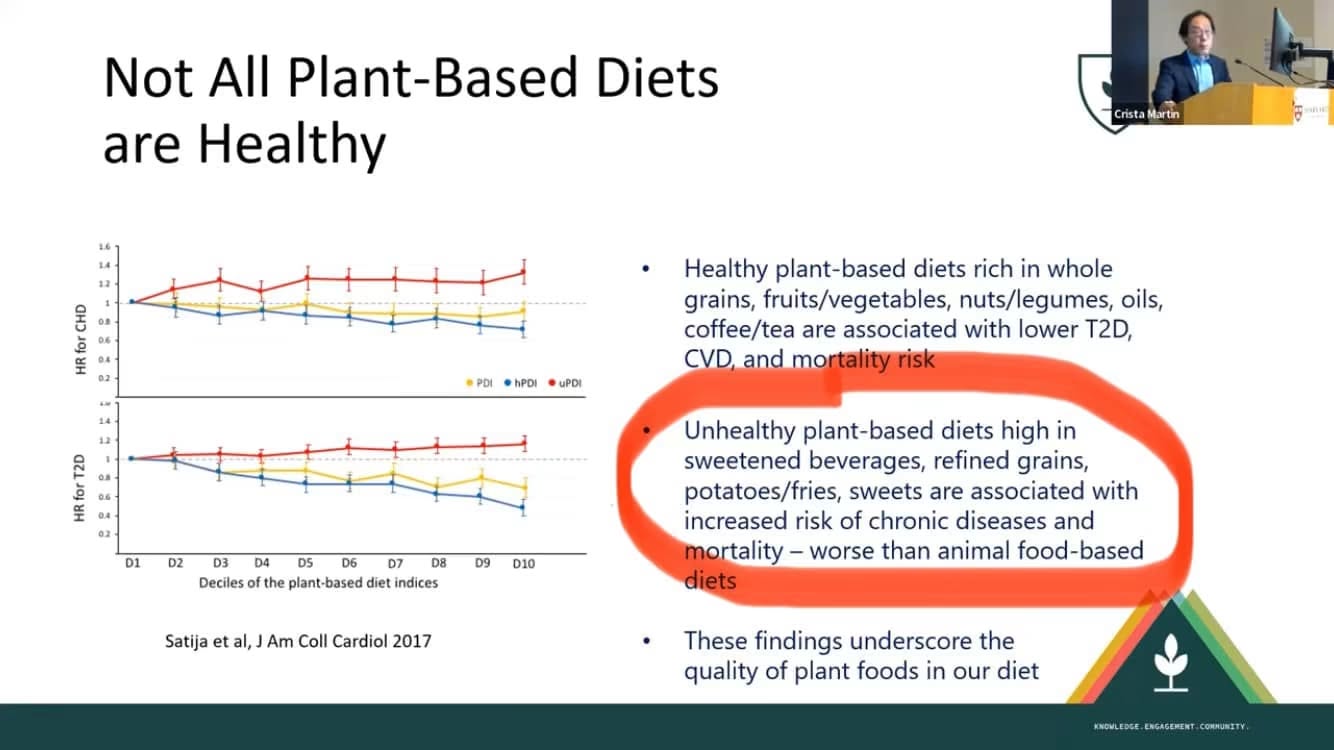
The Harvard cohorts also show why food quality matters. In the Satija et al. analysis in the Journal of the American College of Cardiology (2017), a plant-based index rich in healthy plant foods was associated with substantially lower coronary heart disease risk, whereas an index emphasizing sugar-sweetened beverages, refined grains, potatoes and sweets was associated with higher risk, worse than the standard-diet baseline.11 Likewise a large dementia study found whole grains, vegetables, vegetable oils, nuts and legumes associated with lower risk and refined grains, juices, white potatoes and added sugars with higher risk; Louis's summary is that a plant-based diet full of low-quality foods does more harm than good.26
Guideline and society views
The European Society of Cardiology scientific statement on diet, as summarized by Louis, concludes that diet is a primary factor in cardiovascular prevention and treatment. Plant-based patterns rich in minimally processed foods reduce risk; ultra-processed foods, red meat, salt, sugar and saturated fat increase it. The Mediterranean, DASH and vegetarian diets reduce risk, while "vegan diets offer no additional benefit".27 A JACC: CardioOncology review quoted in the group says that the AHA, ACC, American Cancer Society, NCCN and WCRF/AICR guidelines all recommend a predominantly whole-food plant-based diet, and that Mediterranean and DASH patterns qualify.14 Harvard's Walter Willett, in an interview shared by Louis, says his cohorts found total fat irrelevant, trans fats bad and unsaturated fats associated with substantially lower heart disease and mortality, which fits the traditional Mediterranean pattern.28
Nuances, controversies and misconceptions
"Esselstyn proved the diet reverses heart disease"
Louis says Esselstyn's studies are case-based observational studies at the bottom of the evidence hierarchy, that his patients were heavily medicated (most on statins), and that no randomized trial of the diet exists. He quotes Esselstyn's own 12-year follow-up stating that combining a plant-based diet with medication achieves better long-term results than diet alone, and that the lipid reductions were due to dietary compliance "combined with a statin agent".329 Louis acknowledges that the Esselstyn diet "can be very healthy" and "almost certainly reduces risk for CVD"; his objection is to overhyped claims.1
He also critiques a widely shared before-and-after angiogram of Esselstyn's patient Joseph Crowe. The baseline image was taken right after a heart attack and so mixed fixed plaque with acute clot and vessel spasm, meaning some of the later opening reflects natural healing. Louis adds, in fairness, that Crowe survived nearly 28 years after a heart attack at age 44 and died at 72.30 He further argues that Esselstyn's claim that everyone who complies sees disease stop is untrue, citing people in online groups who followed the diet closely and still progressed, usually those who declined medication.1231 This is Louis's experience and opinion rather than a study.
Was the Ornish "reversal" real?
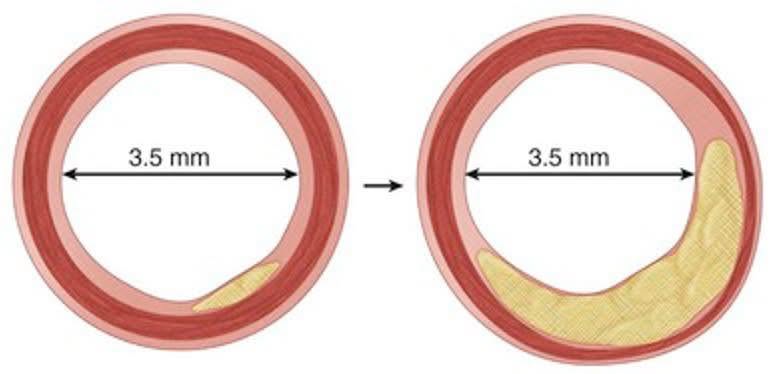
Louis relays criticism from academic cardiologists. The trial used x-ray angiography, which outlines the lumen (the channel the blood flows through) rather than the plaque itself. The reported lumen change was about 2.1% at one year and 3.4% at five years, which on a typical 3 mm artery is roughly 0.06 to 0.1 mm, below the roughly 0.2 mm resolution of the technique, so much of it may be measurement error.32 A related post explains the Glagov phenomenon: early plaque causes the artery wall to expand outward, so a vessel can look normal on angiography while carrying substantial plaque; this is why modern studies use IVUS or CT angiography.3233
Olive oil, nuts, avocado and the "no oil" rule
Esselstyn's program excludes oil and, according to Louis, he has argued that olive oil impairs endothelial function and that nuts harm people with heart disease. Louis disputes both. For olive oil, he cites a randomized crossover trial in adults at risk for type 2 diabetes in which a single 50 mL dose of high-polyphenol extra virgin olive oil changed endothelial function by +1.2% versus -3.6% for refined olive oil (p = 0.0086), an absolute flow-mediated dilation improvement of 4.8%, with no acute blood-pressure effect.1734 He says that more than 30 human RCTs show olive oil improves flow-mediated dilation and endothelial function over longer periods, and that the brief dip after refined olive oil resembles the transient, probably hormetic dip that follows exercise.353637 He also states that no human randomized trial shows extra virgin olive oil impairing endothelial function.38
On nuts, the Ornish program itself changed course. It now allows a limited amount of select nuts and seeds, citing cohort studies (the Adventist, Iowa Women's, Nurses' and Physicians' studies) in which nut intake was associated with 30 to 50% lower cardiovascular disease risk, and the PREDIMED trial of 7,216 high-risk participants, in which the nut group halved stroke incidence.1639 Louis suggests following Ornish rather than Esselstyn on this point.1739 Readers should note this is Louis's position; the Forks Over Knives "Great Oil Debate" shows that experts in the whole-food plant-based community do not agree among themselves about added oils.40 He further comments that a plant-based cardiologist's meal and Esselstyn's family guacamole contained as much or more unsaturated fat than a Mediterranean diet, opinions offered without a specific study.4142
Not a cure, and not heart-attack proof
Several posts make the same point. A former president of the Vegetarian Society (Singapore) described having a heart attack at 70 after 43 years as a vegetarian or vegan, despite a good diet and regular exercise, with his weight and LDL cholesterol having crept up.4344 Louis also cites the sudden death at 59 of Dr. Baxter Montgomery, a cardiologist and plant-based advocate, as a reminder that these diets reduce risk but are not "magic cures".1218 He is similarly critical of the extreme high-starch (roughly 90% starch) diet promoted by John McDougall, including white potatoes and refined starch and sugar, though this is his opinion backed by links rather than a study.45
Potential downsides raised in the group
- Hemorrhagic stroke: Louis flags that plant-based diets may modestly raise hemorrhagic stroke risk in observational data, while noting that this cannot prove causality, and that lifetime risk of heart attack in the US is about 20% versus about 3% for hemorrhagic stroke.46
- Older age: the AHS-2 neurological findings in vegans over 85 described above.25
- White potatoes and refined starch: Louis calls white potatoes "not health food" and says a Harvard clinical trial is testing whether they harm the arterial lining; he prefers sweet potatoes and intact whole grains.47
- Sustainability: Gokhan suggests looking at accounts from former vegans, noting these diets "aren't always sustainable or beneficial long-term".48
Weight and liver fat may drive many of the benefits
Louis argues that many metabolic benefits attributed to a particular diet come from losing visceral and liver fat. Low-fat vegan, Mediterranean and keto diets all reduce liver fat and improve insulin sensitivity, and the large drop in hsCRP (a marker of inflammation) that vegans and carnivore dieters each credit to their diet mostly reflects weight loss.4950 A trial covered by Lifespan.io found that a low-fat plant-based diet improved glycemic control, liver fat and skin AGEs even without calorie restriction.49 For vegans who still have insulin resistance, Louis suggests targeting liver fat and adopting a strict plant-based version of the traditional Mediterranean diet.47
The evidence hierarchy
Louis repeatedly asks members to check where a study sits on the hierarchy of evidence, with randomized trials at the top, before citing it, and warns that citing low-tier studies to rebut top-tier ones is a common misinformation technique.26 Observational cohort studies, including the Adventist and Harvard data above, can show associations but are open to confounding. Gokhan likewise cautions that reverse causality and confounders such as socioeconomic status are always possible in observational diet research.4651
What this means for you
These points reflect what the group's admins and the posts they shared say; they are not personal medical advice, and decisions about medication or diet changes belong with your doctor.
- The group's admins recommend treating a plant-based diet as a risk-reducing foundation rather than a guaranteed cure, and discussing lipid-lowering medication with your doctor even if you follow Esselstyn or Ornish closely.122931
- Food quality matters more than the label: the evidence favors vegetables, fruit, legumes, whole grains and nuts over refined grains, sugary drinks, juices and potatoes.1126
- If you choose a vegan diet, Louis welcomes people sharing good results and says it can be very healthy if done correctly.643 If you are open to including fish or yogurt, the Adventist and Harvard data point to a slight edge for pesco-vegetarian and lacto-ovo patterns over vegan ones.101323
- Gokhan states that the Mediterranean diet has the strongest evidence for the average person, and that low-carb or low-fat vegan options may suit those with insulin resistance. He adds that monitoring weight, blood markers and blood pressure is probably more important than the exact diet.48
- Louis suggests that vegans can follow a plant-based version of the traditional Mediterranean diet, which retains olive oil, nuts and legumes.47
- Keep imaging and testing in perspective: older angiography studies, including the Ornish trial, measure the lumen rather than plaque, so modern CT angiography or IVUS data are more reliable for judging plaque.3233
- Be wary of anyone who claims a single diet makes you immune to heart attack.1243
Frequently asked questions
Has any randomized trial shown that a vegan diet reverses plaque?
According to Louis, no. Of the six dietary RCTs showing plaque reversal, none used a pure vegan diet; even the Ornish diet allowed egg whites and non-fat dairy.67
Is the Ornish program better than the Mediterranean diet?
Louis says the Ornish trial's results were good but no better than the large Mediterranean-diet trials, and the Ornish trial was much smaller.34 The Mediterranean diet also permits olive oil, nuts, fish and poultry that the Ornish diet largely excludes.15
Does the Esselstyn diet work without statins?
The published Esselstyn studies mostly included patients on statins and Esselstyn himself says the combination works better than diet alone, so the group's admins say the studies cannot separate the two effects.329 Louis says some followers who declined medication still saw progression.1231
Are vegans or pescatarians healthier in long-term studies?
In AHS-2, pesco-vegetarians had the lowest mortality (18% lower than non-vegetarians), then lacto-ovo-vegetarians (15%) and vegans (3%).1013 Vegans still did well overall, and observational data cannot prove cause.2346
Do all plant-based diets protect the heart?
No. In Harvard cohorts a diet emphasizing sugary drinks, refined grains, potatoes and sweets was linked to higher coronary risk than the baseline diet, while a diet rich in healthy plant foods was linked to lower risk.11
Are nuts and olive oil harmful in heart disease?
Louis rejects that claim, citing the PREDIMED and CORDIOPREV trials, in which diets with olive oil and nuts were associated with plaque regression on imaging, and the Ornish program's change of position on nuts.161939