Ezetimibe Lipid-Lowering Therapy Beyond Statins
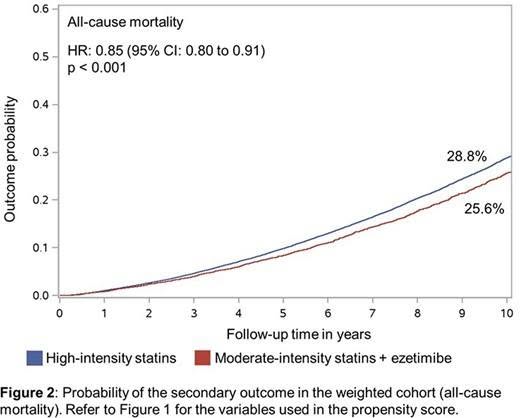
(TL;DR It just works. Multiple benefits throughout studies. Image from Canadian primary prevention study.)
1. Mortality and Cardiovascular Outcomes:
- Meta-analysis of 15 randomized controlled trials including 123,785 patients showed that intensified lipid-lowering therapy (ezetimibe, bempedoic acid, or PCSK-9 inhibitors) combined with statins reduced cardiovascular events by 19% (OR 0.81 [0.75-0.86]) compared to statin monotherapy
- Risk reductions were observed for:
- Myocardial infarction: OR 0.81 [0.74-0.89]
- Ischemic stroke: OR 0.77 [0.70-0.84]
- However, all-cause mortality was not improved (OR 0.99 [0.93-1.04]), even in studies with ≥3 years follow-up
2. Combination Therapy vs High-Intensity Statin Monotherapy:
- Analysis of 13 studies with 8,592 patients showed moderate-intensity statin plus ezetimibe (MIS+EZT) achieved:
- Higher rates of LDL <70 mg/dL (OR 1.76 [1.26-2.45])
- Greater LDL reduction (-5.05 mg/dL [-9.02 to -1.07])
- Greater total cholesterol reduction (-7.91 mg/dL [-14.90 to -0.91])
- Greater triglyceride reduction (-8.20 mg/dL [-13.05 to -3.35])
- No significant differences in adverse events between groups
3. Real-World Effectiveness (Finnish Registry Study):
- Among 57,505 post-MI patients:
- Cumulative ezetimibe use: 3.7% at 90 days, 13.4% at 5 years, 19.8% at 10 years
- Early ezetimibe use associated with lower all-cause mortality (adj. HR 0.77 [0.69-0.86])
- Ongoing ezetimibe therapy showed even greater mortality benefit (adj. HR 0.53 [0.48-0.59])
- 43.6% discontinued ezetimibe during follow-up
4. Primary Prevention Outcomes:
- Canadian study of 67,884 primary prevention patients showed:
- Combination therapy vs high-intensity statin resulted in:
- Lower 10-year cumulative incidence of primary outcome (32.7% vs 36.1%)
- Reduced all-cause death (HR 0.85 [0.80-0.91])
- Reduced stroke (HR 0.86 [0.74-0.99])
- No difference in MI or revascularization
5. Secondary Prevention and Target Achievement:
- Study of 264 STEMI patients showed:
- Rosuvastatin 40mg + ezetimibe 10mg achieved LDL target (<55 mg/dL) in 90% of patients
- Rosuvastatin 40mg alone achieved target in only 47.92%
- Combination therapy provided greater LDL reduction (-59.65% vs -37.54%, p<0.0001)
6. Special Populations - Elevated Lipoprotein(a):
- Study of 520 IHD patients showed:
- High-intensity statin + ezetimibe reduced:
- All-cause mortality (HR 0.44 [0.21-0.89])
- MACE (HR 0.71 [0.52-0.95])
- Benefits more pronounced in patients with elevated Lp(a):
- MACE reduction with Lp(a) ≥70 nmol/L: HR 0.51
- MACE reduction with Lp(a) ≥100 nmol/L: HR 0.36
7. Triple Therapy Results:
- Study of 299 ACS patients compared:
- High-intensity statin (HIS) alone
- Rosuvastatin + ezetimibe (RE)
- Rosuvastatin + ezetimibe + bempedoic acid (REB)
- LDL-C reduction at 4 weeks:
- HIS: 44.4%
- RE: 55.5%
- REB: 62.2%
- Target achievement (<70 mg/dL):
- HIS: 81.6%
- RE: 88.7%
- REB: 95.2%
8. Meta-analysis of Combination LLT vs Statin Monotherapy:
- Analysis of 11 studies (106,358 patients) showed combination therapy achieved:
- Greater LDL-C reduction (-12.13 mg/dL [-18.26 to -5.99])
- Lower all-cause mortality (OR 0.75 [0.62-0.92])
- Lower cardiovascular mortality (OR 0.75 [0.66-0.84])
- Lower MACE (OR 0.72 [0.63-0.82])
- Comparable safety profile
9. Systematic Review of Secondary Prevention:
- Analysis of 8 studies (40,236 patients) showed MIS+EZE vs HIS achieved:
- Lower cardiovascular mortality (RR 0.83 [0.73-0.94])
- Lower all-cause mortality (RR 0.90 [0.82-0.98])
- Lower non-fatal stroke (RR 0.83 [0.73-0.93])
- Higher LDL-C target achievement (RR 1.26 [1.19-1.34])
- Lower adverse events (RR 0.84 [0.74-0.95])
- Lower muscle-related adverse events (RR 0.67 [0.49-0.92])
Key Conclusions:
1. Efficacy:
- Combination therapy consistently shows superior LDL-C lowering compared to statin monotherapy
- Better achievement of target LDL-C levels across multiple studies
- Cardiovascular event reduction demonstrated in both primary and secondary prevention
- Particular benefit in high-risk populations (e.g., elevated Lp(a))
2. Safety:
- Similar or better safety profile compared to high-intensity statin monotherapy
- Lower rates of muscle-related adverse events with combination therapy
- Comparable rates of liver-related adverse events and new malignancies
- No increase in treatment discontinuation rates
3. Clinical Implementation:
- Despite proven benefits, real-world utilization remains suboptimal
- High discontinuation rates in clinical practice
- Younger patients more likely to receive combination therapy
- Cost considerations may influence therapy choice, particularly regarding PCSK9 inhibitors
4. Specific Populations:
- Benefits observed across various subgroups including:
- Primary prevention
- Secondary prevention
- Acute coronary syndrome
- Elevated Lp(a)
- Diabetic patients
These findings suggest that combination lipid-lowering therapy, particularly moderate-intensity statin plus ezetimibe, offers an effective and well-tolerated alternative to high-intensity statin monotherapy. The evidence supports its use in both primary and secondary prevention, with particular benefits in high-risk populations. However, real-world implementation remains suboptimal, suggesting a need for improved clinical adoption strategies and patient education to maximize therapeutic benefits.
References:
- Ezetimibe Lipid-Lowering Therapy Beyond Statins (mylongevityjourney.blogspot.com)