Interleukin-11 (IL-11) Signaling Pathways
Interleukin-11 (IL-11) is a cytokine that plays a significant role in various biological processes such as hematopoiesis, inflammation, and tissue repair. The signaling pathways of IL-11 primarily involve the activation of the Janus kinase (JAK)/signal transducer and activator of transcription (STAT) pathway. Here is a detailed explanation of IL-11 signaling pathways:
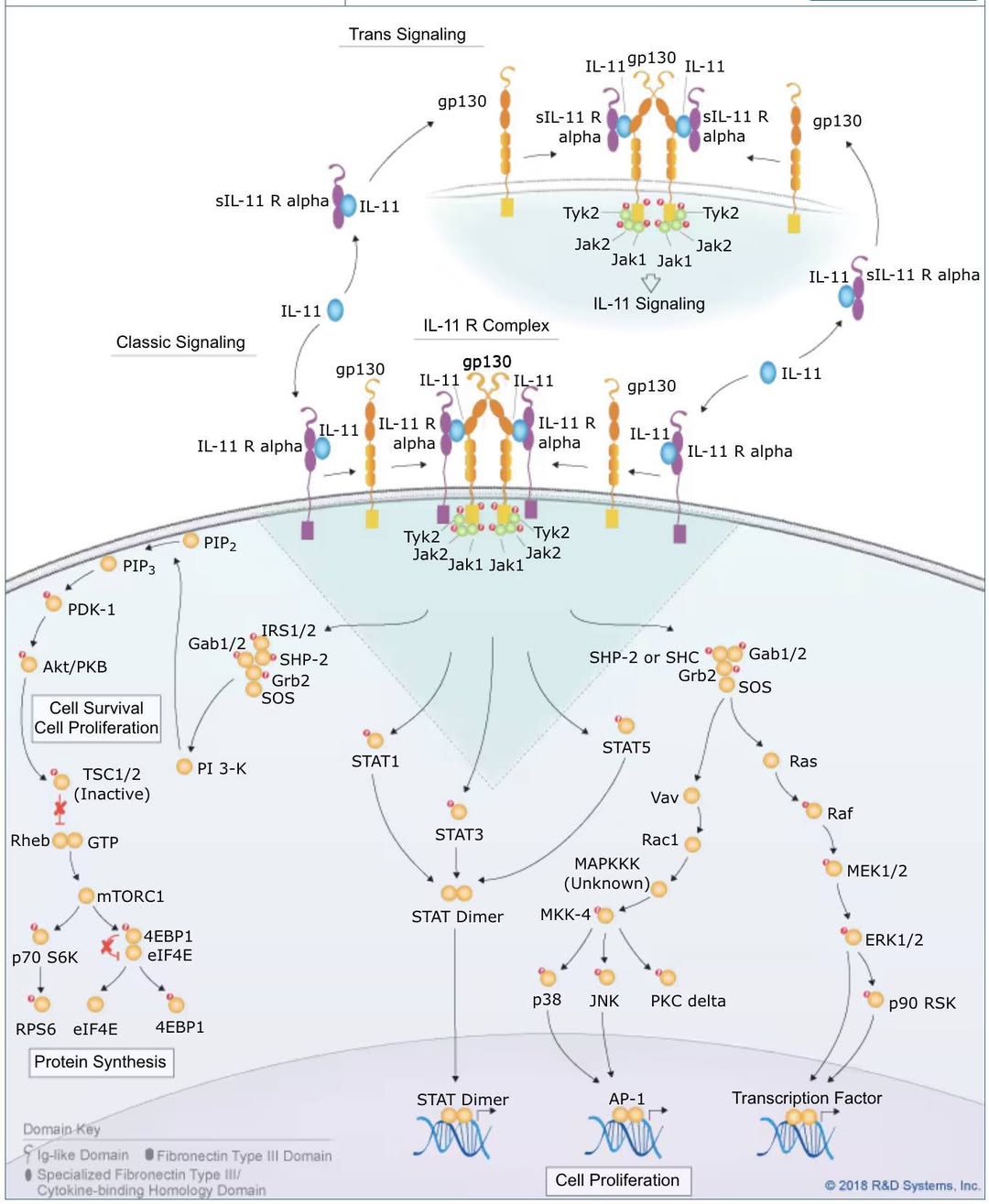
IL-11 AND ITS RECEPTOR COMPLEX
- IL-11 Binding: IL-11 exerts its effects by binding to its specific receptor complex on the cell surface. This complex is composed of two subunits:
IL-11Rα (IL-11 receptor alpha): The specific receptor for IL-11.
gp130: A signal-transducing subunit that is shared with other cytokine receptors.
JAK/STAT PATHWAY
- Receptor Dimerization: Upon IL-11 binding to IL-11Rα, the receptor undergoes a conformational change that brings two gp130 subunits into close proximity, leading to the formation of a receptor dimer.
- JAK Activation: The dimerization of gp130 activates associated Janus kinases (JAK1, JAK2, or Tyk2). These kinases phosphorylate specific tyrosine residues on the intracellular domain of gp130.
- STAT Recruitment and Activation: Phosphorylated tyrosine residues on gp130 serve as docking sites for STAT proteins (primarily STAT3). Once recruited, STAT proteins are also phosphorylated by JAKs.
- STAT Dimerization and Translocation: Phosphorylated STAT proteins dimerize and translocate into the nucleus.
- Gene Transcription: In the nucleus, STAT dimers bind to specific DNA sequences, initiating the transcription of target genes involved in cell proliferation, differentiation, and survival.
OTHER SIGNALING PATHWAYS
Apart from the JAK/STAT pathway, IL-11 signaling can also activate other intracellular pathways, including:
- MAPK Pathway: Activation of the mitogen-activated protein kinase (MAPK) pathway can lead to cellular responses such as proliferation and differentiation.
- PI3K/AKT Pathway: The phosphoinositide 3-kinase (PI3K)/AKT pathway can be activated, promoting cell survival and growth.
- mTOR Pathway: IL-11 signaling can also influence the mammalian target of rapamycin (mTOR) pathway, which is involved in cell growth and metabolism.
BIOLOGICAL EFFECTS OF IL-11 SIGNALING
- Hematopoiesis: IL-11 plays a role in the production and maturation of blood cells, particularly in enhancing the proliferation of megakaryocytes and increasing platelet production.
- Tissue Repair and Fibrosis: IL-11 contributes to tissue repair processes, including wound healing and the resolution of inflammation. However, excessive IL-11 signaling can lead to fibrosis in various tissues.
- Inflammation and Immune Response: IL-11 can modulate inflammatory responses and influence the immune system by affecting the activity of various immune cells.
REGULATION OF IL-11 SIGNALING
- Negative Feedback: SOCS (suppressor of cytokine signaling) proteins can be induced by IL-11 signaling and act as negative regulators, inhibiting JAK activity and preventing excessive signaling.
- Receptor Internalization and Degradation: The receptor complex can be internalized and degraded, reducing the availability of receptors on the cell surface and thereby downregulating the signaling pathway.
In summary, IL-11 signaling pathways involve a complex network of interactions primarily centered around the JAK/STAT pathway, with additional involvement of MAPK, PI3K/AKT, and mTOR pathways. These pathways mediate the diverse biological effects of IL-11, including roles in hematopoiesis, tissue repair, and immune modulation.
rndsystems.comIl signaling pathwaysrndsystems.com