Quoted:
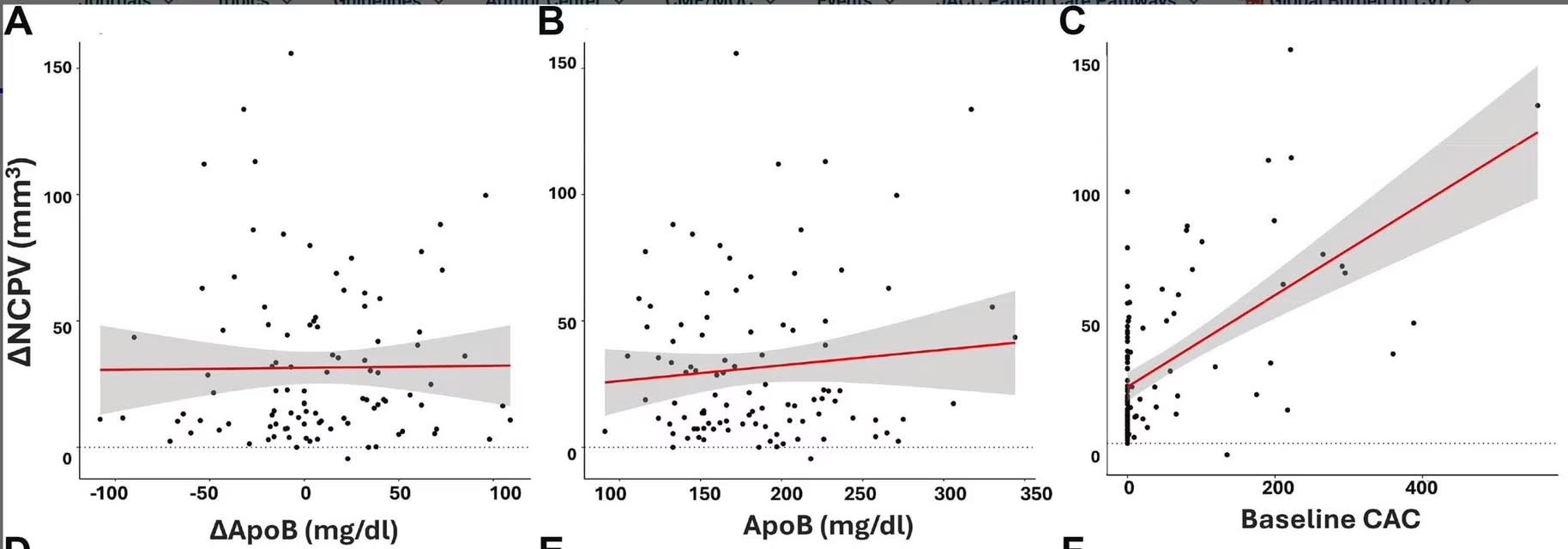
“One way to gauge the magnitude of these findings is to compare against plaque progression rates reported in other studies (especially since this trial lacked its own control group). The numbers paint a stark picture: LMHRs had plaque growth equal to or exceeding that of much “higher-risk” populations.
PARADIGM Study (general population, with/without metabolic syndrome): In a large observational study (PARADIGM) of 1,200 adults undergoing serial CTAs, individuals without metabolic syndrome showed an average NCPV increase of ~10.3 mm³ over 3.2 years, whereas those with metabolic syndrome had about 17.8 mm³ over 3.2 years.
Annualized, that’s roughly 3.2 mm³/year (no MetS) vs 5.6 mm³/year (MetS). The LMHR median of ~18.8 mm³ in one year is comparable to three years’ worth of plaque accrual in people with metabolic syndrome [14]. In fact, an LMHR’s plaque progression in 1 year outpaced the 3-year progression of an average metabolically unhealthy person, and was about triple the rate seen in metabolically normal individuals in PARADIGM.
Diabetes and Hypertension (Budoff et al. cohort): In another study co-authored by Dr. Matthew Budoff (who is also a KETO-CTA author), patients with dyslipidemia and hypertension but no diabetes had an NCPV increase of ~28.9 mm³ over 3 years (~9.6 mm³/year) [Progression of coronary artery calcium predicts all-cause mortality. (JACC Cardiovasc Imaging, 2010)].
Those with type 2 diabetes had ~52.3 mm³ over 3 years (~17.4 mm³/year). Strikingly, the LMHR group’s 18.8 mm³/year is on par with the progression rate seen in frank type 2 diabetics over the same time frame. In other words, these ostensibly “low-risk” keto dieters accumulated soft plaque as fast as patients with one of the strongest cardiovascular risk factors (diabetes).
SMARTool high-risk cohort: The SMARTool project studied people with multiple risk factors (obesity, smoking, hypertension, dyslipidemia, diabetes) undergoing serial CTA. Even in this high-risk population, those not on statins had an average NCPV increase of ~6.4 mm³ per year, and those on statins had only ~1.0 mm³ per year [Estimating the Risk of Cardiovascular Events in U.S. Veterans Using the SMART Risk Score (JACC: Advances, 2025)].
LMHRs – who were lean, normotensive, non-diabetic, etc. – still had nearly 3× the plaque growth of the high-risk non-statin group [14]. Compared to the statin-treated group, LMHR progression was ~18× higher (since many LMHRs had shunned lipid-lowering therapy). This context underscores how unexpectedly high the LMHR plaque progression was, given their favorable baseline health.
Recall the LMHR median was 0.8%, with subsets ranging up to 2.4%. The PARADIGM registry reported PAV progression stratified by risk: low 10-year risk patients had ~+0.45% PAV/year, high-risk patients ~+0.99%/year.
Even the healthiest LMHRs (CAC=0) gained +0.5% – which is as much or more plaque than low-risk populations – and LMHRs with CAC>100 saw PAV increases 2.4 times greater than the average high-risk group [11]. In fact, a CAC>100 LMHR’s PAV increase (2.4%) was ~2.4× the average high-risk person’s.
This suggests that once a LMHR has developed some atherosclerosis, it may advance very rapidly under continued high-LDL exposure.
As the comparisons illustrate, the LMHR phenotype did not confer protection against plaque buildup – if anything, these individuals accumulated plaque faster than many groups traditionally considered at higher risk.
It’s an arresting finding: being lean, fit, and inflammation-free did not stop the march of atherosclerosis when LDL was extremely elevated. Recall that the trial participants were the cream of the crop; many less healthy LMHRs never qualified for the study.”
 Dr Brad StanfieldLean Mass Hyper-Responders See Rapid Plaque ProgressionA newly published study – “Plaque Begets Plaque, ApoB Does Not: Longitudinal Data From the KETO-CTA Trial” – has stirred substantial discussion in the nutrition and cardiology communities [https://www.jacc.org/doi/10.1016/j.jacadv.2025.101686]. This study examined so-called Lean Mass Hyper-Responders (LMHRs), individudrstanfield.com
#ketoctaHD #lmhrHD #ncpvHD #paradigmHD #smartoolHD #ketoctasummaryHD