The idea that lowering protein intake worsens insulin resistance and weight control is likely wrong.
We have a carefully done feeding study in overweight patients with insulin resistance and metabolic syndrome which shows exactly the opposite.
In this randomized trial, lowering protein intake to 10% of calories produced many of the same short term metabolic benefits as restricting calories by 25%, including significant weight loss.
(For reference, the average American diet is about 15% protein.)
This was a small short-term study (27 days), but was done in a very tightly controlled hospital setting where all meals were provided.
Every calorie of protein that was restricted was replaced 1 for 1 with the same calorie from carbs+fat. The protein restricted (PR) group was eating around 2000 calories per day on average. The calorie restricted (CR) group was eating only around 1400 calories on average. Yet both groups lost a similar amount of fat, during the 27 day duration of the study.
Link to full journal paper:
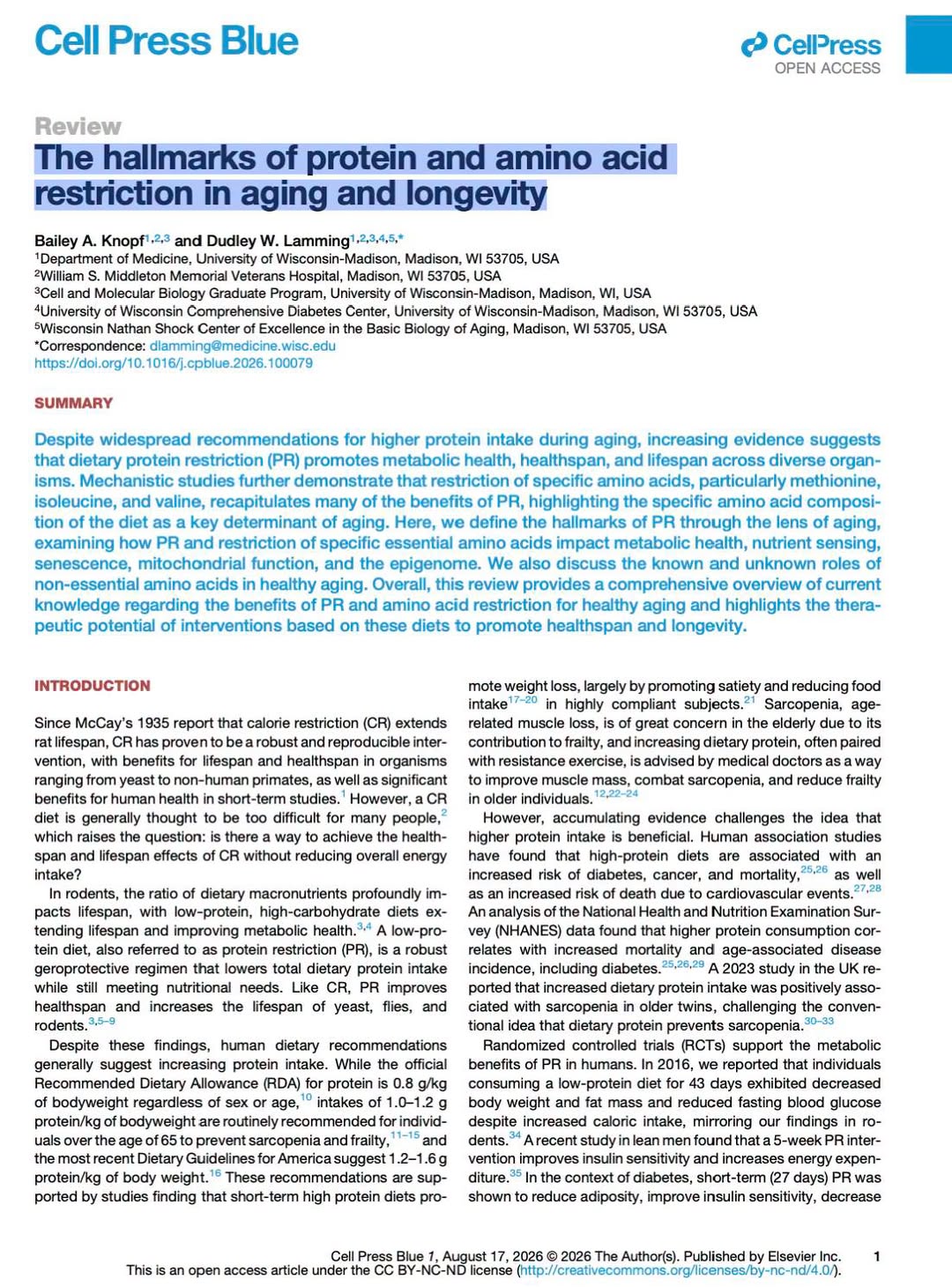
Dietary Protein Restriction Improves Metabolic Dysfunction in Patients with Metabolic Syndrome in a Randomized, Controlled Trial (Nutrients, June 2022)
PaperMDPI articlemdpi.comQuoted:
“This study was conducted to determine whether isocaloric dietary protein restriction is sufficient to confer the beneficial effects of dietary [caloric] restriction in patients with metabolic syndrome. We performed a prospective, randomized controlled dietary intervention under constant nutritional and medical supervision.
“Twenty-one individuals diagnosed with metabolic syndrome were randomly assigned for caloric restriction (CR; n = 11, diet of 5941 ± 686 KJ [1415 calories] per day) or isocaloric dietary protein restriction (PR; n = 10, diet of 8409 ± 2360 KJ [2002 calories] per day) and followed for 27 days.”
“Like CR, PR promoted weight loss due to a reduction in adiposity, which was associated with reductions in blood glucose, lipid levels, and blood pressure. More strikingly, both CR and PR improved insulin sensitivity by 62.3% and 93.2%, respectively, after treatment.”
“The changes in body weight were mainly due to a decrease in fat mass, which was reduced in both the PR and CR protocols (−9.9%, p = 0.0033, and −11.5%, p = 0.0010, respectively) (Figure 1B), whereas free-fat mass was not changed (Figure 1C)”
My notes:
These daily calorie amounts being consumed would put the PR group in modest calorie restriction and the CR group in major calorie restriction.
Yet as already pointed out, both groups lost a similar amount of fat during the study.
The implication here is that the protein restriction is somehow amplifying the fat loss from modest calorie restriction to make it similar to major calorie restriction.
As crazy as this sounds, the results of this short human trial are consistent with multiple mouse studies which have shown that restricting protein mimics calorie restriction. For example:
↪ Isoleucine restriction extended male HET3 mouse lifespan 33% despite higher calorie intake
↪ Cutting dietary isoleucine by two-thirds extended male mouse lifespan 33%
Note that these were healthy people. The only major thing wrong with them was their excess weight and metabolic syndrome. They voluntarily checked themselves into the hospital to participate in the study. This was the only way to be absolutely certain that every item that they ate was carefully controlled and monitored.
Did either group lose much muscle? NO
The vast majority of the weight that was lost was fat, in both the CR and PR groups. There was no detectable change in free-fat mass (FFM) in either group, using impedance measurements. This is not the most accurate way to measure FFM, but it does provide assurance that there was no major muscle loss during the 27 days of the study.
#proteinHD #proteinrestrictionHD #proteinsummaryHD #isoleucineHD #dudleylammingHD