Dietary Fiber as a Longevity Intervention
If a new compound were discovered today that could lower all-cause mortality by 30%, reduce systemic inflammation, and actively detoxify environmental pollutants from the bloodstream, it would likely be hailed as a breakthrough in longevity science. It would be patentable, expensive, and prescribed worldwide. Yet, such a compound already exists. It is hiding in plain sight, often dismissed as mere "roughage" or relegated to the unglamorous aisle of digestive regularity. That compound is dietary fiber.
Current research challenges the outdated view of fiber as biologically inert bulk. Instead, it is increasingly understood as a powerful bioactive signaling molecule—a "master key" that unlocks critical longevity pathways. From regulating epigenetic expression to reinforcing the gut barrier against modern toxins like microplastics, fiber performs the complex, systemic work that we typically demand of advanced medical interventions. This summary explores the clinical evidence and biological mechanisms suggesting that the most effective life-extending drug available may simply be the one we stopped eating.
I. The Clinical Evidence: Quantifying the Mortality Signal
To classify a compound as a "longevity intervention," it must demonstrate a reliable ability to reduce all-cause mortality. The epidemiological signal for fiber is one of the strongest in nutritional science, rivaling or exceeding pharmacological interventions for chronic disease.
The Mortality Reduction
The "gold standard" evidence comes from the Reynolds et al. (2019) meta-analysis commissioned by the World Health Organization. Analyzing 185 prospective studies and 58 clinical trials, researchers found a stark dose-response relationship:
- All-Cause Mortality: High fiber consumers (25–29g/day) exhibit a 15–30% reduction in all-cause mortality compared to low consumers.
- Disease Specificity: This intake level correlates with a 16–24% reduction in the incidence of coronary heart disease, type 2 diabetes, and colorectal cancer.
- The Dose-Response: For every additional 8 grams of fiber consumed, the risk of disease falls further, suggesting we have not yet hit the "upper limit" of benefit for the general population.
The Threshold Effect
Recent data from 2025 utilizing NHANES cohorts suggests a "threshold effect" for longevity. While ancestral humans may have consumed 100g+ daily, modern survival benefits appear to plateau or yield diminishing returns after approximately 30g per day. Specifically, in adults with metabolic syndrome, a intake threshold of 22g/day was identified; crossing this line resulted in a 20% drop in all-cause mortality and a 39% drop in cardiovascular mortality.
II. The "Engine" of Longevity: How Fiber Hacks Aging
Fiber does not extend life simply by improving digestion. It functions as a sophisticated pharmacological agent through three primary mechanisms: epigenetic modulation, metabolic signaling, and physical barrier reinforcement.
1. Epigenetic Regulation: The Butyrate-HDAC Axis
The most potent anti-aging mechanism of fiber involves the gut microbiome. Humans cannot digest fiber; instead, colonic bacteria ferment it into Short-Chain Fatty Acids (SCFAs), primarily butyrate.
Butyrate acts as a natural Histone Deacetylase (HDAC) Inhibitor. In aging cells, DNA often becomes tightly wrapped around histone proteins, silencing genes responsible for DNA repair and stress resistance. Butyrate inhibits this process, keeping the genome "open" and youthful. This mechanism mimics the effects of fasting and has been shown to induce regulatory T-cells (Tregs), reducing systemic inflammation ("inflammaging").
2. The "Internal Sieve": Glycemic and Lipid Control
Soluble viscous fibers (like beta-glucan in oats) form a gel matrix in the gut. This physical barrier slows the absorption of glucose and binds bile acids.
- Lipid Lowering: By binding bile acids and forcing their excretion, fiber compels the liver to pull LDL cholesterol from the blood to synthesize new bile. Intake of 3g/day of beta-glucan is shown to consistently reduce LDL cholesterol by ~0.30 mmol/L.
- GLP-1 Secretion: Fiber fermentation stimulates the L-cells in the gut to secrete Glucagon-like Peptide-1 (GLP-1), the same hormone targeted by drugs like Ozempic. This improves insulin sensitivity and satiety naturally.
3. Gut Barrier Defense
A fiber-deprived microbiome will consume the host's own mucin layer for fuel. This erosion leads to "leaky gut," allowing endotoxins (LPS) to enter the bloodstream and drive chronic inflammation. Adequate fiber intake preserves this mucus barrier, preventing the translocation of toxins.
III. The Detoxification Hypothesis: Can Fiber Remove Microplastics?
A critical and emerging area of research (2024–2025) investigates whether fiber can reduce the body burden of microplastics (MPs) and "forever chemicals" (PFAS). The evidence suggests fiber acts as both a "Broom" (sweeping toxins out) and a "Shield" (preventing entry).
Mechanism 1: The "Sweep" (Kinetic Excretion)
Microplastics accumulate in the gut and can translocate into the blood. Insoluble fibers increase stool bulk and decrease transit time, physically sweeping particles out before they can be absorbed.
- The Chitosan Evidence: A landmark 2025 study in rats demonstrated that Chitosan (a fiber derived from shellfish) significantly increased the excretion of polyethylene microplastics. The chitosan group excreted 115.6% of the ingested plastic load (indicating it may have pulled retained plastic from the gut lining), compared to only 83.7% in the control group.
- Human Data: Preliminary 2025 human data suggests that consuming fiber/chitosan with meals increases the recovery of microplastics in stool, implying they are being successfully evacuated rather than absorbed.
Mechanism 2: The "Trap" (Bile Acid Sequestration)
Many environmental toxins, including PFAS, are excreted by the liver into bile but are reabsorbed in the intestine (enterohepatic recirculation). Soluble fiber binds to these bile acids, trapping the associated toxins in a gel matrix for fecal elimination.
- PFAS Reduction: A 2025 study noted that oat beta-glucan supplementation for four weeks led to an 8% reduction in serum PFAS levels, validated by the mechanism of bile sequestration.
Mechanism 3: The "Shield" (Mucus Integrity)
By feeding the microbiome and producing butyrate, fiber reinforces the tight junctions of the gut wall and thickens the mucus layer. A 2025 study on intestinal mucus confirmed that a robust mucus layer significantly prevents the uptake of microplastics by epithelial cells. Fiber is the primary fuel required to maintain this shield.
IV. The Formulation: Not All Fibers Are Equal
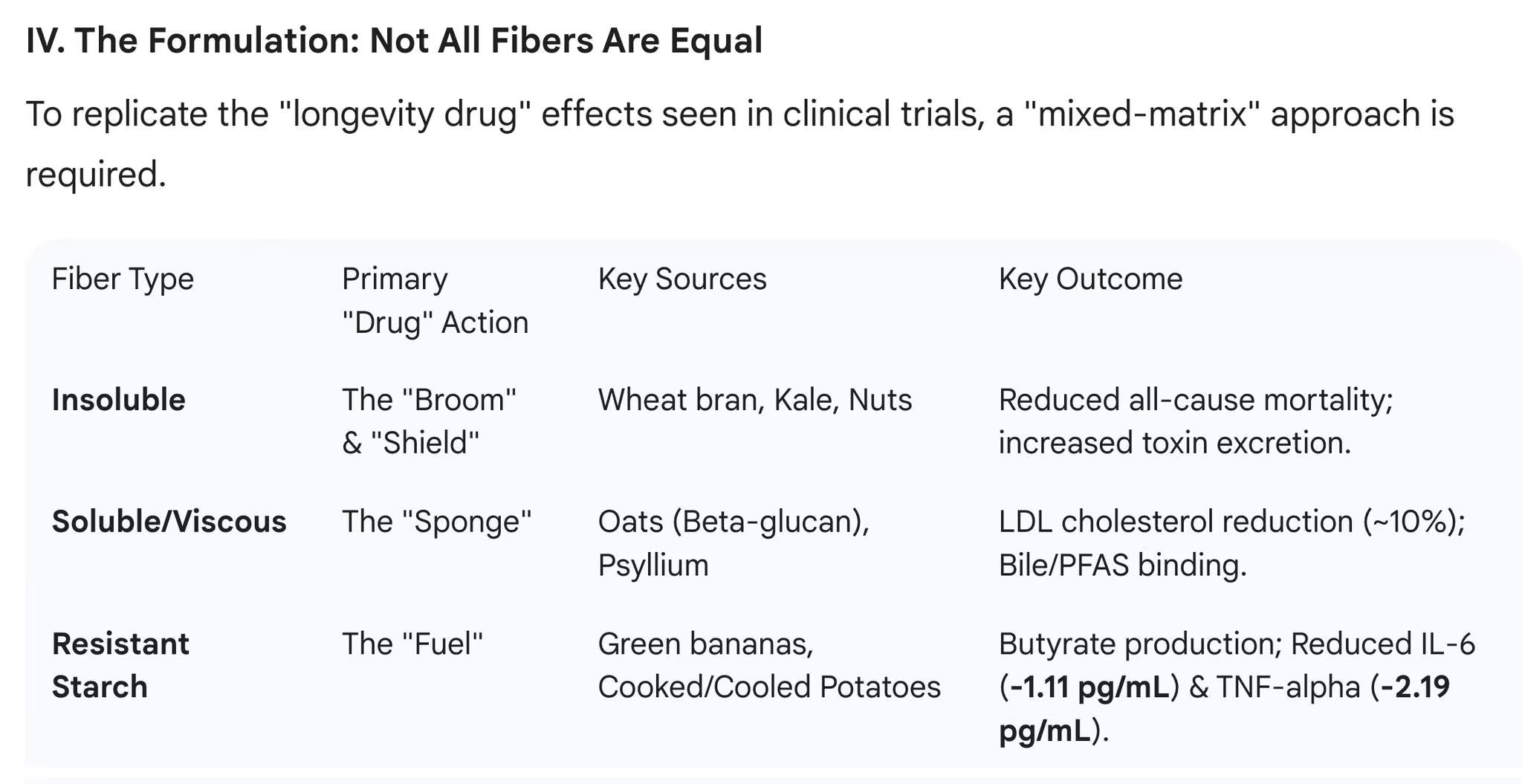
To replicate the "longevity intervention" effects seen in clinical trials, a "mixed-matrix" approach is required.
<See table>
Note on Resistant Starch (RS): RS is unique because it bypasses digestion to ferment in the colon. Meta-analyses show it significantly lowers inflammatory cytokines (IL-6 and TNF-alpha) and fasting insulin. However, it relies on specific gut bacteria (e.g., Ruminococcus bromii) to work; individuals without these bacteria may be "non-responders."
V. Safety Profile and Risks
While fiber is safer than synthetic drugs, it is not without risk, particularly when used as an isolated supplement.
- Liver Cancer Signal (The Dysbiosis Warning): A 2018 Cell study found that in mice with dysbiosis (imbalanced gut bacteria), feeding them highly refined fermentable fiber (specifically inulin) induced hepatocellular carcinoma (liver cancer). The rapid fermentation caused cholestasis and inflammation. This suggests that for people with severe gut issues (SIBO, IBS), flooding the system with refined fiber supplements can be dangerous. Whole foods did not show this effect.
- Mineral Malabsorption: Excessive intake of insoluble fiber (>50g) can bind minerals like zinc, iron, and calcium, potentially leading to deficiencies over time if the diet is not nutrient-dense.
VI. Conclusion: The Protocol
Is dietary fiber a longevity intervention? The data is suggestive of this classification. It targets the hallmarks of aging (inflammation, epigenetic dysregulation, metabolic dysfunction) and is associated with reduced all-cause mortality by up to 30%—a figure comparable to aggressive pharmaceutical interventions. Furthermore, it appears to be one of the few viable strategies for mitigating the bio-accumulation of microplastics.
The "Longevity Prescription":
- Dose: Aim for 30–40 grams daily. (The "survival threshold" is ~22g; optimal benefits plateau around 30-35g).
- Formulation: Prioritize a mix of insoluble fiber (for the "sweep" of toxins) and resistant starch (for the "anti-aging" butyrate production).
- Source: Ideally, rely on whole foods (legumes, whole grains, berries) to avoid the potential risks with supplements.
- Safety: Titrate slowly ("start low, go slow") to avoid GI distress.
By closing the "fiber gap," individuals can effectively deploy a pleiotropic, wide-spectrum intervention that extends healthspan and fortifies the body against modern environmental toxicity.
Detailed references and research:
docs.google.comGoogle Docdocs.google.com