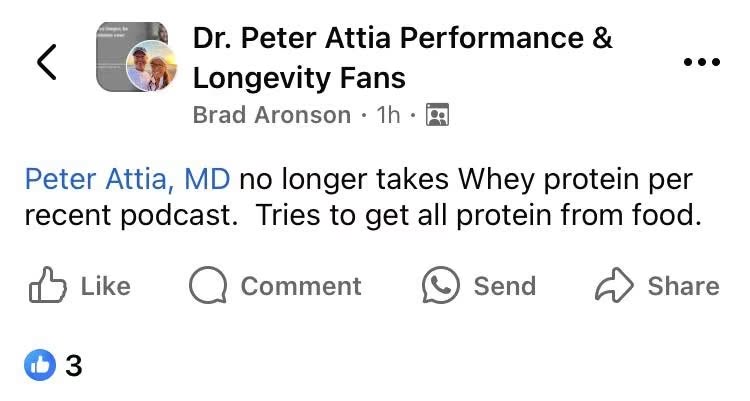
I copied this post from the Rapamycin group. The links are to posts in that group, if you are interested in this topic of insulin/IGF1 and longevity. It is likely that this same insulin/IGF1 pathway promotes cancer, heart disease, and diabetes in humans.
I’ve done similar posts on this topic in our heart disease group, if you search here for “IGF1”.
————-
Hmm…
I wonder if has to do with the fact that whey protein raises IGF1 more than any other food on the planet?
facebook.com/share/p/1C3cMSRmoL
facebook.com/share/p/1GNqVL2pnA
facebook.com/share/p/16K2DAyWMd
Or that whey protein spikes post-prandial insulin far more than white bread or even pure glucose (when compared calorie for calorie) ?
facebook.com/share/p/194CXPvKxN
Genetic interventions to lower IGF1 (or its equivalent) extend lifespan in most animal species tested. The pet longevity company Loyal is claiming to have evidence that lowering IGF1 in adulthood extends lifespan in dogs as well. IGF1 directly drives mTOR. Rapamycin works in part by lowering IGF1 signaling.
facebook.com/share/r/1CfJ8KnCDg
facebook.com/share/p/1CyEUpEhbW
The longest lab mouse ever to live was a transgenic mouse with silenced IGF1. It lived twice as long as controls.
facebook.com/share/p/1EDgYHBt1R
A similar mutation occurs naturally in humans producing a disease called Laron syndrome. These people have very low IGF1 from birth, just like the mice. They almost never develop cancer or diabetes, and rates of heart disease and Alzheimer’s are low. No one with Laron Syndrome has ever been documented to have died from cancer.
facebook.com/share/p/16Z8h1gXqn
facebook.com/share/p/1AVZ3p9jeQ
In Nir Barzilai’s studies of centenarians, the factor that seems to be most responsible for their longevity is genes that keep IGF1 low throughout their lives.
facebook.com/share/p/16UGd2znFE
The evidence that high IGF1 levels in adulthood increase risk for cancer in humans keeps getting stronger and stronger.
facebook.com/share/p/16Sz1PEhtC
facebook.com/share/p/15XKxA9Pf5
facebook.com/share/p/16WDsYZjxL
facebook.com/share/p/1JDbyCRLXv
Shorter humans live longer and have less risk of cancer. This is very likey due to lower levels of IGF1 from birth.
facebook.com/share/p/1JDbyCRLXv
facebook.com/share/p/16QH1VGijB
facebook.com/share/p/1CSAUxEuGX
facebook.com/share/p/15Py7sdgNa
This is true for many other species of mammals as well. For example, if you’ve ever owned dogs, then you know that the smaller breeds live much longer than the larger ones. This is thought to be due in large part to IGF1.
facebook.com/share/p/1BqffQrKXm
facebook.com/share/r/1L4u3L7kYa
————-
Peter Attia co-owns a company that SELLS very expensive whey protein bars (David). He has hyped whey protein for months before starting this company. And yet he now refuses to take whey protein himself— likely for the many obvious reasons above.
 David ProteinOur Philosophy & Science-Based Nutrition | David ProteinSee our evidence-based, expert-backed approach to nutrition. Substantial protein, straightforward nutrition, and craveable taste. Check out David Protein.davidprotein.com
He gives bad nutrition advice, often driven by his many financial conflicts of interest.
(And then quietly changes his mind later after the harm is already done.)
I guarantee you that he will change his mind on processed red meat as well. Those cured venison sticks that he sells directly cause colon cancer:
facebook.com/share/p/19LeCACeTK
facebook.com/share/p/1EWN1wgrj1
#igf1HD #insulinHD #wheyHD #heightHD #laronsyndromeHD #centenariansHD #longevityHD #dogsHD #cancerHD #diabetesHD #mtorHD #peterattiaHD