Frailty and sarcopenia: stop blaming “low protein”
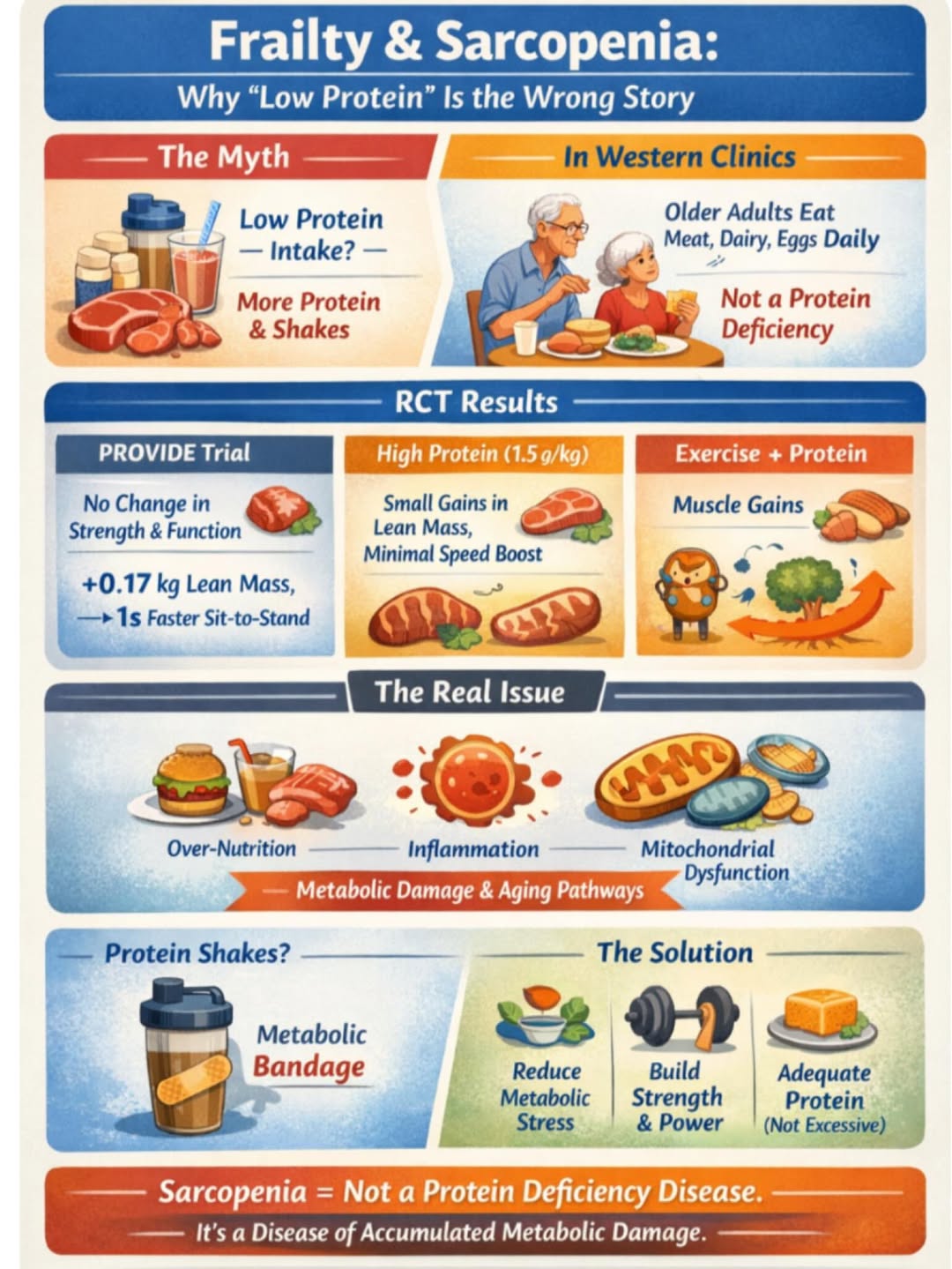
In my clinical practice, I see older adults who are frail yet eat meat, milk, cheese, poultry, and eggs every day.
They are not protein-deficient. They are metabolically damaged after decades of over-nutrition and physical inactivity.
Yet we keep pushing the narrative that frailty is caused by “too little protein” and can be fixed with protein supplements and shakes.
The randomized trial data tell a very different story.
🔹 PROVIDE trial (n=380, 13 weeks, whey + leucine + vitamin D vs isocaloric control):
No difference in primary outcomes (handgrip strength, SPPB).
A small signal only: +0.17 kg appendicular lean mass and ~1 s faster chair-stand. That’s not a therapy.
🔹 Park et al., AJCN 2018 (n=120, 12 weeks, no exercise; 0.8 vs 1.2 vs 1.5 g/kg/day protein):
Only 1.5 g/kg/day differed from 0.8:
+0.52 kg vs +0.08 kg appendicular lean mass; gait speed +0.09 vs +0.04 m/s.
1.2 g/kg/day = no difference.
🔹 Tieland et al. 2012 (n=62, 24 weeks, resistance training ± protein):
Protein increased lean mass slightly (+1.3 kg vs −0.3 kg), but functional gains came from resistance exercise, not protein.
🔻 Uncomfortable conclusion:
In most Western older adults, sarcopenia is not a protein-deficiency disease.
It is a disease of lifelong metabolic overload, inflammation, mitochondrial dysfunction, and loss of regenerative capacity.
Adding protein late in life—without changing the biological terrain—is often just a bandage, not a solution.
If we want to change frailty trajectories, we need less focus on adding substrate and more focus on sinergistically reducing metabolic damage (by improving diet) and restoring mechanical signaling with resistance exercise.
Paper · Nat Rev Endocrinol · 2020A word of caution against excessive protein intakenature.com
Paper · Nat Rev Mol Cell Biol · 2022Molecular mechanisms of dietary restriction promoting health and longevitynature.com
Paper · J Gerontol A Biol Sci Med Sci · 2018Caloric Restriction and Healthy Life Span: Frail Phenotype of Nonhuman Primates in the Wisconsin National Primate Research Center Caloric Restriction Study.Calorie restriction without malnutrition increases longevity and delays the onset of age-associated disorders in multiple species. Recently, greater emphasis has been placed on healthy life span and preventing frailty than on longevity. Here, we show the beneficial effect of long-term calorie restriction on frailty in later life in a nonhuman primate. Frail phenotypes were evaluated using metabolic and physical…pmc.ncbi.nlm.nih.gov