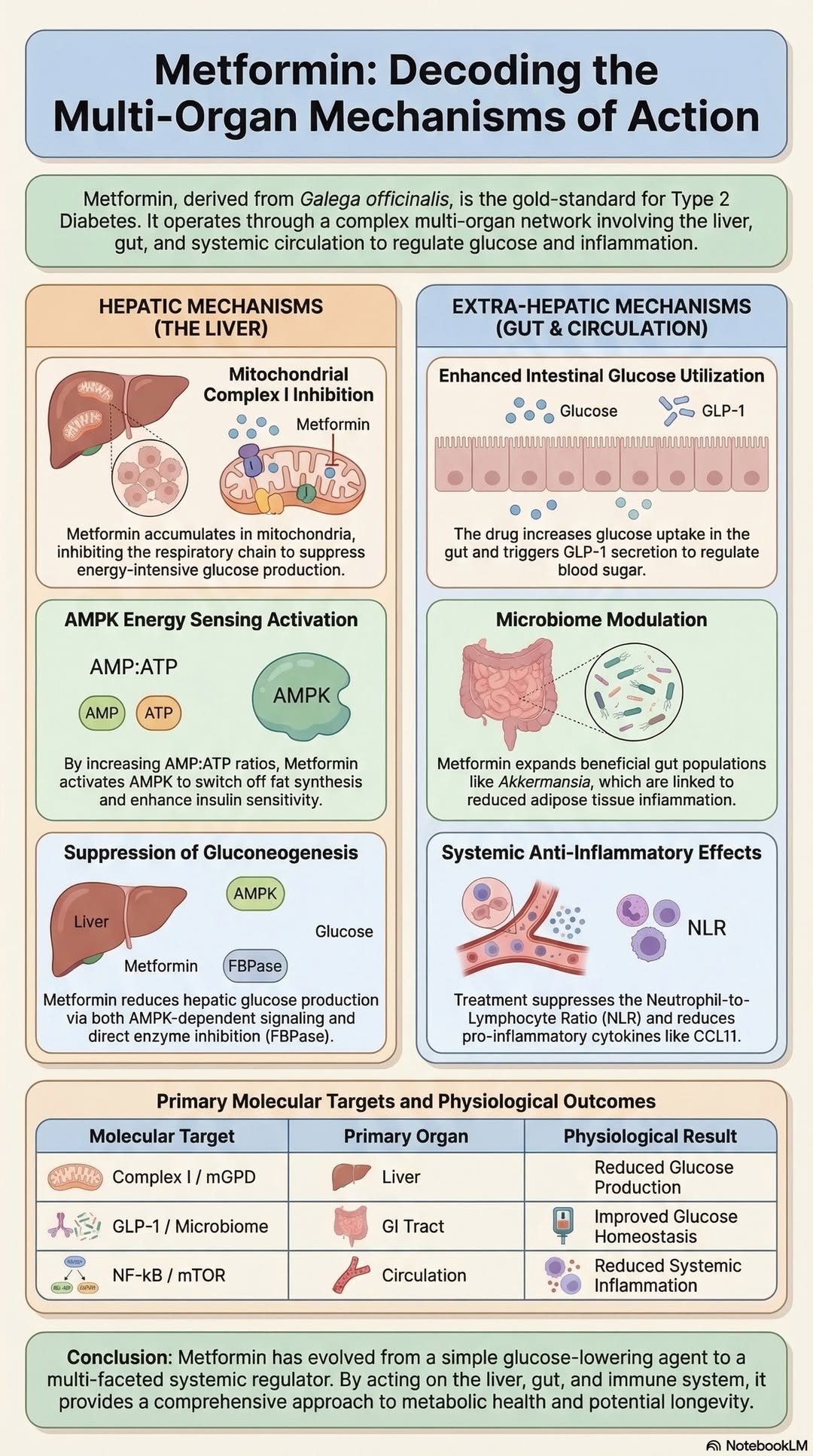
A nice description of how the drug metformin actually works. We now know that it does a lot more than just lower blood sugar.
#metforminHD
The 60-Year-Old Mystery in Your Medicine Cabinet: How Metformin Really Works
Metformin has reigned as the "gold standard" first-line treatment for type 2 diabetes for decades, helping millions manage their blood sugar with remarkable safety and efficacy. Yet, a surprising paradox exists at the heart of modern pharmacology: despite its ubiquity, we are only just beginning to map the full extent of how it actually functions within the human body. After sixty years of clinical use, recent research is dismantling old assumptions and revealing a sophisticated, multi-layered molecular machine that operates far beyond the simple regulation of the liver.
The Medieval Herb That Conquered Modern Medicine
Unlike most modern "designer" drugs that are engineered to hit a single molecular target, metformin is a product of historical serendipity. It is a synthetic derivative of galegine, a compound found in Galega officinalis (commonly known as goat’s rue), which was used in medieval European herbal medicine to treat frequent urination. Though galegine was identified as a glucose-lowering agent in the 1920s, it proved too toxic for human use, leading to the synthesis of its safer biguanide cousins.
Remarkably, metformin remained "hidden in plain sight" for nearly thirty years between its initial synthesis and its clinical adoption in the 1950s. This accidental discovery preceded the era of detailed molecular mapping, meaning the drug was a global success long before we possessed the tools to understand its brilliance. Today, it stands as a rare bridge between medieval botanical wisdom and 21st-century metabolic science.
"Unlike most modern drugs, metformin is therefore derived from a natural product used in herbal medicine and was not designed to target a particular pathway or disease mechanism."
It’s Not Just About the Liver Anymore
For years, the scientific consensus was that metformin worked almost exclusively by telling the liver to stop producing excess glucose. However, a major paradigm shift is underway as researchers realize the drug’s primary theater of operations may actually be the gut. New data shows that when patients take metformin, the drug reaches concentrations in the small intestine that are 30 to 300 times higher than those found in the bloodstream.
The most compelling evidence for this "gut-centric" shift comes from studies on delayed-release metformin, which is designed to stay in the intestines with minimal absorption into the blood. Despite the lack of systemic circulation, these formulations are just as effective at lowering blood sugar as standard versions. This suggests a sophisticated "gut–brain–liver crosstalk," where metformin triggers the vagus nerve and hormones like GLP-1 in the digestive tract to send remote signals to the liver.
Hacking the Cell’s Power Plant
At the cellular level, metformin acts as a subtle saboteur of the mitochondria, the cell's "power plants." Because metformin carries a positive charge, it is naturally drawn into the negatively charged environment of the mitochondria, where it inhibits Mitochondrial Complex I. Recent research has also identified a second, alternative mitochondrial target: mitochondrial glycerophosphate dehydrogenase (mGPD). By inhibiting mGPD, metformin disrupts the "shuttle" that moves energy-carrying molecules, further suppressing the liver's ability to manufacture new glucose.
This double-pronged inhibition "tricks" the cell into a state of perceived energy crisis, activating a master sensor called AMPK (AMP-activated protein kinase). Once AMPK is flipped on, it restores balance by switching off energy-consuming processes like fat synthesis. This biochemical balancing act is so efficient that the cell often compensates by shutting down the energy-draining process of gluconeogenesis, explaining why some studies see a stable energy ratio despite the mitochondrial "sabotage."
Rewriting Your Internal Ecosystem
Metformin does not just interact with human cells; it appears to fundamentally rewrite the ecosystem of the gut microbiome. The drug promotes a "bloom" of beneficial bacteria like Akkermansia spp. and Escherichia, while simultaneously causing a consistent decrease in Intestinibacter spp. These microbial shifts are now believed to be a central part of the drug’s therapeutic effect, potentially reducing tissue inflammation and improving metabolic health from the inside out.
Scientists are currently investigating whether these microbial changes are the primary "cause" of the drug's success or merely a "consequence" of its presence. What is clear, however, is that this internal rewrite may be responsible for the drug’s most common hurdle: gastrointestinal intolerance. Between 20% and 30% of patients experience side effects, which may be linked to how these microbial shifts—along with variations in local serotonin transport—irritate the gut lining.
A Potential Secret to Longevity?
Perhaps the most exciting frontier of metformin research is its potential to slow the aging process, a prospect that has turned a humble diabetes pill into a "Holy Grail" for longevity researchers. The drug exhibits powerful anti-inflammatory properties, suppressing the Neutrophil to Lymphocyte Ratio (NLR)—a key predictor of cardiac events and mortality. It also suppresses CCL11 (also known as eotaxin-1), a specific chemokine linked to age-related tissue dysfunction and cognitive decline.
By dampening these inflammatory markers and inhibiting mTOR signaling—a major pathway involved in cellular growth and aging—metformin may extend "healthspan," or the period of life spent in good health. This phenomenon has already been observed with startling clarity in laboratory settings, where the drug significantly alters the trajectory of decay.
"In the nematode worm, Caenorhabditis elegans, metformin lengthens lifespan through effects on intestinal microbial growth."
Conclusion: The Road Ahead
In the last decade, our understanding of metformin has moved from a "simple picture" of a liver-targeting drug to a "complex map" involving the gut, the brain, the microbiome, and the very foundations of cellular aging. We now know that an individual's journey with the drug is dictated by their unique genetic architecture. Variations in genes like OCT1 and ATM influence how the drug is absorbed, while markers like SERT and SLC2A2 (which affects GLUT2 expression) can determine whether a patient thrives on the drug or suffers from intolerance.
As we continue to deconstruct the secrets of this 60-year-old mystery, we are forced to look at our medicine cabinets with new eyes. If a medieval herbal derivative can hold the keys to mitochondrial hacking and anti-aging, what other "old" drugs are hiding untapped molecular powers that could redefine the future of human health?