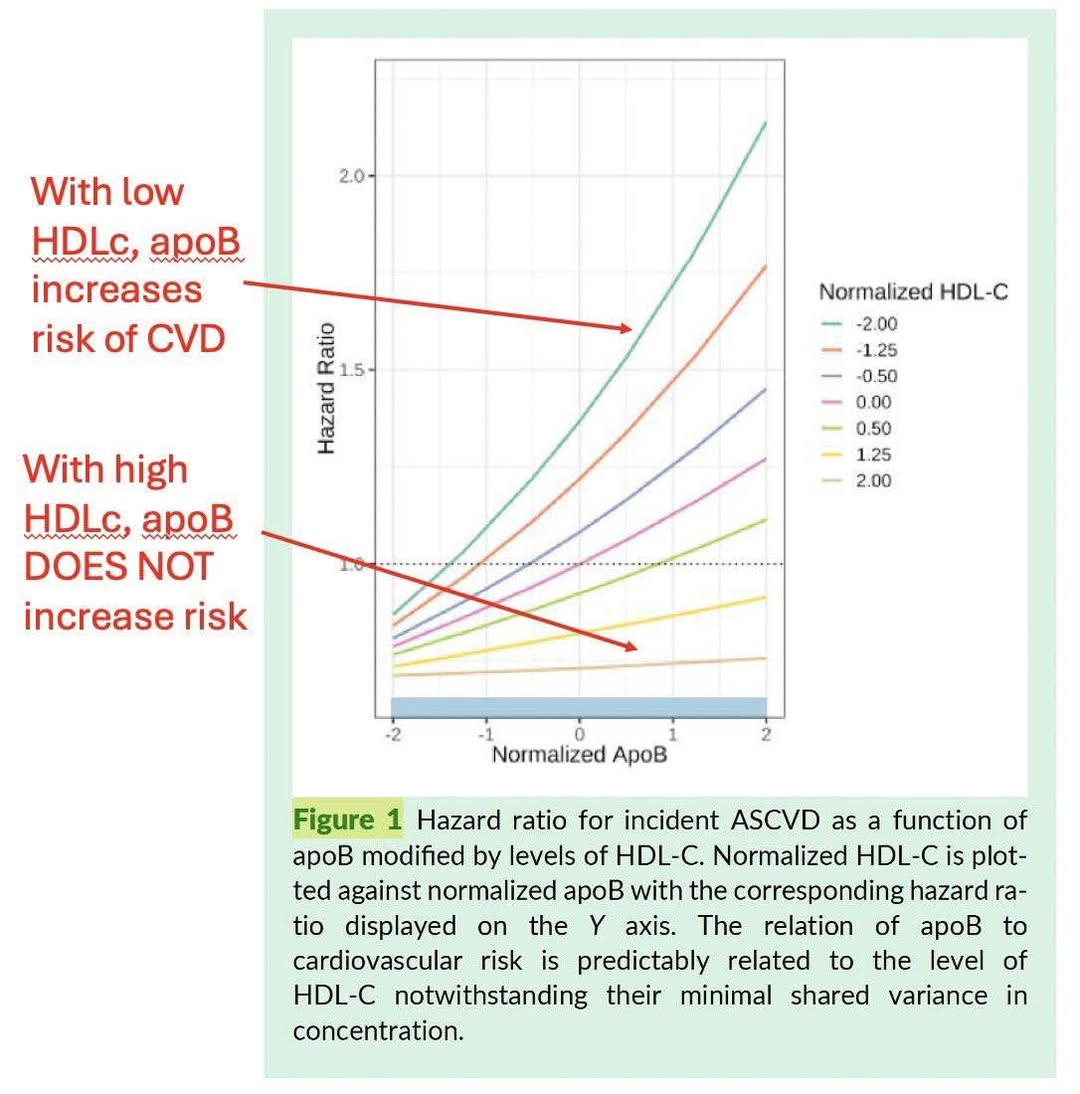
This recent observational study using UK Biobank data is attracting a lot of attention on social media, particularly this graph from the paper.
Link to journal paper:
Paper · Eur J Prev Cardiol · 2026Interplay of HDL cholesterol and apoB and the risk of incident atherosclerotic cardiovascular disease in UK Biobank.Conclusion: High HDL-C is associated with lower ASCVD risk, independent of apoB, and it attenuates the effect of high apoB on ASCVD risk. These findings suggest HDL-C's role in primary ASCVD prevention warrants re-evaluation. However, findings from an observational study, such as this, do not establish causation.academic.oup.comThere is nothing really new in this graph.
There are dozens of observational studies in cardiology that associate higher HDL with lower risk of CVD, at any given level of LDL/ApoB. Everyone in cardiology knows that this association exists. That’s why big pharma was so interested in HDL as a drug target for so long.
The most notable thing about this paper is that the magnitude of the effect was particularly large— larger than in many previous studies.
The obvious problem however is that every randomized trial testing drugs to raise HDL failed to reduce hard endpoints like heart attacks and strokes. Big pharma spent billions on these trials, to no avail. There was a perfect track record of failures. See this post:
↪ HDL and ApoA-I raising therapies repeatedly failed, so HDL is probably not directly causal
The same result occurs in Mendelian randomization studies. Genes that predispose people to higher HDL (without increasing insulin sensitivity) do not lower lifetime risk.
The consensus opinion in academic cardiology is that HDL as a whole is not directly causal, but rather acts as a crude proxy for insulin resistance which is causal. So high HDL is good so long as it reflects better insulin sensitivity, but otherwise is useless. It is the insulin sensitivity that really matters, not the HDL. There are far more accurate ways to measure insulin resistance directly than with proxies like HDL (e.g. an oral glucose tolerance test). So the obvious thing to do is just measure it directly, instead of messing around with proxies. See this post:
↪ TG/HDL guide: insulin resistance and LDL are both independent causes of heart disease
The really interesting question is whether or not there are subfractions of HDL that are causally protective, even if HDL as a whole is not? Another important question is whether there are some subfractions of HDL that might even be harmful? Levels of HDL that are too high have been associated with increased risk in some studies. This paper does not present new data on any of this. Nor does it present any other new data on causality. It simply reinforces a very well-known association.
As with the dozens of previous observational studies showing this same association between high HDL and lower risk, the main takeaway here is to avoid insulin resistance. But everyone in cardiology already knows that.
#hdlHD #insulinresistanceHD #snidermanHD #tghdlratioHD #ldlHD #apobHD