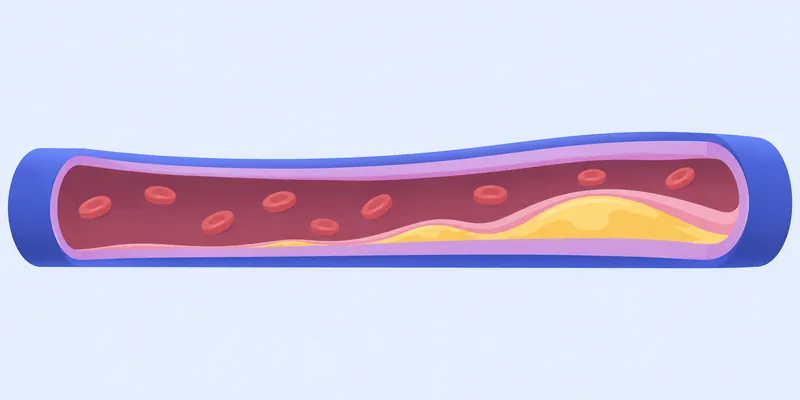
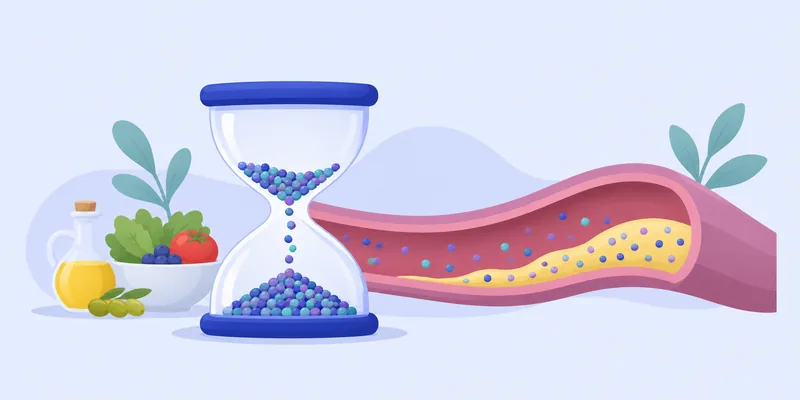
LDL cholesterol is often called "bad cholesterol", but the more precise story is about particles. Cholesterol travels in the blood inside lipoprotein particles, and the ones that wear a protein tag called apolipoprotein B (ApoB) are the ones that can enter the artery wall and be retained there, where they drive plaque. LDL is the most numerous of these, but VLDL (the main carrier of triglycerides), Lp(a) and a few others carry the same tag.12
The group's position, argued mainly by Louis Nervegna and Gokhan Can, is that LDL and ApoB are causal, meaning they are not just markers but actual drivers of atherosclerosis, and that the best way to measure them is ApoB. The evidence cited for causality comes from genetics, randomized trials and biology. How low to go, though, is less settled: targets scale with risk, benefit depends on duration as well as depth, and the admins themselves attach several cautions to "lower is always better".34
This article walks through what the numbers mean, why the evidence supports causality, which targets are cited, and where the nuances are.
LDL-C, LDL-P and ApoB: what each test actually measures
Louis explains the difference like this9:
- LDL-C is the amount of cholesterol carried inside all LDL particles. It is what most standard lab reports mean by "LDL".
- LDL-P is the number of LDL particles.
- ApoB is the number of all ApoB-tagged particles, of which LDL-P is a subset. It also counts VLDL and other atherogenic particles.
The two can disagree. Someone can have a low LDL-C but a high particle count if their particles are small and each carries little cholesterol. Louis argues that such "discordant" people may be at higher risk than their LDL-C suggests, because the number of atherogenic particles predicts risk better than the cholesterol mass.912 He also notes that in most people the markers move together, and a significant discordance is uncommon but can happen.13
A boats-and-cargo picture
Louis uses an analogy: lipoprotein particles are boats, cholesterol and triglyceride are the cargo, and ApoB is a sign on the boat marking it as dangerous. LDL and Lp(a) boats carry LDL cholesterol, VLDL boats carry triglyceride, and an ApoB test counts all the boats with the sign.1
One consequence is that the LDL-C on a lab report includes cholesterol carried by Lp(a). In people with very high Lp(a), a significant share of reported LDL-C may come from Lp(a). Louis adds that Lp(a) appears especially dangerous because its apo(a) protein is sticky in the artery wall and is prothrombotic.1415
Triglycerides, VLDL and "double counting"
Triglycerides are mostly carried by VLDL, which is ApoB-tagged, so VLDL adds to total ApoB just as LDL does. Louis therefore finds it inconsistent to accept that Lp(a) and triglyceride-rich particles are causal while denying that LDL is.16 His practical point is that triglycerides below 400 mg/dL do still matter when carried by VLDL, but they are already counted in ApoB, so using both separately double counts risk.17
Louis also describes drug trials where lowering triglycerides did not shrink plaque. In BRIDGE-TIMI 73a, olezarsen cut triglycerides 64% without changing plaque volume. He says triglycerides mainly act as a proxy for metabolic health, with the atherogenic part captured by ApoB.18 He also notes that insulin resistance and LDL are independent risk factors, so both matter.1920
Particle size and the NMR test
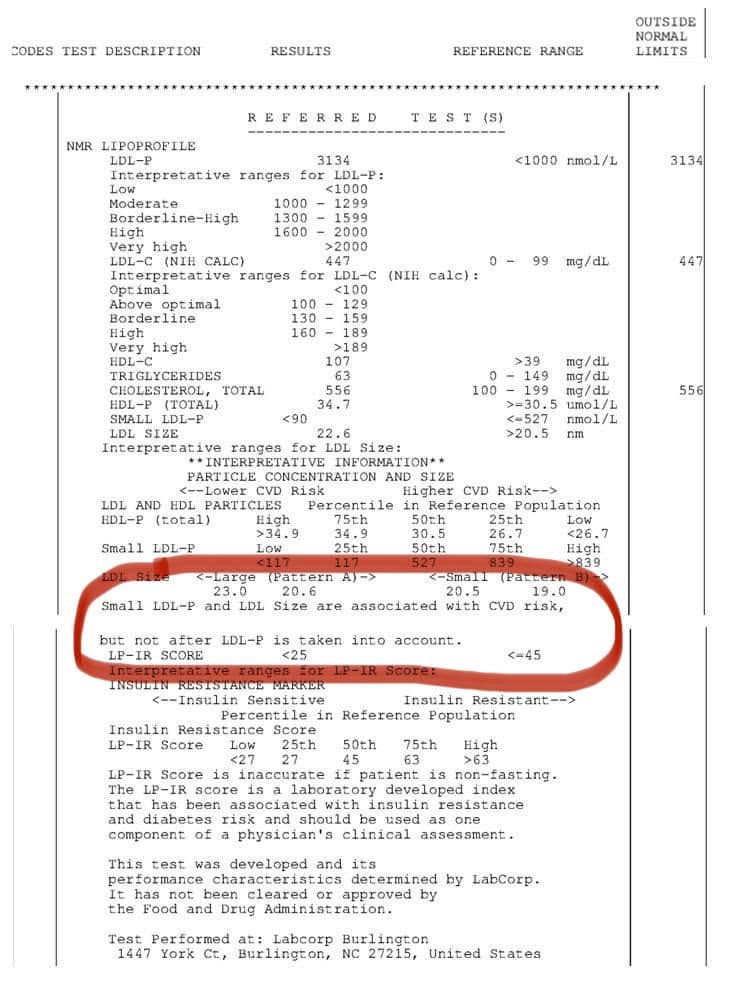
Louis repeatedly argues that LDL particle size does not matter once particle number is counted. NMR reports themselves say that small LDL-P and LDL size are associated with CVD risk, "but not after LDL-P is taken into account". Having large, "fluffy" particles will not protect someone with a high ApoB.21222324 A 2025 European Heart Journal paper he shared concluded that lipid-related risk is best reflected by total ApoB particle count, largely independent of particle type or size, with elevated Lp(a) adding risk.25 Gokhan relays a genetic analysis in about 200,000 people over 14 years in which ApoB plus Lp(a) best captured lipid-mediated risk and size added nothing, and he advises against paying for NMR particle-size panels.26
Can you estimate ApoB from a standard panel?
Technically no, but Louis says you can get a rough feel. Non-HDL cholesterol (total cholesterol minus HDL) is mostly LDL plus some VLDL and a little IDL, and he gives a crude estimate of ApoB at about 0.7 times non-HDL cholesterol.27 He also offers ApoB of roughly 0.7 x (LDL + triglycerides/5). The direct ApoB test is still more accurate because it counts particles, including some not captured by non-HDL.2728 He points out that ApoB tests are cheap, citing about $28 if ordered yourself.8
Why LDL and ApoB are considered causal
Genetics: lifelong exposure
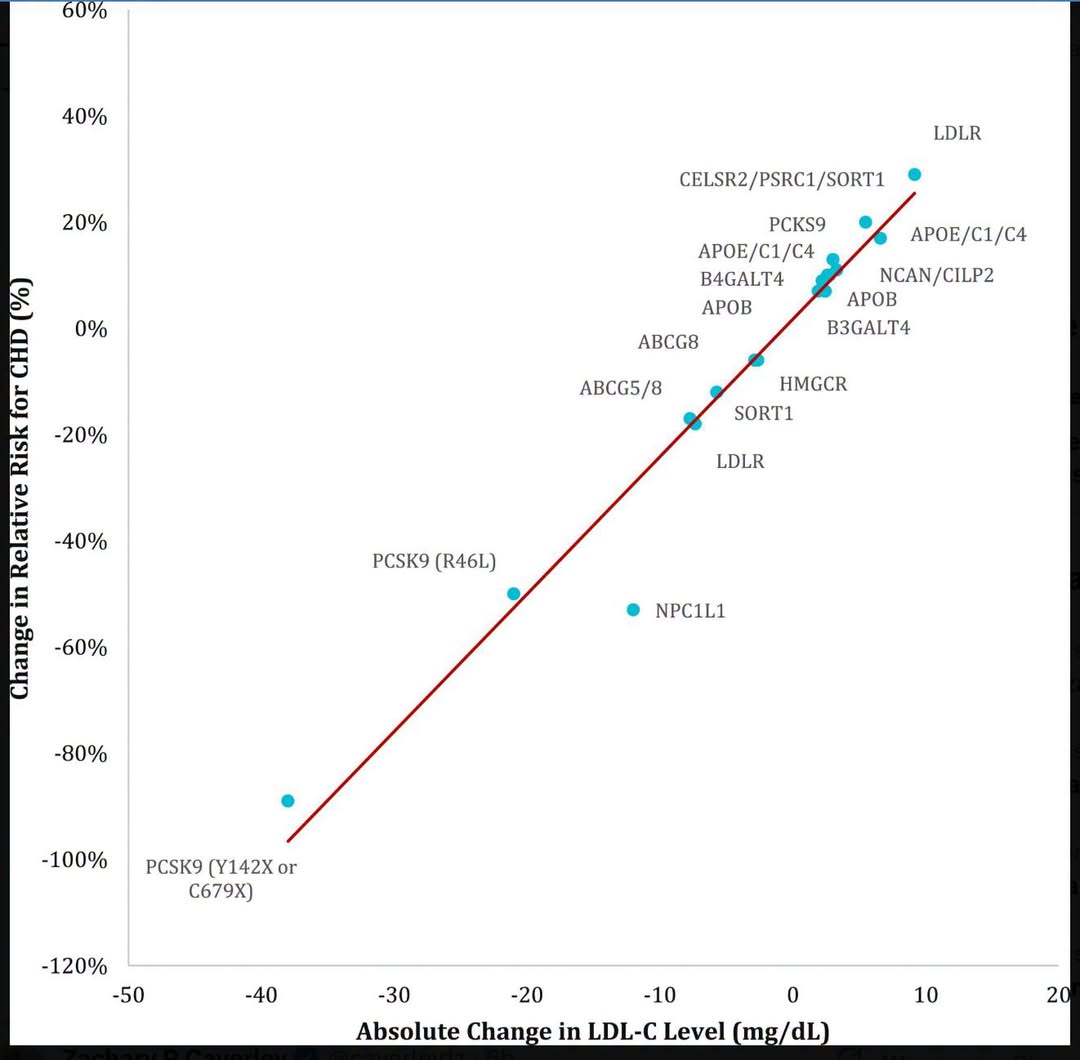
Mendelian randomization uses gene variants that raise or lower a factor from birth as a natural experiment. A chart from a European Atherosclerosis Society consensus statement, explained by Louis, shows variants acting through different pathways (LDLR, PCSK9, APOB, HMGCR, NPC1L1 and others). In each case, coronary risk changes in proportion to the LDL change. Lifetime relative risk reductions range from about 5% to 90%, and the pattern is the same linear relationship seen in statin trials. He notes that a 90% reduction applied to an average American lifetime heart attack risk of about 20% would leave about 2%.29
Gokhan also summarized a 2024 Mendelian randomization study (Martin et al.) in which each 1 SD genetically higher ApoB shortened healthspan, the time to first chronic disease, by about 0.13 years, with a direct effect independent of LDL.30
Randomized trials: lower LDL, fewer events and less plaque
Louis highlights EZ-PAVE, a NEJM trial of over 3,000 patients with established heart disease. Both arms were already treated: one targeted LDL below 70 mg/dL with a statin, the other below 55 with a statin plus ezetimibe. Major events over 3 years were 9.7% versus 6.6%, a 33% reduction, with essentially identical safety.6
Imaging studies tell a similar story. In a meta-analysis of 31 IVUS studies with 4,997 patients, lipid-lowering reduced total and percent atheroma volume, with maximal regression at LDL below 80 mg/dL, and each 1% fall in percent atheroma volume was linked to 20% lower event risk (an association).31 Louis also quotes a Medscape interview in which about half of subjects regressed at LDL near 80 and about 90% of regressable plaques regressed below 60.32
Particle number in outcomes
The Copenhagen General Population Study, summarized in a post Louis shared, followed 13,015 adults on statins for a median of 8 years. People with high ApoB but normal LDL-C had a 49% higher rate of heart attack and a 21% higher rate of death than people with both markers low, whereas high LDL-C with normal ApoB showed no excess risk. Non-HDL cholesterol behaved like ApoB.5 The CARDIA analysis he shared found that people with higher atherogenic particle counts between ages 18 and 40 had a 30% higher risk of heart attack or stroke after 40, with no safe lower threshold identified.7 A JACC Advances study of 1,033 "low-risk" adults found plaque in 35.9%, with prevalence rising with LDL, non-HDL and ApoB even below guideline levels.33
Mechanism
Gokhan explains that cholesterol itself is essential, but having too many ApoB particles means more of them enter the artery wall and are trapped there, driving an inflammatory, cholesterol-rich plaque.2 Louis adds that LDL oxidation that matters mostly happens inside the artery wall, after particles are retained. Oxidized LDL measured in blood does not predict risk once ApoB is accounted for, which is why Tom Dayspring calls the circulating test "useless".3435
What targets do the sources cite?
LDL-C goals by risk
Louis summarized the 2026 ACC/AHA lipid guideline: the goal is under 100 mg/dL for borderline or intermediate risk, under 70 for high risk, and under 55 for people with very high-risk ASCVD (secondary prevention). Any coronary calcium supports a goal under 100, with lower targets for higher calcium amounts.10 An earlier summary by Gokhan of a 2023 JAHA review gives similar thresholds, with at least a 50% LDL-C reduction for high and very high risk and a goal under 40 for recurrent events on statins in the very high-risk group.36 A separate Louis post lists expert targets of under 55 (very high risk), under 70 (high), under 100 (moderate) and under 116 (low).37
| Risk group | 2026 ACC/AHA guideline10 | 2023 JAHA review36 | Expert targets list37 |
|---|---|---|---|
| Very high risk | under 55 mg/dL (secondary prevention) | under 55, or under 40 for recurrent events on statins; at least 50% reduction | under 55 |
| High risk | under 70 | under 70; at least 50% reduction | under 70 |
| Borderline, intermediate or moderate risk | under 100 | not given | under 100 |
| Low risk | not given | not given | under 116 |
The groupings differ slightly between sources, and the admins stress that these are not hard rules. Individual decisions should be made with a doctor.
ApoB goals
Gokhan summarized Gil Carvalho's video, which suggests ApoB ideally under 100 mg/dL for healthy people and under 80 for those at higher risk.38 The National Lipid Association consensus, as summarized in the group, says ApoB testing is most useful for borderline-risk patients deciding on a statin and for people considering treatment intensification, with ApoB thresholds matching LDL-C goals. It stresses that routine ApoB for everyone is not required.3940 The 2026 ACC/AHA summary says ApoB may be used to assess residual risk in people with cardiovascular-kidney-metabolic syndrome, type 2 diabetes, high triglycerides or known cardiovascular disease who have reached LDL-C goals.10
Examples from the group: Gokhan shared labs of LDL 61 and ApoB 58 mg/dL on 5 mg rosuvastatin.41 He has said he prefers an LDL of about 70 mg/dL within a 70 to 100 range as his own personal approach.4
How to get there
- Statins. Louis, sharing a Dayspring slide, notes diminishing returns: atorvastatin 10 mg lowers LDL about 37%, 20 mg 43%, 40 mg 48% and 80 mg 51%. He suggests maximizing lifestyle first and then using the lowest effective dose, and lowering rather than stopping the dose if side effects occur.4243
- Ezetimibe. Gokhan's summary gives an average LDL-C reduction of 18-20% alone and a further 21-30% on top of a statin.44
- Fiber. A meta-analysis of 28 trials found about 10 g/day of psyllium lowered LDL by about 13 mg/dL. A meta-analysis of 74 trials found oats lowered LDL-C by 0.29 mmol/L.454647
- Dietary fats. Louis notes that coconut oil raises LDL and ApoB, though less than butter. In a crossover trial, butter raised ApoB by 10 mg/dL while full-fat yogurt lowered it by 4.4849 Louis states that most saturated fats raise LDL-P, ApoB and LDL-C.13
Is lower always better?
Duration matters as much as depth
Gokhan's "the longer the lower the better" post argues that benefit depends on both how much and how long LDL is lowered. He estimates about 60% lifetime risk reduction for a 70 mg/dL drop sustained for 30 years, based on reading a chart, and he notes that effects beyond about 80 mg/dL of lowering are unknown.4 The CARDIA finding, which tracks particle exposure across ages 18 to 40, fits this idea.7
Proportionality and possible downsides
Louis shared an NEJM review whose message is "proportionality, not 'lower for everyone'". Targets should scale with absolute risk, with a focus on lifestyle in lower-risk people.3 Louis also criticizes advice that low-risk people should use multiple drugs to push LDL-C below 20 mg/dL. He cites Walter Willett's view that very low LDL may increase hemorrhagic stroke risk, and he stresses this does not apply to high-risk people, for whom heart attack and ischemic stroke risk outweigh it.50 This is an opinion presented with evidence from one expert; the group's index also lists posts on whether low cholesterol is harmful.51
LDL is not a cure
Louis stresses that residual risk persists in every randomized trial, regardless of how low LDL goes, and that it appears higher in older people. Lowering ApoB is no cure. He lists other drivers such as family history, blood pressure, smoking, weight, inflammation, diet, inactivity and insulin resistance.11 Gokhan's index post gives a blunt rule: if you are at high risk, find a good cardiologist and listen to them.51
"My LDL is high but I'm metabolically healthy"
The Keto-CTA (LMHR) study is central to this debate. Louis says it tested whether good metabolic health and large LDL particles protect against very high LDL, with an average LDL of 254 mg/dL, and found no protection. He reports plaque progression of 3 to 3.8 times worse than a comparison group with normal LDL, while the DISCO intervention (statins, other medications and a DASH diet) achieved significant plaque reversal in a year.5253 Louis proposes that the LMHR phenotype reflects a starvation-like response in very lean people on strict keto.54 Not everyone is affected: a video Louis recommends says some people are genetically protected despite high LDL, but most are not.55
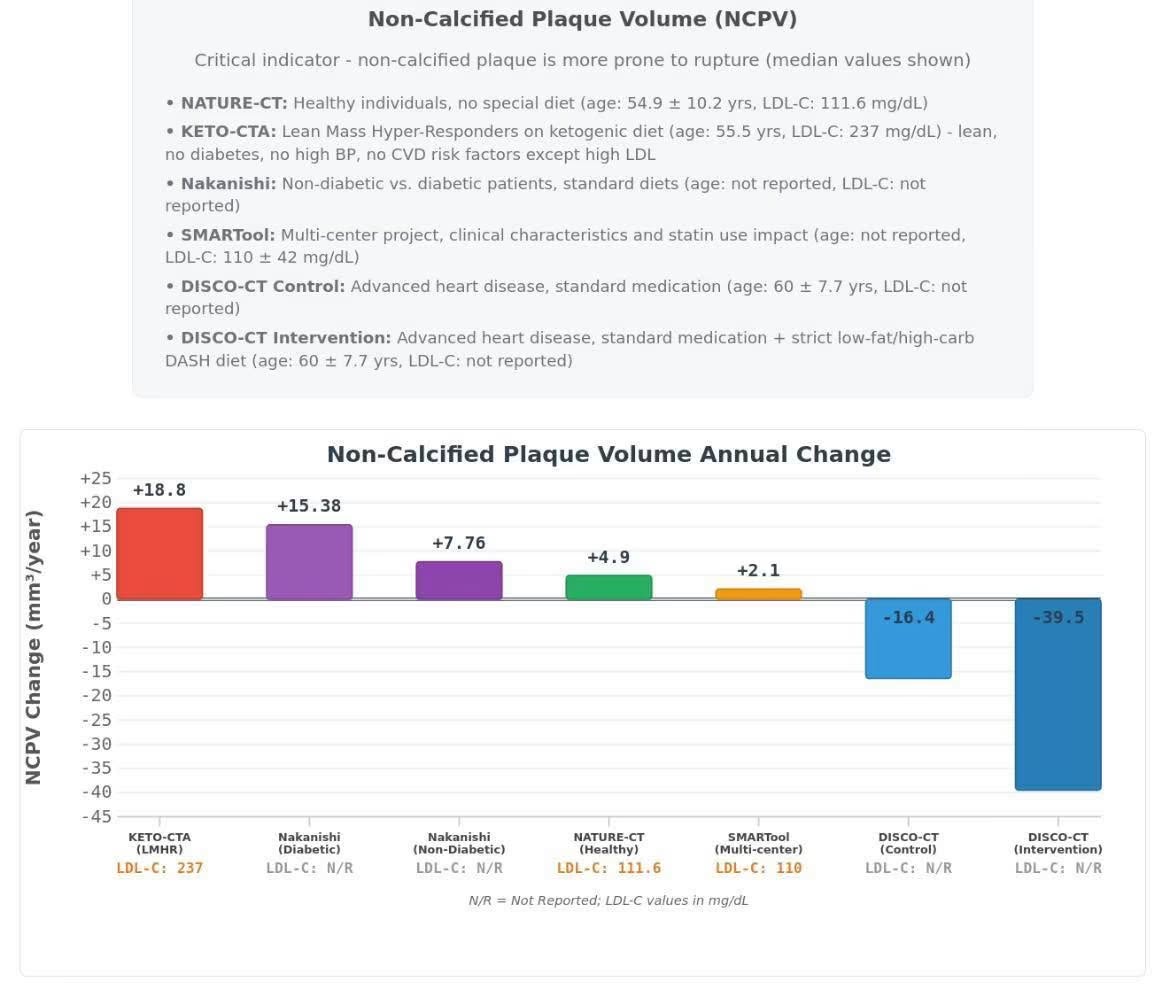
HDL is another common distraction. Louis notes that HDL-raising drug trials failed on hard outcomes and treats HDL as a crude proxy for insulin resistance.56
What this means for you
- Ask about ApoB. The group's admins favor it over LDL-C alone, especially if triglycerides are high, you have diabetes or metabolic syndrome, or your LDL-C looks low but you have other risk factors.939
- Measure Lp(a) at least once. The 2026 guideline summary says to measure it at least once in adulthood, with high values (125 nmol/L or above) linked to about a 1.4-fold higher long-term risk.10 Gokhan's explainer says Lp(a) is 80-90% genetic and stable through life.57
- Discuss the right target with your doctor. The sources cite under 100, 70 or 55 mg/dL for LDL-C depending on risk.610
- Don't rely on particle size, oxidized LDL or HDL. The admins say particle size and circulating oxidized LDL add nothing once ApoB is known.2134
- Think long term. Earlier and sustained lowering is argued to give more benefit.47
- Combine approaches. Diet, fiber, the lowest effective statin dose and ezetimibe are all discussed. Louis suggests LDL lowering combined with attention to inflammation, insulin resistance and the aging process.324244
Frequently asked questions
Is LDL-C or ApoB the better test?
Louis argues ApoB is the best lipid test because it counts all atherogenic particles, with LDL-C usually tracking it. Standard panels also miss Lp(a), remnants and other ApoB-rich particles.1358
Can I calculate ApoB myself?
Only roughly. Louis gives about 0.7 x non-HDL cholesterol, or 0.7 x (LDL + TG/5), but recommends the direct test.2728
If my LDL-C is under 100, am I safe?
Not necessarily. The Copenhagen study found high ApoB with normal LDL-C carried higher risk, and residual risk persists in every trial.511
Do triglycerides matter?
Yes, as VLDL particles carrying ApoB. But Louis says they are already counted in ApoB, and lowering triglycerides alone with drugs did not shrink plaque in the olezarsen trial.1718
Can LDL be too low?
For most people at risk, the sources cited favor lower. Louis notes a possible hemorrhagic stroke concern at very low levels in low-risk people, and a proportionate approach in the NEJM review.350