HD-OPM Archive
Topics › GLP-1 drugs (semaglutide, tirzepatide)

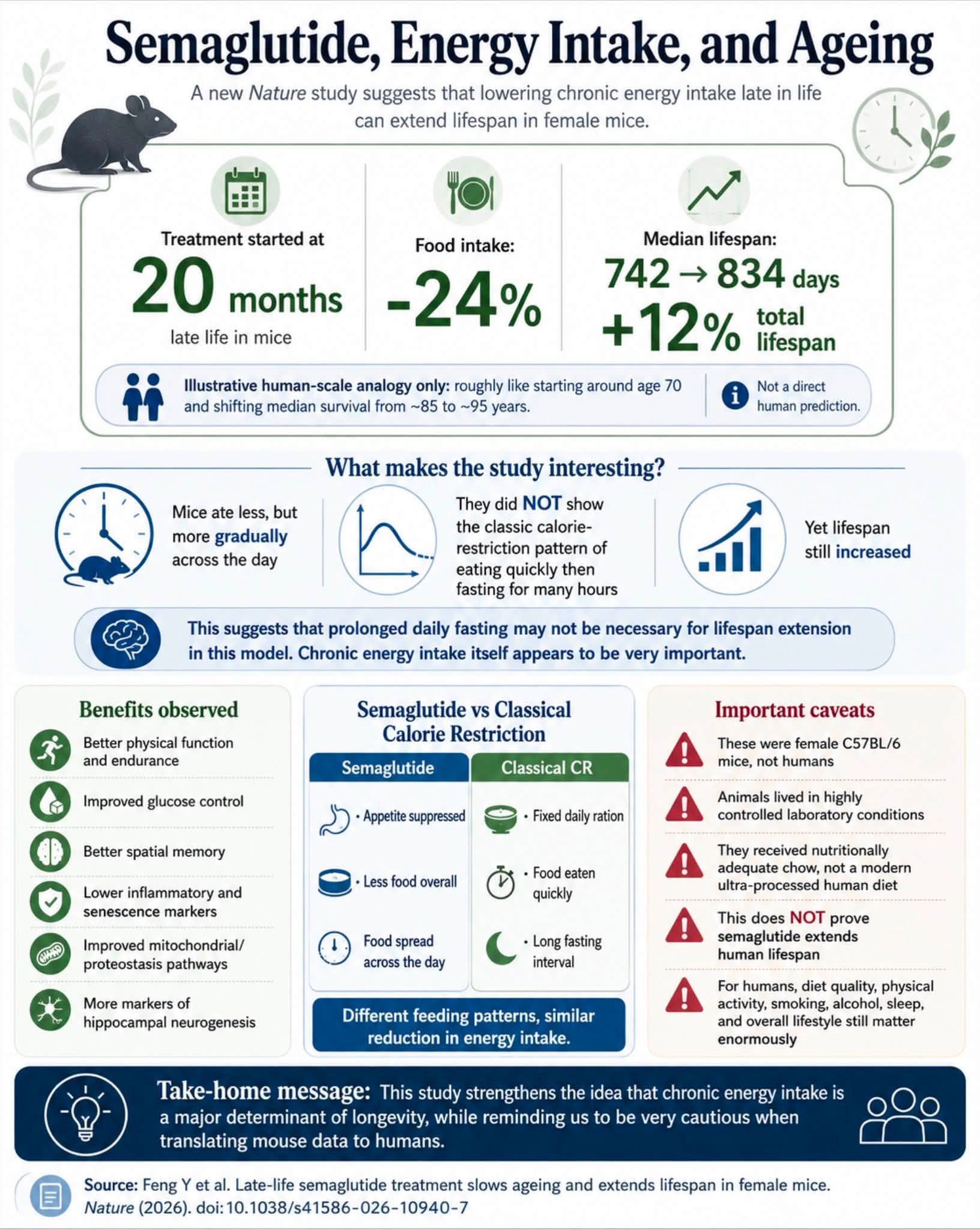
Semaglutide extended lifespan 12% in elderly female mice, hinting GLP-1 slows aging

Louis Nervegna · Oct 29, 2026 · ♥ 3 reactions · 3 comments · original Facebook post
GLP-1 drugs (semaglutide, tirzepatide)Aging & longevity
AI summary & key facts

A Nature study found elderly female mice given semaglutide lived 12 percent longer than controls, regained curiosity and memory, and improved across hallmarks of aging. Louis notes the main mechanism is almost certainly calorie restriction. Researchers suggest slowed aging could explain GLP-1's benefits across heart, kidney, liver and brain conditions.

GLP1 drugs appear to slow aging in mice.

(The main causal mechanism is almost certainly calorie restriction.)

Quoted:

“But two researchers at the National Institute on Aging put the finding plainly: rather than explaining GLP-1's benefits one disease at a time, the results suggest they share a common cause. Slowed aging.”

Link to full story:

SingularityHubCould GLP-1 Drugs Help You Live a Longer, Healthier Life?Elderly mice on the popular weight-loss drug semaglutide aged slower and lived longer, mimicking the longevity effects of caloric restriction.singularityhub.com

Link to journal paper:

Paper · Nature · 2026Late-life semaglutide treatment slows ageing and extends lifespan in female mice.Pharmacological glucagon-like peptide-1 receptor (GLP-1R) activation reduces food intake and is an effective therapy for type 2 diabetes and obesity1. The use of GLP-1 medicines has revealed pleiotropic beneficial effects beyond glucose and weight control2-5, but little is known about the underlying basis of the pleiotropic effects. Here, treatment of 20-month-old female C57BL/6 mice with the GLP-1R agonist…pmc.ncbi.nlm.nih.gov

Press release:

National Institutes of Health (NIH)GLP-1 drug slows aging in miceA GLP-1 drug extended lifespan and prevented age-related decline in older female mice.nih.gov

Media coverage:

Smithsonian MagazineGLP-1 Weight-Loss Drugs Can Slow Aging and Extend Life Span, Mouse Study SuggestsOlder female mice—equivalent in age to 60-year-old women—given daily injections of the active ingredient in Ozempic lived about 12 percent longer than animals that didn't receive the drugsmithsonianmag.com

#glp1HD #glp1agingHD #agingHD #longevityHD #miceHD #calorierestrictionHD

Research cited

Ozempic already reduces cardiovascular disease, kidney disease, liver disease, and neurodegenerative conditions. Scientists have struggled to explain why a drug designed to control blood sugar and appetite produces benefits across so many unrelated systems.

A new study in Nature suggests one answer: it may be slowing aging itself.

Elderly female mice given semaglutide lived 12 percent longer than controls, regained their curiosity and memory, and showed improvement across virtually every hallmark of aging, including inflammation, senescent cells, DNA damage, and brain cell growth. When compared directly to caloric restriction, the drug matched or outperformed it on several measures, without the hunger or metabolic adaptation that makes dieting so hard to sustain.

The caveats are significant. These are inbred female mice. Rapid weight loss can reduce lean muscle in older people, raising real concerns about frailty. Whether these results hold in humans remains an open and genuinely important question.

But two researchers at the National Institute on Aging put the finding plainly: rather than explaining GLP-1's benefits one disease at a time, the results suggest they share a common cause. Slowed aging.

ICYMI: Read the full story, link in comments.

May be an image of text
← newer: Absence of evidence is not evidence of absence: weighing unpolder: Berberine 500 mg twice daily lowered ApoB in two trials; CVD →