Non traditional risk factors for heart disease
Modern cardiology is undergoing a paradigm shift, expanding beyond the traditional risk factors of hypertension, high cholesterol, diabetes, and smoking to recognize a new frontier of non-traditional contributors to heart disease. While managing classic risks remains crucial, a significant portion of cardiovascular events occur in patients with well-controlled traditional factors, a phenomenon known as "residual risk." Emerging research reveals that this residual risk is often driven by a diverse set of factors including poor dental health, chronic immune activation, age-related genetic mutations in blood cells, gut microbiome activity, and environmental pollutants. A powerful unifying theme connects these seemingly disparate elements: they all converge on the common pathogenic pathways of chronic systemic inflammation and oxidative stress, which are now understood to be fundamental drivers of atherosclerosis, the underlying cause of most heart attacks and strokes.
Dental Health: The Oral-Systemic Connection
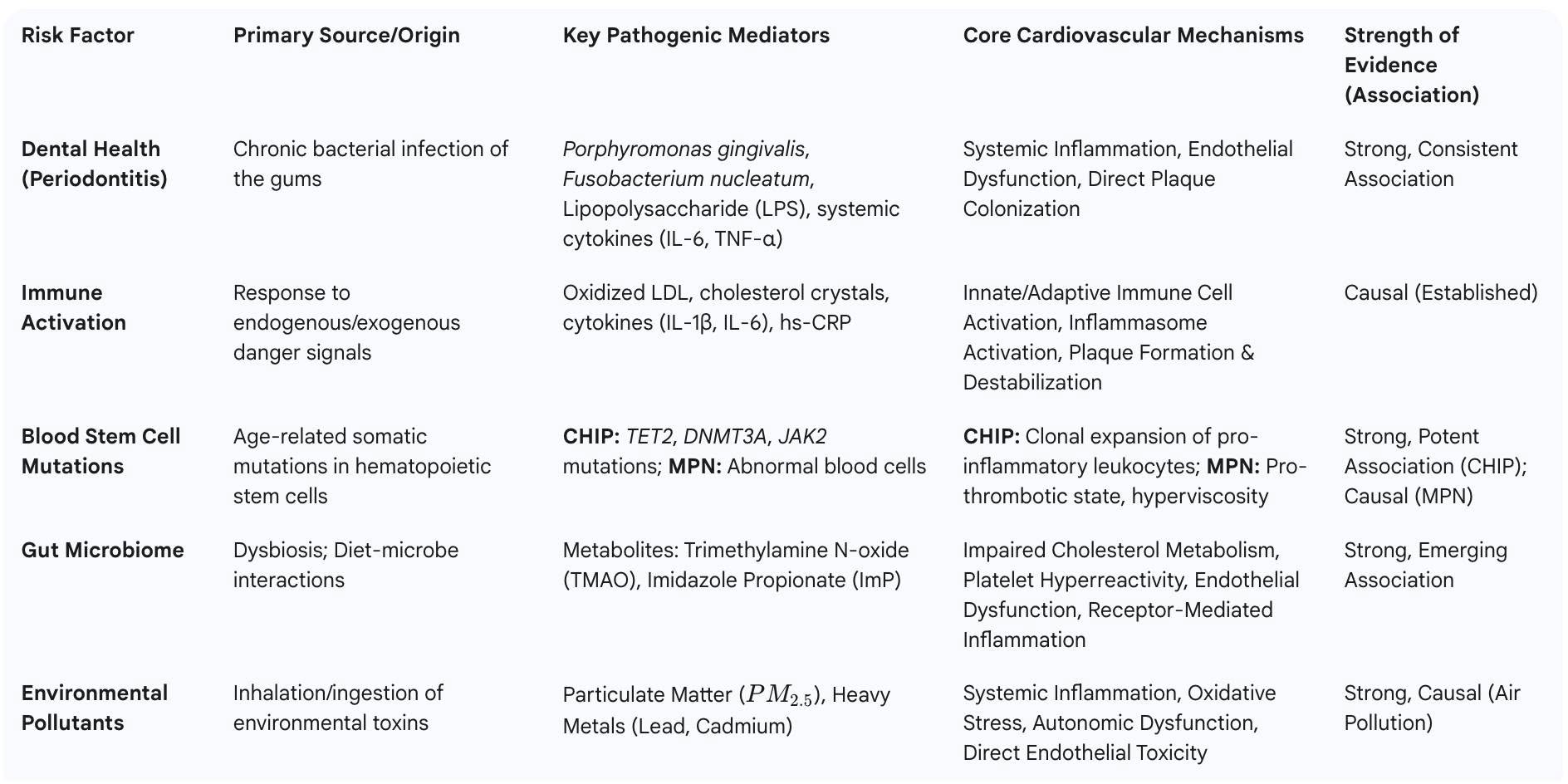
The link between the mouth and the heart is now firmly established. Chronic periodontal disease (gum disease), a persistent bacterial infection of the oral tissues, is not merely a localized problem but a significant systemic threat. Extensive meta-analyses have shown that periodontitis confers a 1.1- to 2.2-fold increased risk for coronary heart disease, a magnitude comparable to moderate elevations in cholesterol or blood pressure. This association is believed to be causal, as intervention trials show that treating gum disease measurably improves the function of the vascular endothelium.
The primary mechanism is chronic, low-grade inflammation. The inflamed gums act as a constant source of pro-inflammatory cytokines like IL-1β, TNF-α, and IL-6, which spill into the bloodstream and injure blood vessels throughout the body. Furthermore, routine activities like chewing can cause transient bacteremia, allowing oral pathogens such as Porphyromonas gingivalis to enter the circulation. The DNA of these bacteria has been found directly within atherosclerotic plaques, suggesting they can colonize the vessel wall and incite local inflammation, accelerating plaque development. This highlights the critical importance of oral hygiene as an often-overlooked component of comprehensive cardiovascular prevention.
Chronic Inflammation: The Fiery Heart of Atherosclerosis
Atherosclerosis is now fundamentally understood as a chronic inflammatory disease of the arterial wall. This "inflammation hypothesis" places the immune system at the center of the disease process. The entire lifecycle of an atherosclerotic plaque, from its initial formation to its ultimate rupture, is orchestrated by immune cells and inflammatory signaling. A key clinical measure of this risk is high-sensitivity C-reactive protein (hs-CRP), a biomarker for systemic inflammation. Landmark studies have demonstrated that healthy individuals with hs-CRP levels in the highest quartile have a 2- to 3-fold greater risk of suffering a future heart attack compared to those in the lowest quartile, independent of their cholesterol levels. Similarly, patients with chronic autoimmune diseases like rheumatoid arthritis, which are characterized by persistent inflammation, face a 50% to 70% higher risk of cardiovascular events.
The central inflammatory pathway involves the NLRP3 inflammasome, a protein complex within immune cells that, when activated by danger signals like cholesterol crystals in a plaque, triggers the release of the master cytokine IL-1β. IL-1β then stimulates the production of IL-6, which in turn causes the liver to produce CRP. This cascade has been proven to be a causal pathway in humans. The groundbreaking CANTOS trial showed that specifically blocking IL-1β with the drug canakinumab resulted in a 15% reduction in major cardiovascular events in high-risk patients, without affecting their cholesterol levels. This was the first definitive proof that targeting inflammation alone can prevent heart attacks and strokes, validating inflammation as a standalone, treatable risk factor.
Clonal Hematopoiesis (CHIP): An Age-Related Genetic Risk
A surprising and potent risk factor has been discovered originating from our own bone marrow. Clonal hematopoiesis of indeterminate potential (CHIP) is an age-related condition where a blood stem cell acquires a somatic mutation that allows it to outcompete other stem cells, creating a large, dominant clone of blood cells carrying the mutation. While CHIP was initially studied as a precursor to leukemia, it has emerged as a major driver of heart disease. The condition is common, affecting 10% to 20% of people over 70, and its presence confers nearly double the risk of coronary artery disease. Certain high-risk mutations, such as JAK2 V617F, are particularly dangerous, being associated with a 4-fold higher incidence of early-onset heart attack.
The mechanism is again rooted in inflammation. The mutated genes, particularly TET2 and JAK2, create leukocytes (monocytes and macrophages) that are genetically programmed to be hyper-inflammatory. These cells exhibit heightened NLRP3 inflammasome activity, leading to excessive production of the atherogenic cytokines IL-1β and IL-6. This effectively creates a persistent, endogenous source of inflammation that accelerates plaque growth. At the far end of this spectrum are myeloproliferative neoplasms (MPNs), which are overt blood cancers where these clones proliferate uncontrollably, leading to an extremely high risk of thrombosis; for instance, ET patients with a JAK2 mutation have a 2.5-fold higher risk of arterial blood clots. The discovery of CHIP provides a molecular link between aging, inflammation, and cardiovascular disease, and it opens the door to future strategies like genetic screening and targeted anti-inflammatory therapies for high-risk individuals.
The Gut Microbiome: Metabolites and the Gut-Heart Axis
The trillions of microbes in our gut function as a metabolic organ that can profoundly influence cardiovascular health. The interaction between diet and gut bacteria can produce circulating metabolites that directly promote atherosclerosis. The most well-studied example is trimethylamine-N-oxide (TMAO), a molecule produced when gut microbes digest nutrients like choline and L-carnitine, which are abundant in red meat and eggs. Numerous studies have shown a strong link between high blood levels of TMAO and heart disease; individuals in the top quartile for TMAO have approximately a 2.5-fold greater risk of suffering a heart attack or stroke. TMAO appears to be a causal agent, as it has been shown to promote inflammation, impair the body's ability to remove cholesterol from plaques, and increase platelet reactivity, making blood more prone to clotting.
More recently, another microbial metabolite, imidazole propionate (ImP), derived from the amino acid histidine, has been identified as a causal driver of atherosclerosis. Remarkably, studies show ImP can induce robust plaque formation in animals even with normal cholesterol levels. It does so by activating a specific receptor on immune cells (I1R), triggering a powerful inflammatory response. These discoveries highlight how our diet is processed by our "microbial organ" to create molecules that can either protect or harm our arteries, opening up novel therapeutic avenues such as dietary interventions, probiotics, or drugs that block the production or action of these harmful metabolites.
Environmental Pollutants: The Air We Breathe, The Toxins We Absorb
Environmental factors are now recognized as cardiovascular risk factors on par with traditional ones. Air pollution, specifically fine particulate matter (PM₂.₅), is a leading global threat. The statistics are staggering: air pollution is the fourth leading risk factor for cardiovascular mortality worldwide, and it is estimated that almost 20% of all cardiovascular deaths are attributable to it. In 2019, nearly 62% of the 9 million premature deaths linked to pollution were due to heart disease and stroke. Both acute exposure (triggering heart attacks) and chronic exposure (accelerating atherosclerosis) are dangerous. Inhaled particles provoke intense inflammation in the lungs that spills over into the systemic circulation, causing widespread endothelial dysfunction, oxidative stress, and an increased tendency for blood to clot.
Beyond air quality, chronic exposure to toxic heavy metals like lead, cadmium, and arsenic is a causal risk factor for hypertension and atherosclerosis. Lead, for example, directly induces high blood pressure by causing severe oxidative stress that impairs nitric oxide signaling in blood vessels. Similarly, endocrine-disrupting chemicals like BPA, found in many plastics, have been linked to a higher prevalence of heart disease. What sets environmental factors apart is that exposure is often involuntary and affects entire populations, underscoring that public health policies aimed at ensuring clean air and water are powerful and essential cardiovascular prevention strategies.
docs.google.comGoogle Docdocs.google.com