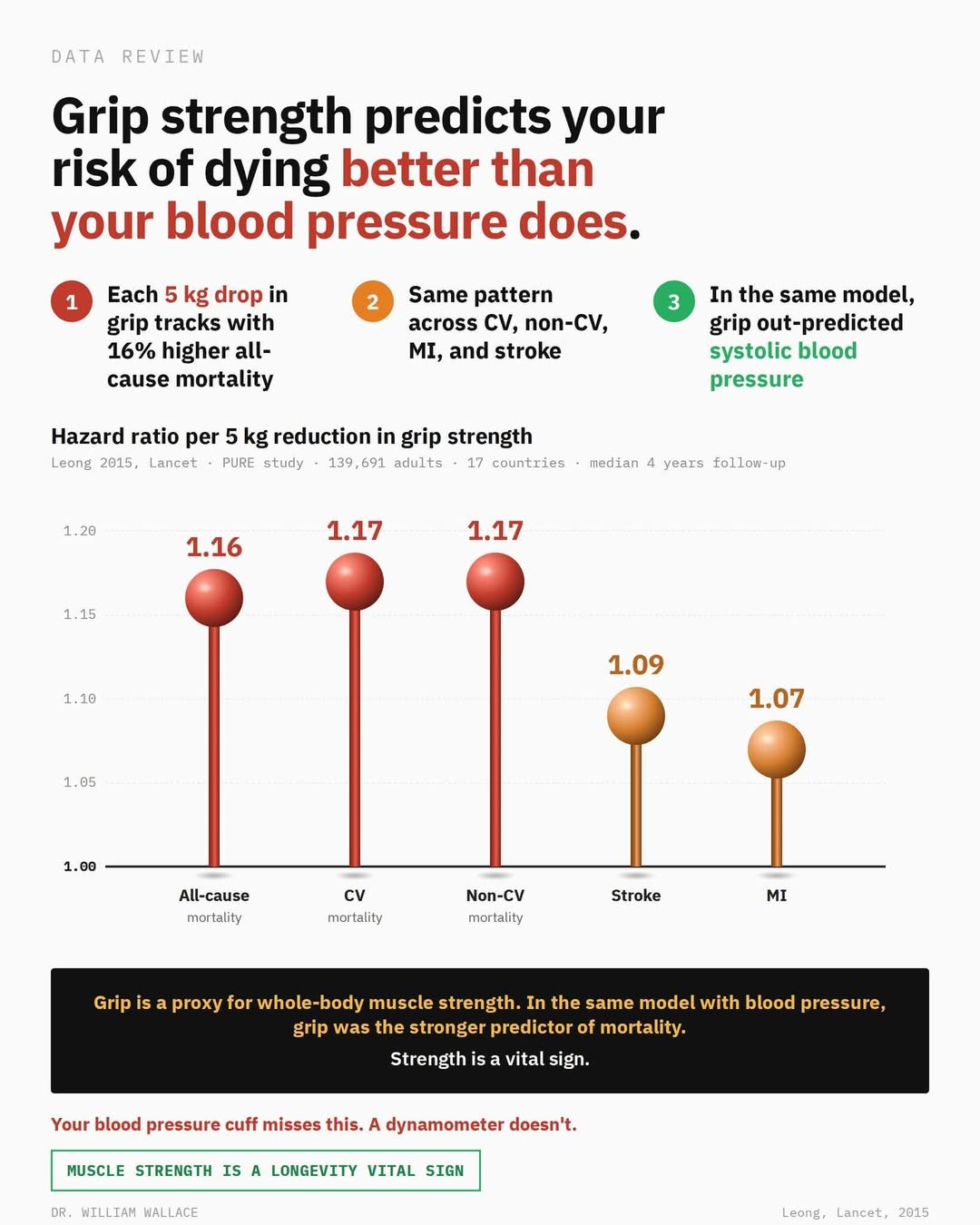
Grip strength is a better predictor of mortality than blood pressure.
This is true.
But there is an important lesson here:
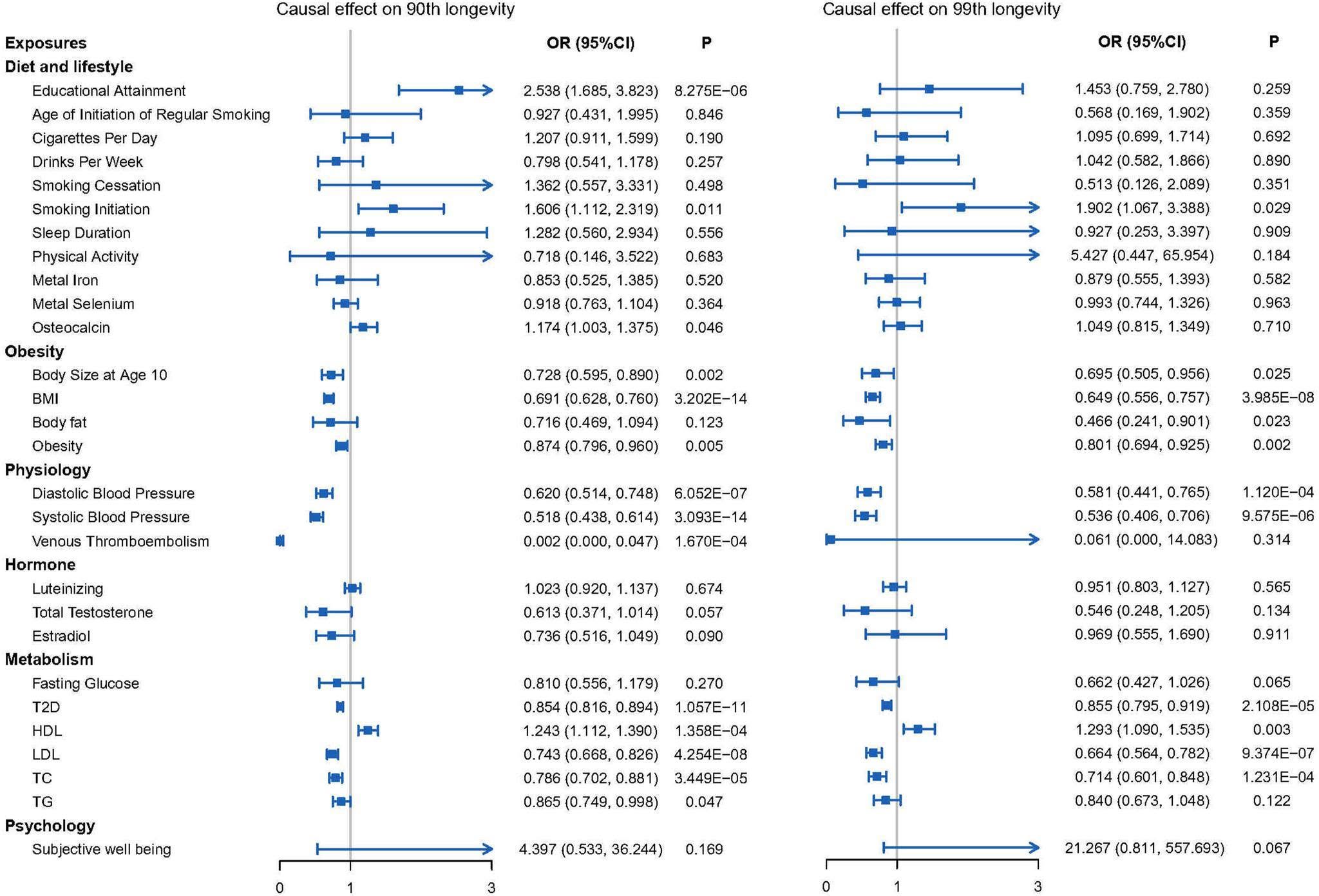
Blood pressure is causal.
Grip strength is not.
Treating high blood pressure will dramatically lower your risk of dying in the long term. Doing handgrip exercises will have little to no effect.
It’s most important to focus on risk factors that are proven causal.
Non-causal risk factors, like grip strength, can be good proxies for assessing risk. But the moment that you try to artificially hack them, they lose their predictive value.
For example, doing handgrip exercises ends up hiding mortality risk, from the perspective of the test. It doesn’t reduce it. In this case, the improvement seen in the grip strength test gives you the false impression that your risk has gone down… when in fact, it has not.
You will see people claim all the time on social media that hacking non-causal factors lowers risk. In reality, it just hides risk. It gives people a false sense of security.
#mortalityHD #gripstrengthHD #bloodpressureHD #riskfactorsHD #causalityHD
Muscle strength is one of the most reliable predictors of how long you live. The simplest way to measure it is to squeeze a handheld dynamometer for 30 seconds. The kilograms get recorded. That single number tracks with mortality across nearly every cause researchers have measured.
The Prospective Urban Rural Epidemiology study followed 139,691 adults across 17 countries on five continents for a median of 4 years. Every 5 kilogram drop in grip strength tracked with 16% higher all-cause mortality. The same direction and magnitude held up for cardiovascular death, non-cardiovascular death, heart attack, and stroke. 3,379 deaths occurred over the follow-up period and the relationship persisted after adjustment for age, sex, education, smoking, alcohol, physical activity, and country.
The headline finding came from a separate analysis. When grip strength and systolic blood pressure were both placed in the same model, grip was the stronger predictor of all-cause and cardiovascular mortality. Blood pressure is the most universally measured risk factor on earth. A squeeze test outperformed it.
Grip strength is a proxy for whole-body muscle strength. It correlates with quadriceps strength, with overall lean mass, and with neuromuscular function. The European Working Group on Sarcopenia in Older People uses grip as the primary measure of muscle strength in their diagnostic criteria.
The mechanism is straightforward. Skeletal muscle is the largest insulin sensitive tissue in the body. It is the primary engine of glucose disposal, the largest reservoir of amino acids, and an endocrine organ that secretes myokines during contraction. When that tissue degrades, the entire metabolic system loses its main shock absorber. Weaker bodies die earlier across a long list of causes.
The PURE data is observational. It does not prove that getting stronger causes lower mortality, only that the strength signal is consistent across continents, across country income levels, and across cause of death.
Almost every adult who walks into a clinic gets a blood pressure measurement. Almost none get their grip strength measured. Your blood pressure cuff misses this. A dynamometer doesn't.
Strength is a vital sign.
Leong et al., Lancet, 2015