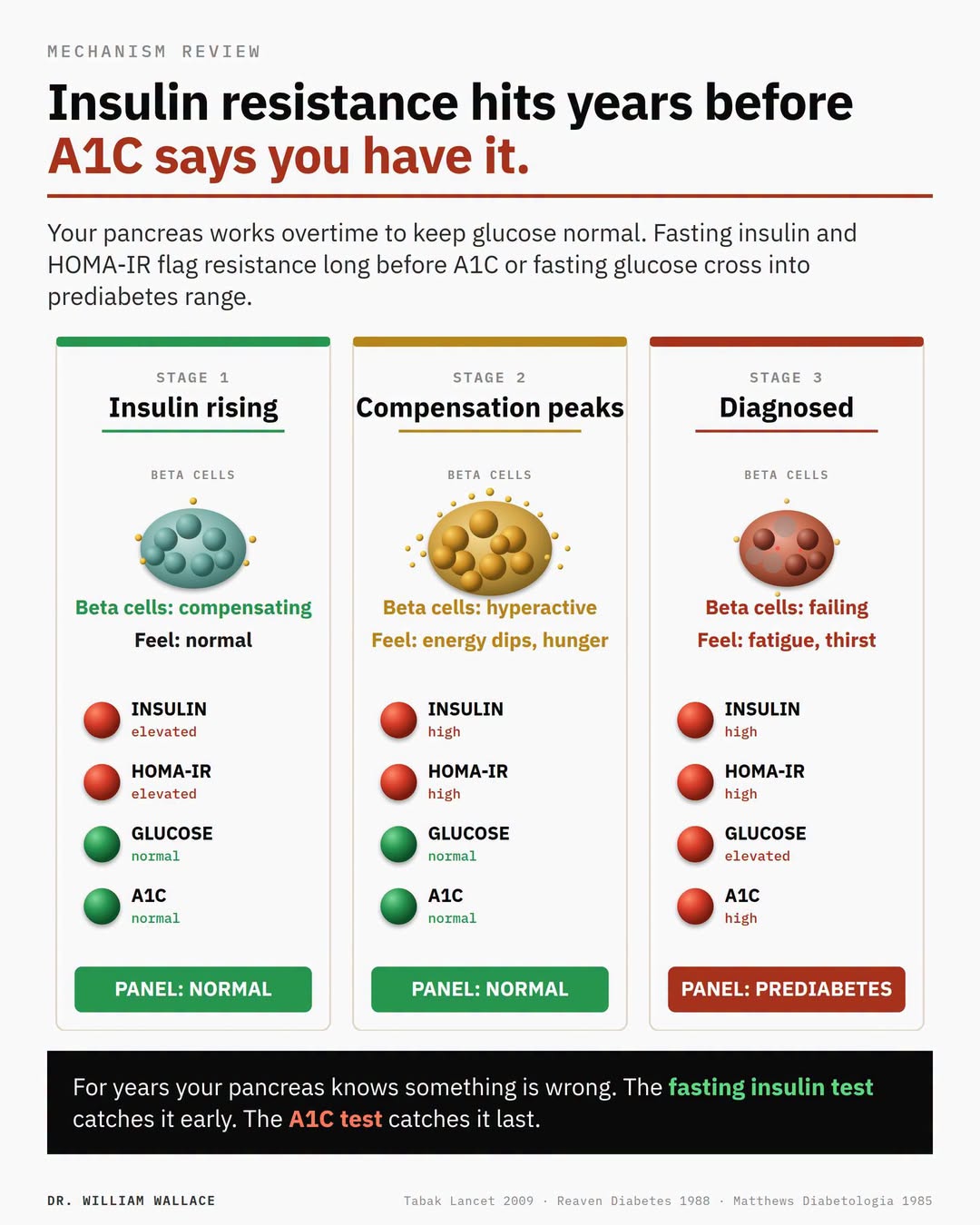
Insulin resistance occurs years before A1C says that you have it.
“The mechanism Reaven described in his 1988 Banting lecture explains the gap. As muscle, liver, and fat lose insulin sensitivity, the pancreas compensates by producing more insulin. Glucose stays normal because the compensation works. The patient feels fine. Standard screening reads “normal”. Meanwhile fasting insulin, calculated insulin resistance scores like HOMA-IR, and oral glucose tolerance testing with insulin curves are showing dysfunction the whole time.”
“The two tests that catch it earliest are fasting insulin and a 2-hour oral glucose tolerance test with insulin measured alongside glucose at 30, 60, 90, and 120 minutes.”
#insulinresistanceHD #glucoseHD #a1cHD #homairHD #insulinHD #ogttHD
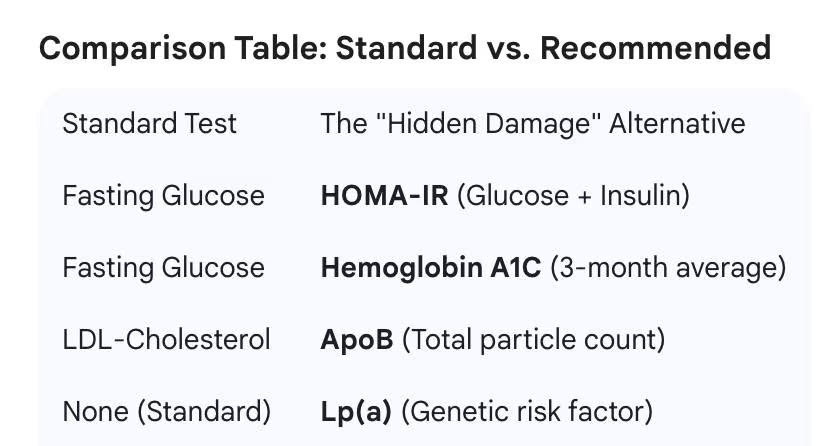
Standard diabetes screening looks at fasting glucose and A1C. Both stay in normal range for years while insulin resistance accumulates underneath.
The Whitehall II study followed 6,538 British civil servants and built 13-year retrospective trajectories for the 505 who eventually developed type 2 diabetes. Fasting glucose rose linearly from 13 to 3 years before diagnosis, then accelerated into a quadratic climb in the final 3 years. Postload glucose followed its own accelerating curve, with the steepest rise in the last 2 years before diagnosis. HOMA insulin sensitivity was already about 34 percent lower in eventual cases across the entire 13-year window, with a steeper decline beginning 5 years before diagnosis. HOMA beta cell function tracked higher than controls the whole time, peaked between years 4 and 3 before diagnosis at 92.6 percent, and then collapsed to 62.4 percent at diagnosis.
The mechanism Reaven described in his 1988 Banting lecture explains the gap. As muscle, liver, and fat lose insulin sensitivity, the pancreas compensates by producing more insulin. Glucose stays normal because the compensation works. The patient feels fine. Standard screening reads "normal." Meanwhile fasting insulin, calculated insulin resistance scores like HOMA-IR, and oral glucose tolerance testing with insulin curves are showing dysfunction the whole time.
This matters for who gets caught early. Lean adults with insulin resistance, women with PCOS, and people with strong family history can have HOMA-IR in the resistance range while passing every standard lab. The two tests that catch it earliest are fasting insulin and a 2-hour oral glucose tolerance test with insulin measured alongside glucose at 30, 60, 90, and 120 minutes.
HOMA-IR is calculated as (fasting glucose in mg/dL times fasting insulin in microUI/mL) divided by 405. Functional thresholds in the literature suggest insulin resistance starts somewhere between 2.0 and 2.5, with severe resistance above 5. Lab "normal" ranges for fasting insulin can run as wide as 2 to 25 microUI/mL, which catches frank insulin deficiency but misses the early resistance phase entirely. Both tests are available through direct-pay labs without a prescription, typically under 50 dollars combined.
In people already at the prediabetes stage, the Diabetes Prevention Program showed lifestyle intervention reduced progression to type 2 diabetes by 58 percent versus metformin at 31 percent, over an average follow-up of 2.8 years. The lifestyle arm targeted 7 percent body weight loss and at least 150 minutes of physical activity per week. Whether catching insulin resistance earlier in the trajectory, at the pre-prediabetes stage Tabák identified, leads to additional benefit is the open question. What earlier detection clearly buys is more time on the linear part of the curve, before glucose enters the steep terminal rise.
Tabak et al., Lancet, 2009.
Reaven, Diabetes, 1988.
Matthews et al., Diabetologia, 1985.
Knowler et al., N Engl J Med, 2002.