Reposting this for new members.
Don’t let charlatans and fools lie to you about this on social media.
↪ A 1.1-4.7% absolute risk reduction from statins is large against a 20% lifetime risk
Reposting an explainer on relative versus absolute risk: statin trials show absolute risk reductions of 1.1% to 4.7% over about 5 years, which the poster argues is substantial against a roughly 20% lifetime heart attack risk. Over decades he suggests lifetime risk could fall toward 10%, an extrapolation.
Reposting this for new members.
Don’t let charlatans and fools lie to you about this on social media.
↪ A 1.1-4.7% absolute risk reduction from statins is large against a 20% lifetime risk
Relative risk vs Absolute risk, when it comes to statin trials.
——
Statins have been shown to reduce absolute risk of having a heart attack or stroke by anywhere from 1.1% to 4.7% in randomized controlled trials lasting about 5 years.
A common claim on social media is that this makes little practical difference.
Let’s examine the basic math behind this claim:
For the average American, the absolute risk of having a heart attack in their entire lifetime is only about 20%. (1 in 5 Americans will have a heart attack in their lifetime.)
A drop in absolute risk of 1.1% to 4.7% in only 5 years reduces this lifetime risk from 20% down to 15.3% to 18.9%. All in just 5 years.
That is huge. If the average American continues this for decades, they will likely drop their lifetime risk of a heart attack or stroke all the way down to 10%.
So instead of 1 in 5 Americans having a heart attack, it would be 1 in 10. That is fantastic. Millions of lives would be saved.
↪ LDL down 39 mg/dL: 20%+ fewer heart attacks in RCTs, 30%+ in cohorts, 50%+ genetically
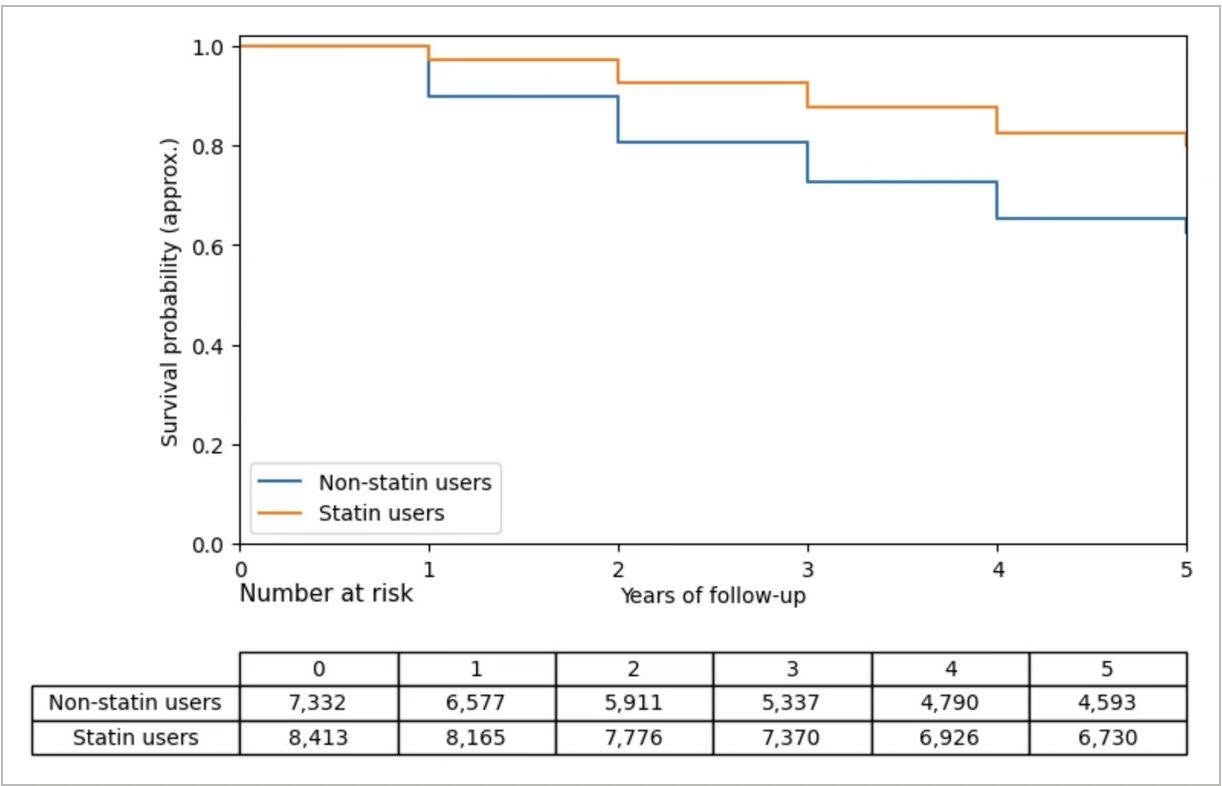
Quotes Dr Carvalho on a new analysis in people aged 80 or older: statin users had a 31% lower relative risk of dying and, as stated, a 17% lower absolute risk. The key principle is that absolute benefit depends on control-group risk, so it looks small in young people over the short term but grows with time, age or illness.
Louis works through why universal statin use could cut lifetime heart attack and stroke risk from about 20% to 10% while extending average lifespan by only days over 5 years: only about 10% of heart attacks and strokes are fatal, and only 1 in 5 US deaths are from them, so the reduction in overall deaths is about 50 times smaller. His arithmetic suggests a 0.022% to 0.094% reduction in overall deaths over 5 years. Note that this is a population-averaged back-of-envelope calculation.
Louis explains that over a few years the absolute risk of a heart attack is only about 2-5%, so no intervention, even a complete cure, can cut absolute risk by more than that in a short trial. A 1-2% absolute reduction from statins or from diet and lifestyle trials is therefore a meaningful result.
Louis asks whether CAC scanning changes whether you have a heart attack; for some it is a wake-up call, but for the average person it does not seem to change outcomes. The shared text cites a Danish trial of 30,000 men (no reduction in death, MI or stroke at seven years, more serious bleeding) and the US CorCal trial of nearly 6,000 people (same event rates as a risk calculator).
Louis summarizes nattokinase as promising but unproven, quoting a KevinMD article that no one should stop a statin because of it. Large independent RCTs showing fewer heart attacks, strokes and deaths are needed.
Dr. Michael Richman explains that much statin muscle pain arises from the nocebo effect, citing the SAMSON trial.