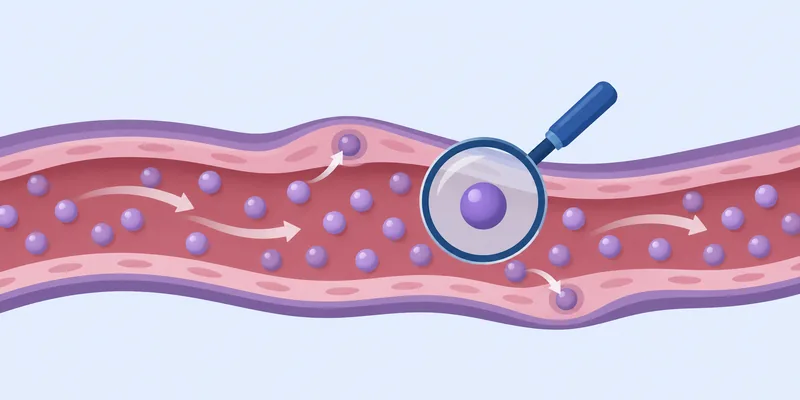
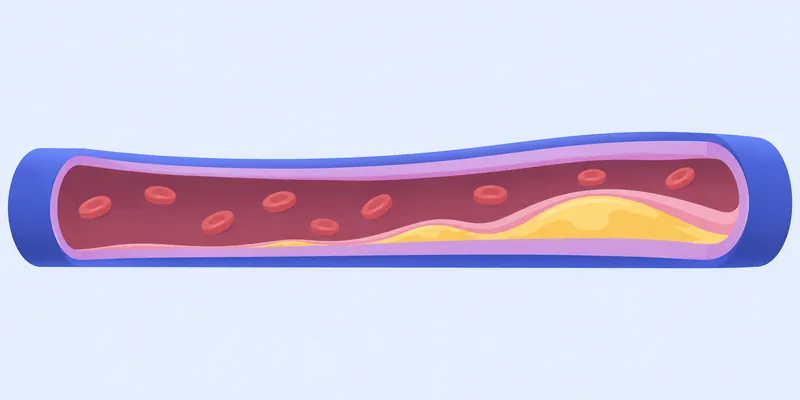
Most people think of cholesterol as a number on a lab report. The group's posts argue for a different picture: LDL cholesterol is a cumulative exposure, much like years of smoking. Plaque in the arteries is built slowly from LDL particles that get trapped in the artery wall, so risk depends on both how high LDL is and how long it stays high. Gokhan Can calls this "cholesterol-years" (or "plaque-years").12
The practical consequence is the slogan "the longer the lower the better". A modest reduction held for decades is argued to protect far more than the same reduction started late, and short randomized trials, which run about five years, understate the full benefit.34 This summary explains where that idea comes from, what the numbers are, where the evidence is thinner than the slogan suggests, and what the group's admins say it means for planning. It is educational, not medical advice; the admins repeatedly say high-risk people should work with a good cardiologist.5
What "cumulative exposure" means
LDL (low-density lipoprotein) is the cholesterol-carrying particle most strongly linked to plaque. Gokhan describes the disease process as LDL particles infiltrating the artery wall and becoming trapped, setting off inflammation, foam cells, fatty streaks and, over decades, complex plaques. He argues this is inherently time- and dose-dependent, and that there appears to be no absolute threshold below which LDL is entirely harmless.1 A companion explainer lists five lines of evidence that LDL is a cause rather than a bystander: oxidized LDL found in human lesions, endothelial dysfunction and inflammation, foam-cell formation, genetics, and the benefit of LDL-lowering therapy.12
Coronary artery disease also unfolds slowly. Gokhan's four-stage overview describes soft plaque beginning as early as childhood or young adulthood, hardening and calcifying later, narrowing the artery until blood flow is limited, and only then causing obvious symptoms, with many people symptom-free through the early stages.13 A video summary he shared describes an NEJM study of 16,000 people without symptoms in which plaque appeared first in the neck and leg arteries in people's 20s, 30s and 40s, before the heart, which is one reason a heart scan can look reassuring while disease is already under way.14 Louis makes a related point about calcium scores: in a Danish registry of 23,759 symptomatic patients, 54% had a calcium score of zero, and he notes that soft plaque precedes calcification by years or decades.15
Measuring "cholesterol-years"
One way researchers express the idea is simply age multiplied by LDL-C, in mg-year/dL. In a cross-sectional study of more than 8,000 people not taking lipid drugs (Yamaji et al., 2024, Journal of Clinical Lipidology), vascular damage appeared in stages: endothelial dysfunction above about 4,000, damage to vascular smooth muscle above about 5,000, and increased carotid wall thickness and plaque at about 6,000 or more. Gokhan's reading is that even moderately raised LDL held for decades can cross these tipping points.16 A related physical clue is a thickened Achilles tendon, which a post describes as a possible reflection of cumulative LDL exposure; in a 2026 study of 1,362 patients who had a stent, 3-year major cardiovascular events were 28.4% with thickening and 17.9% without, though this is an association only.17
What the evidence shows
Cohorts that track people from young adulthood
Gokhan's long summary points to two cohorts. In the Framingham Offspring cohort (Navar-Boggan et al., 2015), people with 11-20 years of hyperlipidemia by age 55 had a later coronary heart disease risk of 16.5%, versus 4.4% with none, and the post says each decade of exposure nearly doubled risk. In CARDIA (Domanski et al., 2020), cumulative LDL from ages 18 to 40 predicted later events, and when the single LDL reading at 40 was put in the same model it lost its predictive power (p=0.42), suggesting a single midlife reading is largely a proxy for the earlier years.1
Mendelian randomization: nature's lifelong trial
Mendelian randomization (MR) uses gene variants that lower or raise LDL from birth as a natural experiment. Because genes are assigned at conception, MR is less prone to reverse causation than ordinary observational studies, though it is still a method with assumptions.18
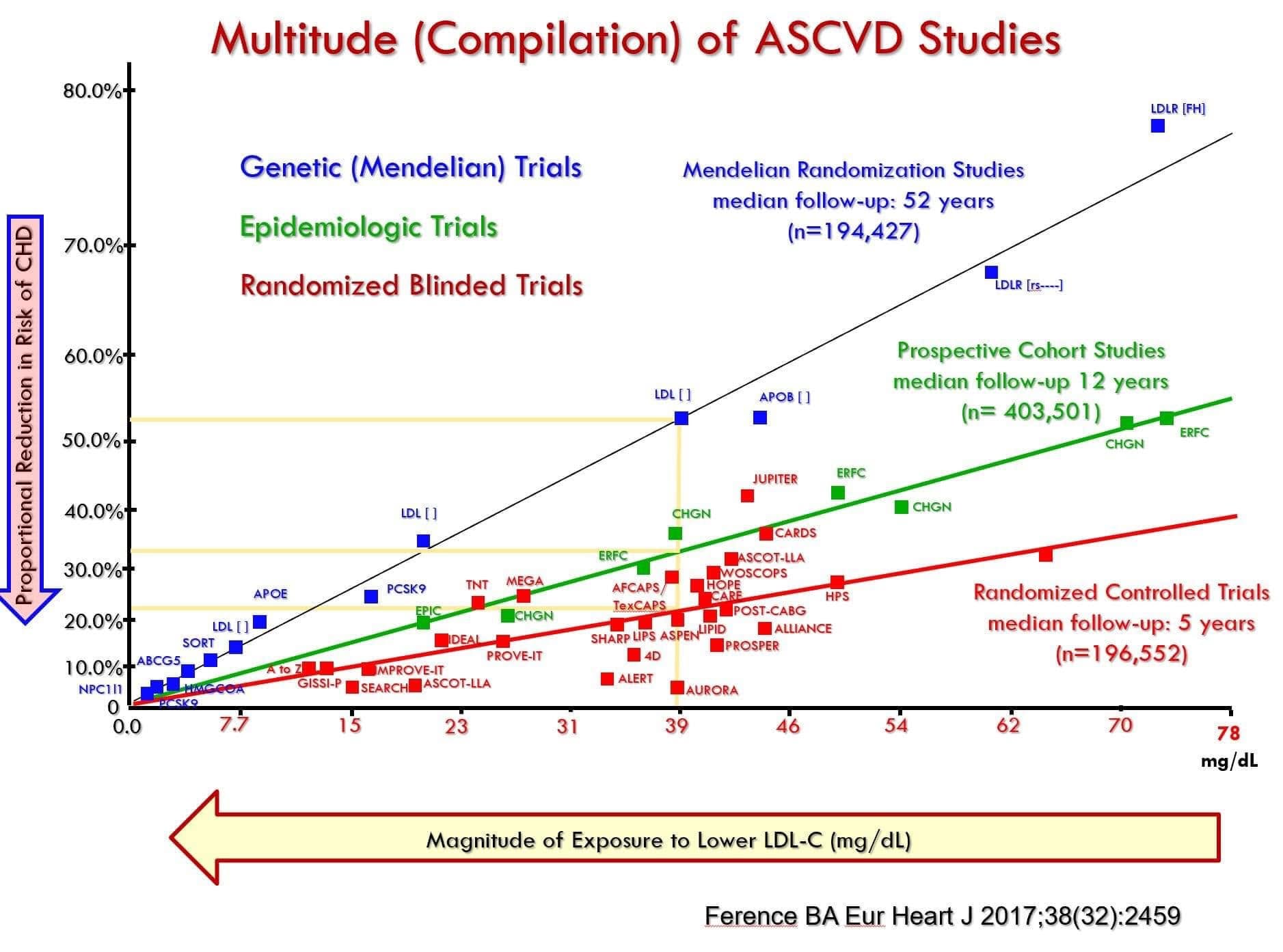
- Ference et al. (2012) is summarized as finding that a lifelong genetically lower LDL of about 39 mg/dL was linked to about 55% lower coronary heart disease risk, roughly three times the benefit per unit of LDL seen in statin trials started in middle age.1
- In PCSK9 loss-of-function carriers (Cohen et al., 2006), 15-28% lower LDL went with 47-88% lower coronary risk.1
- A chart from the European Atherosclerosis Society consensus statement, shared by Louis, shows variants acting through LDLR, PCSK9, APOB, HMGCR, NPC1L1, SORT1 and ABCG5/8; the lower the lifelong LDL, the lower the lifelong risk, and risk tracks the LDL change linearly, as in large randomized trials.19
- A quoted post makes the same point as a log-linear relationship of about 50-55% lower cardiovascular risk per 1 mmol/L (about 39 mg/dL) of lifetime LDL reduction regardless of how LDL is lowered.20
Three time scales on one graph
Louis's central chart combines randomized trials, prospective cohorts and MR studies. Reading off a 39 mg/dL LDL reduction, it shows more than 20% lower heart attack risk at about 5 years (trials), more than 30% at about 12 years (cohorts), and more than 50% at about 52 years (MR). The axes show a change in LDL and a percentage change in risk, not absolute values.821 He describes 18 large randomized trials, each showing that lowering LDL lowers events, with the same straight-line relationship in cohorts and MR studies, and a steeper slope the longer the exposure. He stresses that the trials matter most because they establish causality, but average only about five years.4
A meta-analysis cited by Gokhan gives the compounding in numbers: per 1 mmol/L of LDL-C lowered, the relative reduction in major vascular events was 12% at year 1, 20% at year 3, 23% at year 5 and 29% at year 7 (Circulation: Cardiovascular Quality and Outcomes, 2022).6 The same post cites an MR study (British Journal of Clinical Pharmacology, 2021) estimating that each standard deviation of lifelong lower LDL adds about 1.2 years of expected lifespan, and suggests middle-aged starters may still get somewhat comparable benefit, which is Gokhan's reading rather than a measured result.6 Another MR study of 46 modifiable factors found that genetically higher LDL and total cholesterol, along with higher BMI, blood pressure and type 2 diabetes, were linked to lower odds of reaching age 90 or 99.22
Translating relative risk into absolute risk
Louis often argues that critics quote small absolute numbers from short trials. His reasoning has three steps.
- Short trials start from a small baseline. Over a few years only about 2-5% of people, even higher-risk ones, have a heart attack or stroke, so no intervention can show more than a few percentage points. He says diet and exercise trials show absolute reductions of the same 1-2% size.2324
- Over a lifetime the baseline is much larger. He cites about 20% lifetime heart attack risk for the average American (1 in 5). Statin trials of about 5 years showed absolute reductions of 1.1% to 4.7%.1025
- Benefit accumulates. Taking about half off a 20% lifetime risk means roughly 10%, which he says is what MR and long cohort data imply for sustained use.8 He frames it with the number needed to treat (NNT = 1 divided by absolute risk reduction): a 1% reduction gives an NNT of 100, a 10% reduction an NNT of 10.26
Applying the MR chart, he calculates that a lifelong LDL drop of about 80 mg/dL (about 52 years) is roughly an 80% relative reduction, or from 20% to about 4% (100% - 0.8 x 20%), and that a 90% relative reduction in carriers of certain PCSK9 variants leaves about 2%.1927 Gokhan reads a similar chart for himself: a 70 mg/dL drop sustained for 30 years lands between two of the lines, an estimated 60% lifetime reduction, with very low-dose rosuvastatin as his plan. He notes that effects beyond about 80 mg/dL of lowering are unknown.3
Several of these figures are the admins' own extrapolations, and the posts say so: Louis's lifetime estimate is flagged as an extrapolation and not a trial result.810 He also gives a counterweight on lifespan. Because only about 10% of heart attacks and strokes are fatal and about 1 in 5 US deaths are from them, he calculates that universal statin use would add only days (10-20 over five years) to average lifespan, a population-average back-of-envelope figure.28
Why starting early matters
If exposure accumulates, timing matters in a way the "number today" view hides.
- Modeling study. Gokhan summarized a 2020 Circulation study of early versus delayed primary prevention: for people with non-HDL cholesterol of 160 mg/dL or higher, starting at 40-49 lowered the expected 30-year risk from 17% to 6-12% depending on the model, whereas waiting 10-20 years left 13-15%. He notes that LDL can be lowered by diet and exercise too, and that the study did not quantify harms such as diabetes risk.7
- Lipoprotein(a). Louis shared a UK Biobank analysis (reported by TCTMD, using genetic "natural randomization") in which lifelong high Lp(a) went with a projected 37% higher coronary event risk, completely offset by LDL about 0.5 mmol/L (19 mg/dL) lower at every age. With Lp(a) 150 nmol/L above the median, the LDL reduction needed was 0.6, 0.7, 0.9 and 1.1 mmol/L if started at 30, 40, 50 or 60, and "the later we start" the bigger the drop required.9
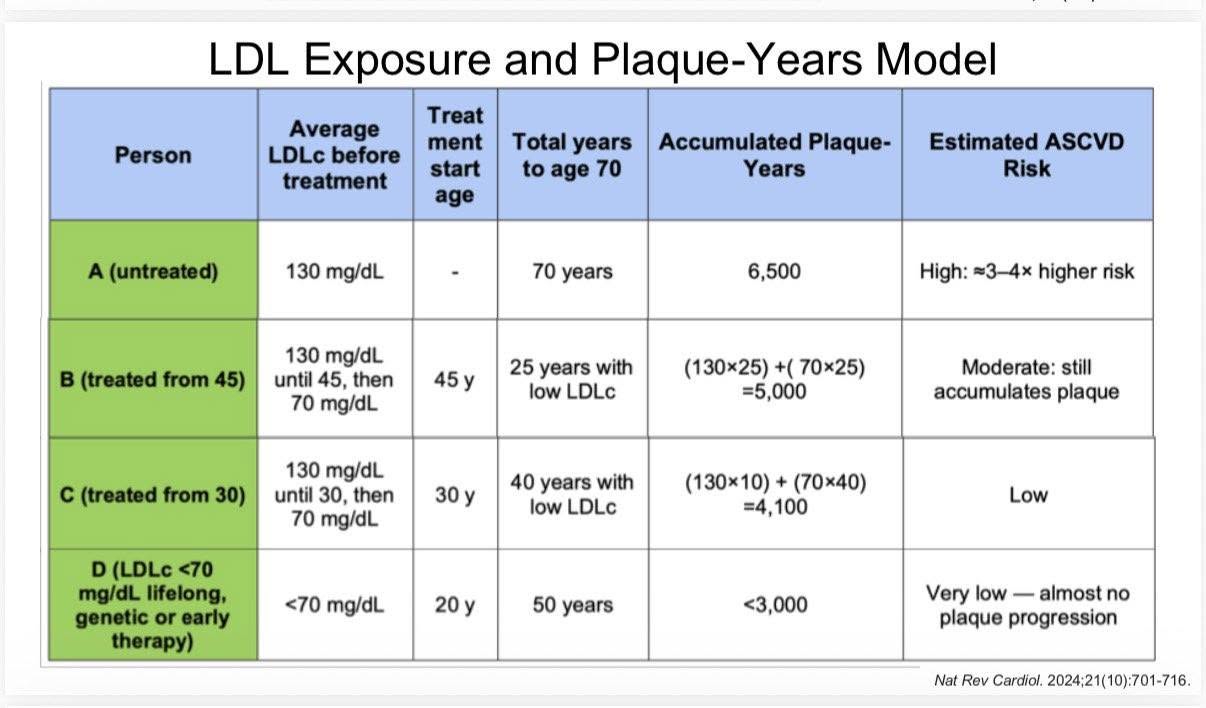
- The "plaque-years" message. An infographic Gokhan reposted says starting at 45 is better than never, but starting at 30 changes the trajectory more, that years of elevated LDL cannot be erased, and that early intervention may matter more than drug strength.2
- Guidelines. Louis's summary of the 2026 ACC/AHA lipid guideline says it stresses earlier intervention through lifestyle and, when recommended, medication, in order to reduce lifetime exposure to unhealthy lipids.29
Beyond the heart: lifelong exposure and the brain
Several posts apply the same logic to dementia, with mixed evidence. A 2025 Alzheimer's and Dementia study of about 1 million people found that variants mimicking statins (HMGCR) and ezetimibe (NPC1L1) were associated with 76% and 82% lower dementia per roughly 40 mg/dL lower non-HDL cholesterol; CETP variants showed 70%, while PCSK9 variants showed no benefit. Louis reasons that short late-life trials cannot show what decades of lower exposure does.1830 A 2024 MR study summarized by Gokhan found that higher ApoB shortens healthspan and, in one analysis, raises Alzheimer's risk, although a replication attenuated toward the null.31 Louis also cites the 2024 Lancet Commission on dementia, which attributes about 7% of cases to untreated high LDL in midlife and 7% to hearing loss, among 14 modifiable factors accounting for nearly half of cases.3233
On the randomized side, Louis notes that the STAREE trial of atorvastatin 40 mg in about 10,000 adults aged 70 and over finished without being stopped early for harm or overwhelming benefit, so he expects results in between; at the time of the posts the results had not been reported.34 A pooled analysis of 23 Cholesterol Treatment Trialists' trials found memory impairment reported at 0.2% per year on both statin and placebo.35
Nuances and common misconceptions
Targets scale with risk
A longer-and-lower message is not a call for the lowest possible number in everyone. Louis shared an NEJM review (2026) whose quoted message is "proportionality, not 'lower for everyone'": focus on absolute risk, identify who benefits meaningfully from drugs, and avoid unnecessary drug treatment in truly low-risk people while emphasising lifestyle.11 The 2026 ACC/AHA summary keeps LDL goals under 100 mg/dL for borderline or intermediate risk, under 70 for high risk and under 55 for very high-risk secondary prevention.29 A 2023 JAHA review summarized by Gokhan gives similar tiers and at least a 50% LDL reduction for high and very high risk.36
Louis argues that low-risk people forcing LDL below 20 with several drugs is unwise, quoting Walter Willett that very low LDL appears to raise hemorrhagic stroke risk, while saying this does not apply to high-risk people for whom the benefit outweighs that risk.37 Gokhan's own estimate flags that the benefit beyond about 80 mg/dL of lowering is unknown.3
"Low cholesterol is dangerous" and U-shaped curves
Observational studies sometimes show higher mortality at low LDL. Louis argues this is reverse causality: cholesterol falls before cancer is diagnosed, statin trials show no increase in cancer, and MR studies averaging about 52 years of exposure show no higher cancer in people with genetically lower cholesterol.38 He makes the same argument for U-shaped curves for BMI, HbA1c and blood pressure39, and notes a 2022 cohort of about 36,500 people where the U-shape between ApoB and mortality became linear after adjusting for illness, bilirubin and malnutrition.40
Real trade-offs
Statins are not free of downsides. The Lancet CTT analysis found almost no excess of listed side effects versus placebo, with a small rise in liver blood test abnormalities (about 0.1%) and a small increase in blood sugar.35 A Gemini-assisted post shared by Louis argues that the small rise in diabetes with intensive lipid lowering (about 9-12% relative increase in high-intensity statin trials) looks target-mediated, since variants mimicking HMGCR and NPC1L1 show modestly higher diabetes risk.41 The MR evidence is also strongest for coronary disease; applying "lifelong" results to someone starting in their 50s is an extrapolation, as the posts acknowledge.39
Another nuance concerns calcium. Gokhan's review argues that statins reduce events and soft plaque but do not slow coronary calcium score progression, and interprets rising calcium as plaque turning into stable scar.42
What this means for you
- Think of LDL as a running total, not a single reading; Gokhan argues that optimal prevention means controlling LDL across a lifetime rather than relying on one late measurement, and notes that early plaque can be silent for decades.114
- Gokhan and Louis describe betting on a very low-dose statin to hold LDL in a lower range for decades; Louis says 10 mg of atorvastatin drops his LDL by about 39 mg/dL. These are personal choices, and the admins recommend discussing treatment with your own doctor.38
- Louis explains his own preference for a statin by the long safety record of statins compared with newer drugs; he describes this as a personal rationale, not a study result.43
- If LDL is not at goal on a statin, a 2025 ESC/EAS graphic Louis shared lists ezetimibe (about 20% LDL-C reduction), bempedoic acid (about 23%), PCSK9 antibodies (about 50-60%) and inclisiran as stepwise add-ons.44
- Diet and exercise count: Louis says their absolute effects over a few years are in the same ballpark as drugs and that the largest benefit comes from combining them over the long term.26
- High Lp(a) is a reason for a more aggressive LDL goal, and the 2026 ACC/AHA summary recommends measuring Lp(a) at least once in adulthood.929
- Scale intensity to risk, using the guideline tiers above and a risk calculator with your clinician.1136
Frequently asked questions
If a statin trial shows only 1-2% absolute benefit, is it worth it?
Louis argues yes, because the trials last only a few years when baseline risk is just 2-5%; he points out that a complete cure of heart disease would also show only a few percent in such a window, and that the benefit grows with time.23
Does a low-dose statin prevent heart attacks entirely?
No. Louis says the best a low-dose statin can do is roughly halve lifetime risk if taken for decades, and that the remaining risk must be tackled with diet, lifestyle and other therapies.21
Is it too late if I am already in my 50s or 60s?
The posts do not say it is too late, but they do say it gets harder: the LDL reduction needed to offset a given risk rises the later treatment starts, and the modeling study found delayed treatment left more remaining risk. Gokhan's view is that middle-aged starters can probably still get somewhat comparable benefit because the worst damage shows in later years, which is his reading rather than a proven figure.679
Is LDL the only thing that matters?
No. Gokhan's summary index points readers to blood pressure, weight and other markers beyond LDL-C, and the group's guideline summaries add Lp(a), apoB and calcium scoring when deciding how intensively to treat.529
Does lowering LDL a lot cause harm?
Posts describe a possible hemorrhagic stroke signal at very low LDL as an unresolved concern for low-risk people, and a small diabetes signal with statins, while the CTT analysis found little excess of other listed symptoms.353741