Just published today in the New England Journal of Medicine:

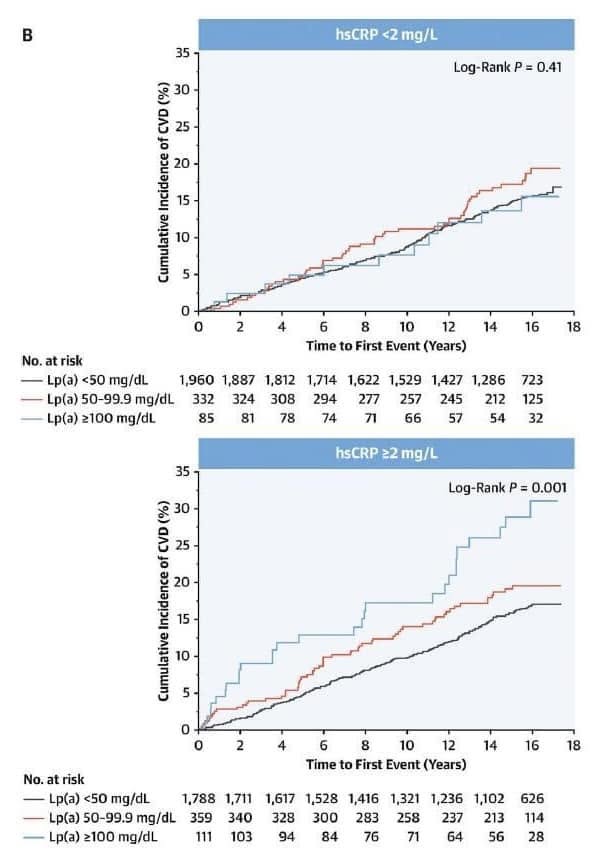
Lp(a), hs-CRP, and LDL all predict risk of a heart attack or stroke over a 30 year period, and a combined measure of all 3 is most accurate.
Being in the top 1/5 for Lp(a) raised 30-year risk by 33%, compared to being in the bottom 1/5.
Being in the top 1/5 for hs-CRP raised 30-year risk by 70%, compared to being in the bottom 1/5 !
Being in the top 1/5 for LDL raised 30-year risk by 36%, compared to being in the bottom 1/5.
Quoted:
RESULTS
The mean age of the participants at baseline was 54.7 years. During the 30-year follow-up, 3662 first major cardiovascular events occurred. Quintiles of increasing baseline levels of high-sensitivity CRP, LDL cholesterol, and lipoprotein(a) all predicted 30-year risks. Covariable-adjusted hazard ratios for the primary end point in a comparison of the top with the bottom quintile were 1.70 (95% confidence interval [CI], 1.52 to 1.90) for high-sensitivity CRP, 1.36 (95% CI, 1.23 to 1.52) for LDL cholesterol, and 1.33 (95% CI, 1.21 to 1.47) for lipoprotein(a). Findings for coronary heart disease and stroke appeared to be consistent with those for the primary end point. Each biomarker showed independent contributions to overall risk. The greatest spread for risk was obtained in models that incorporated all three biomarkers.
CONCLUSIONS
A single combined measure of high-sensitivity CRP, LDL cholesterol, and lipoprotein(a) levels among initially healthy U.S. women was predictive of incident cardiovascular events during a 30-year period. These data support efforts to extend strategies for the primary prevention of atherosclerotic events beyond traditional 10-year estimates of risk. (Funded by the National Institutes of Health; Women’s Health Study ClinicalTrials.gov number, NCT00000479.)
Paper · N Engl J Med · 2024Inflammation, Cholesterol, Lipoprotein(a), and 30-Year Cardiovascular Outcomes in Womennejm.org