Women's heart risk is not simply a smaller version of men's. On average, women develop cardiovascular disease later, but the gap closes with age, and the way a heart attack happens can differ. Menopause sits in the middle of that story: estrogen falls, weight and metabolic markers often shift, and bone loss speeds up. This summary gathers what the group's posts say about each of these changes, and about the big question many women ask, which is whether hormone replacement therapy (HRT, also called menopausal hormone therapy) helps or harms the heart.
The short version in the group's posts is that HRT is neither a miracle nor a poison. Louis Nervegna, one of the admins, describes it as reasonably safe and beneficial for many women, with clear exceptions: women starting long after menopause, women with established heart disease and women with a history of breast cancer12. He is also openly sceptical of the idea that high levels of sex hormones are "anti-aging"3. Most of the evidence in the posts on HRT and the brain is mixed or negative45.
This article is a summary of discussion in a patient and enthusiast community, not medical advice. The group's admins encourage anyone considering HRT to weigh their own risk profile with their doctor.
How women's heart risk differs from men's
The timing gap
A 2026 JAHA analysis shared by Louis found men develop cardiovascular disease about 7 years earlier than women, driven mostly by earlier coronary heart disease. The difference appears as early as age 35 and persists even after adjusting for traditional risk factors. In the CARDIA cohort, blood pressure and glycemia were among the strongest attenuators of the gap, but did not remove it6.
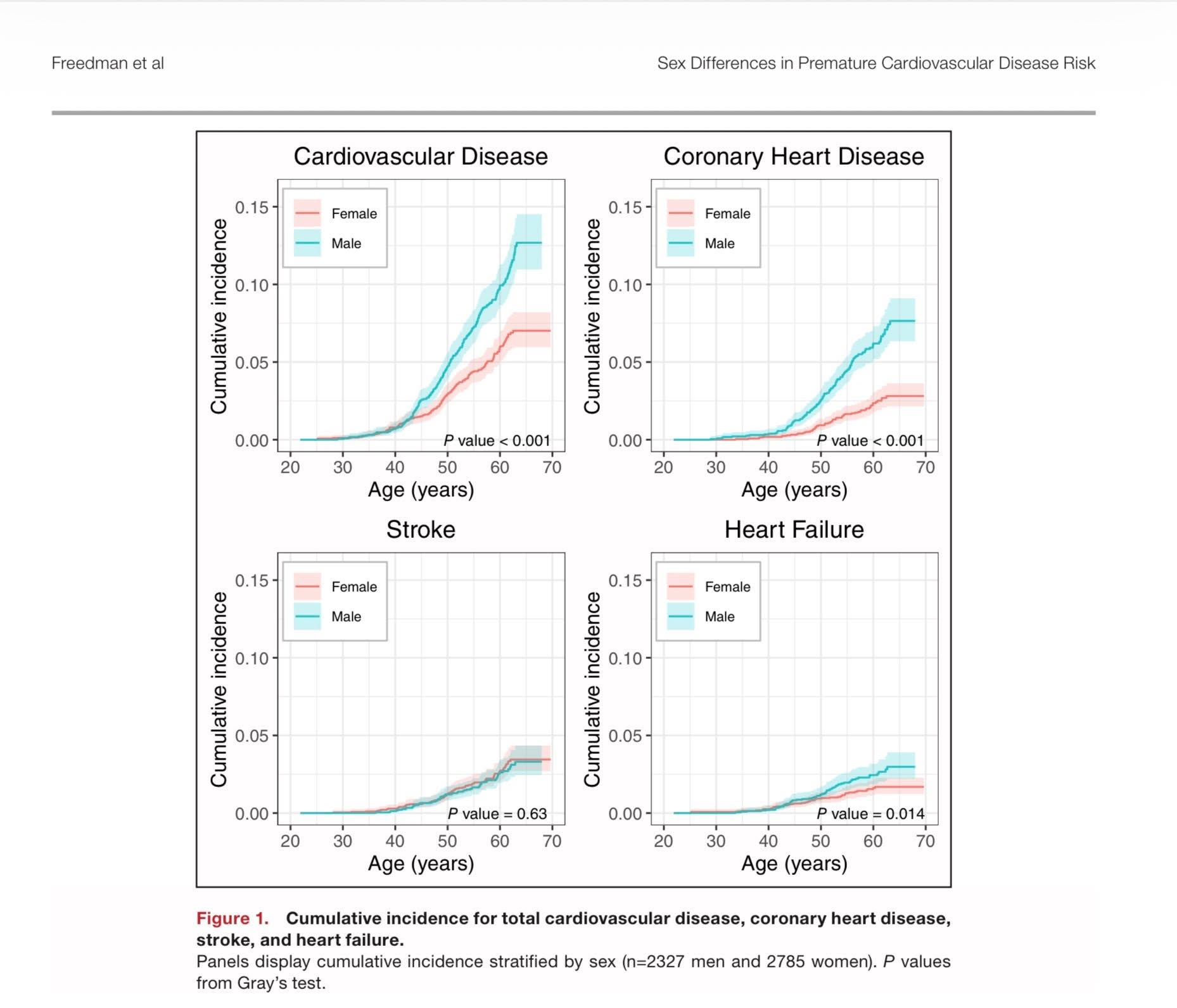
The REACT study in NEJM imaged more than 16,000 adults aged 18-70 without known cardiovascular disease and found plaque in about 57%, rising from 1 in 13 in their 20s to about 9 in 10 in their 60s, with men developing silent disease 5-10 years earlier than women10. Louis uses this to argue that age is by far the biggest risk factor for cardiovascular disease10. In another post he compared hazard ratios from the SCORE O.P. model for people over 65 (using the numbers for women). A hazard ratio of 1.16 per year compounds to about 19.5-fold higher coronary death risk between 65 and 85, compared with 2.3-fold for diabetes and 1.88-fold for smoking11.
Same plaque, different risk?
In a 2026 European Heart Journal Danish cohort of 10,003 asymptomatic adults over 40 who had coronary CT angiography, plaque was less frequent in women at every age: 6% versus 20% at ages 40-44 and 73% versus 92% at ages 75-79. After a median of 6 years, obstructive disease carried a 4.1-fold higher risk of heart attack in women versus 12-fold in men, though the sex interaction was not statistically significant, so the study does not prove that identical plaque is less dangerous in women12.
Show data
| Women | Men | |
|---|---|---|
| Ages 40–44 | 6% | 20% |
| Ages 75–79 | 73% | 92% |
Heart attacks that do not look like the textbook
A Mayo Clinic study reported that more than half of heart attacks in women under 65 had nontraditional causes, such as spontaneous coronary artery dissection (SCAD) and embolism, rather than classic artery-clogging plaque13.
This matters when interpreting calcium scores. In the Western Denmark Heart Registry (23,759 symptomatic patients, median age 58, 55% women), 54% had a coronary artery calcium (CAC) score of zero, and half of those with symptomatic blockages had a zero score. Louis stresses that a CAC of zero is not a clean bill of health when symptoms are present, particularly in young people and women, because soft plaque can exist before it calcifies141516.
Risk markers studied in women
The Women's Health Study analysis in NEJM followed initially healthy women (mean age 54.7) for 30 years and recorded 3,662 first major cardiovascular events. Comparing the top with the bottom fifth, hazard ratios were 1.70 for hs-CRP (a marker of inflammation), 1.36 for LDL cholesterol and 1.33 for lipoprotein(a). Each contributed independently and a combined measure predicted best, supporting prevention strategies that look beyond 10-year risk estimates17.
Other conditions are flagged as possible risk markers. A Nurses' Health Study analysis of 239,907 women found hysterectomy before age 50 increased cardiovascular risk, with a 21% higher risk in those under 46 who did not use estrogen18. An American Heart Association release on a 10-year study of more than 2.7 million US women found uterine fibroids were linked to more than 80% higher long-term heart disease risk, with the strongest link under age 40. That is observational, and the researchers said more work is needed before changing risk guidelines19.
Menopause, ovarian ageing and the heart
Louis argues that the ovaries are the first organ to age in mammals and that slower ovarian ageing tends to track slower overall ageing and a lower risk of age-related diseases including cardiovascular disease2021. He cites early menopause as a risk factor for heart disease in women20. A shared item suggested women who have their last child after age 33 are more than twice as likely to reach 95, though this is a proposed marker rather than proof of cause21. The shared Pharmacy Times piece suggests anti-Mullerian hormone (AMH) as a possible marker of ovarian function20.
A WebMD item Louis shared reported that postmenopausal women may accumulate atherosclerotic plaque faster than men of the same age, apparently related to loss of estrogen, and that statins alone may not be enough to protect them. No numbers were provided in the post22.
Louis adds a counterweight from comparative biology. A Nature analysis of zoo data found that sterilization and contraception extended lifespan by 10-20% across 117 vertebrate species. He cites this as a reason for suspicion that lifetime exposure to high sex hormones is anti-ageing, because reproduction and longevity appear to trade off3. This is an opinion drawn from animal data, not a statement about HRT in women.
Weight, waist and metabolic health around menopause
In a Nurses' Health Study analysis of more than 38,000 women followed for 12 years around menopause, a low-insulinemic dietary pattern and the Planetary Health Diet were most associated with less weight gain. Women with the highest adherence to the Planetary Health Diet had a 54% lower risk of developing obesity. The common features were more nuts, legumes, fruits, vegetables, whole grains, plant protein and unsaturated fats, and less red and processed meat, potatoes and sodium23.
For tracking metabolic health, a post Gokhan Can reshared lists the metabolic syndrome criteria, including HDL below 50 mg/dL and a waist above 35 inches (88 cm) in women, with insulin resistance driven by visceral fat24. Louis points out that in a Swedish study waist circumference beat BMI for obesity-related cancer risk in men but not women. His explanation is that women store more waist fat under the skin, while visceral fat is the dangerous kind25.
Hormone therapy: what the group's posts say
The timing idea and who is considered low risk
The core guidance Louis shared comes from the Cleveland Clinic and an American College of Cardiology working group review. Studies showed an increased risk of cardiovascular disease when HRT is started more than 10 years after menopause, and women who already have significant disease do worse. The review says hormone therapy "may be safe for healthy women aged < 60 years or within 10 years of menopause onset", but in advanced atherosclerosis it may destabilize plaque. Treatment is described as low-risk in women with recent menopause, normal weight and blood pressure, who are physically active and have a 10-year ASCVD risk below 5%. High-risk women with established disease (10-year risk above 10%) should not take HRT or bioidentical HRT (BHRT), nor should women with breast cancer1.
Louis shared a post by Hussein Yassine, who reviewed a case with Howard Hodis, a researcher on how the timing of hormone therapy relative to menopause may decide whether it helps or harms the vessels. The post covers the evidence on HRT and cardiovascular disease, "both positive and negative"4.
The Israeli observational study and a critique
An observational Israeli study of more than 80,000 women aged 50 or older (2000-2022) reported that HRT use was associated with several cancers. HRT offered some cardiovascular benefit when started at 50-65 but raised stroke and cancer risks, and starting at 65 or older significantly raised cancer and cerebrovascular risk26.
Louis then shared Dr Brian Lawenda's critique. The reported increases were far larger in women starting at 50-65 (cancer up 749%, stroke up 1,569%, ischemic heart disease up 817%) than in women starting after 65 (up 122%, 170% and 139%). Lawenda calls this implausible, saying it conflicts with physiology and prior evidence, and argues one observational study should not override decades of better evidence27. Note that these two posts reach opposite emphases: one presents the findings, the other questions them.
Breast cancer
Louis says that, based on randomized trials and prospective cohorts, systemic HRT of any kind is not recommended for women with a history of breast cancer. The quoted Breast Cancer Research Foundation text says a 2021 review found it significantly increased recurrence, especially in hormone receptor-positive disease, and a smaller trial was ended because of unacceptable risk2.
Brain health and dementia
Posts on the brain are cautious:
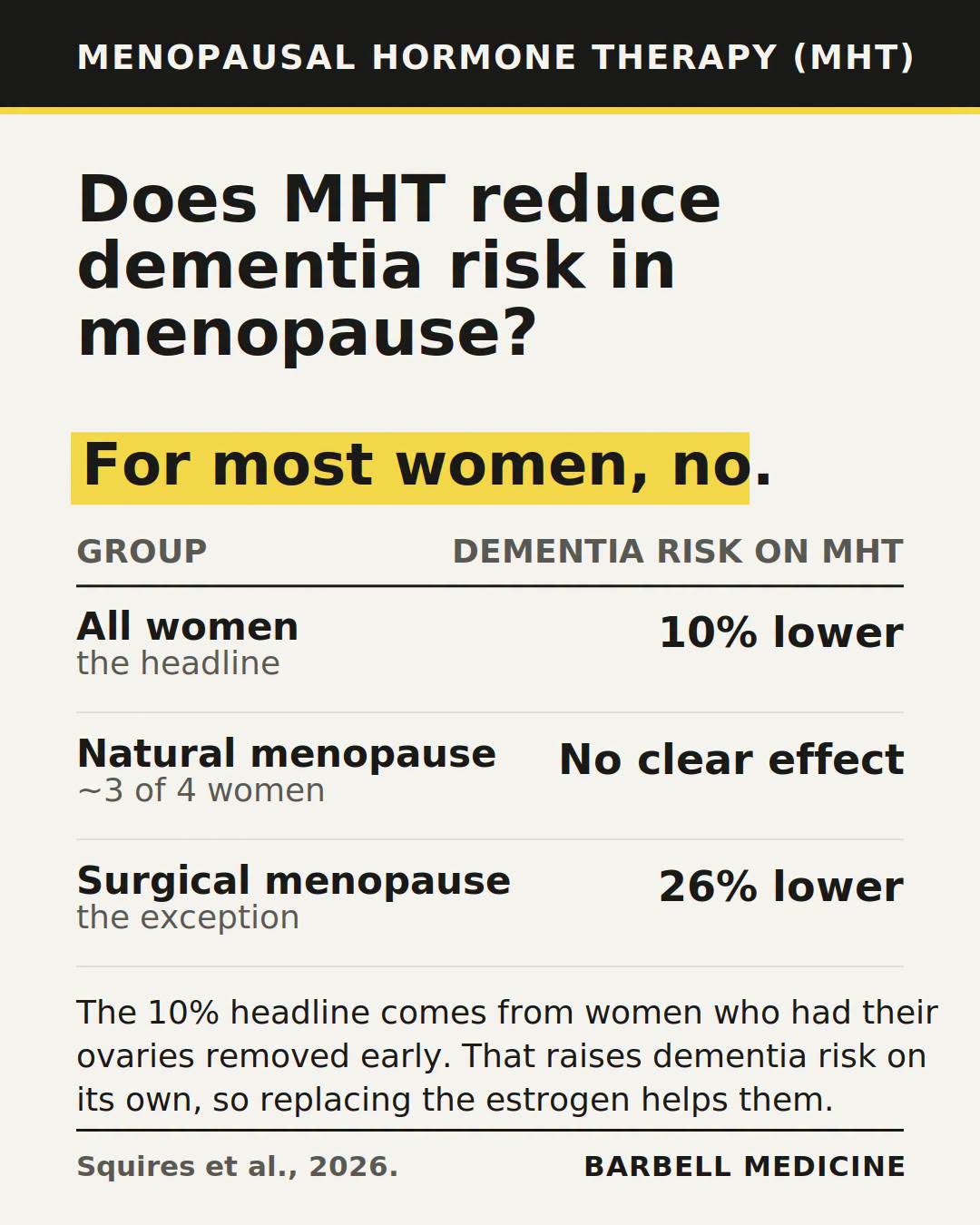
- A shared critique of a study of about 183,000 women said those on hormone therapy had about 10% lower dementia diagnosis, but the effect was mostly absent in the roughly three-quarters with natural menopause and held only in those with surgically removed ovaries. A meta-analysis of 10 studies in over a million women found no reliable effect either way5.
- Louis summarizes that there is currently no strong randomized evidence that HRT reduces dementia risk, and that APOE4 carriers who already have mild cognitive impairment or dementia may face specific risks. HRT's best-supported indications are bone protection and symptom relief4.
- In a cohort of 2,766 women followed up to 25 years, each standard deviation increase in the blood marker p-tau217 tripled dementia risk (7-fold in the top versus bottom quartile). Women with elevated p-tau217 were at even higher risk if on estrogen plus progestin28.
A separate 2025 lipidomics study of 841 adults found women with Alzheimer's had lower omega-3-rich blood lipids, which men did not. The proposed mechanism is that after menopause estrogen no longer boosts the enzyme FADS2 that helps make DHA. The post also cites a review of 58 trials suggesting 1,000-2,500 mg a day of EPA plus DHA as the cognitive "sweet spot"29. This is a cross-sectional study, so cause and effect are not shown.
Muscle
A 2026 meta-analysis of randomized trials (126 studies, 4,019 women) found premenopausal and postmenopausal women gained strength at virtually identical rates (standardised mean differences of 1.50 and 1.46)9. Louis adds that a 2019 JAMA Network Open meta-analysis found HRT alone does not add muscle without resistance training9.
Bone health after menopause
Bone loss accelerates after menopause because of declining estrogen, increasing osteoporosis and fracture risk30. Gokhan Can's checklist for osteopenia and osteoporosis puts weight-bearing exercise first, then discussing hormones with an endocrinologist, then eating 5-10 prunes a day, then having labs reviewed. He warns against starting calcium without medical advice because of heart risk, and considers bisphosphonates if nothing else helps31. These are his personal views.
- Prunes. The Prune Study randomized 235 postmenopausal women (mean age about 62) to no prunes, 50 g or 100 g a day for 12 months. The 50 g group lost significantly less total hip bone density than controls, while 100 g added no benefit and had lower adherence830. An earlier summary reported better bone density maintenance when prunes were combined with calcium and vitamin D than with supplements alone32.
- Zoledronate. In a 10-year NEJM trial of 1,054 women aged 50-60 with normal-to-low-normal bone density, new vertebral fractures occurred in 6.3% (two infusions) and 6.6% (one infusion) versus 11.1% on placebo; the relative risk for two doses versus placebo was 0.56 (95% CI 0.34-0.92)33.
- Bisphosphonates more broadly. Gokhan's review reports alendronate cut vertebral and non-vertebral fractures by about 50% in women with prior vertebral fractures, and yearly zoledronic acid cut vertebral fractures 70% and hip fractures 40%. For the heart, a 2016 meta-analysis of 61 trials found reduced arterial calcification but no effect on cardiovascular events (RR 1.03), and a 2019 meta-analysis of 38 trials found no association with overall mortality (RR 0.98)34.
Heart-protective measures that work in women
- Statins. Louis rebutted the claim that statins are less effective in women. In the Cholesterol Treatment Trialists' meta-analysis of 27 randomized trials (about 174,000 participants), per 1 mmol/L LDL reduction major vascular events fell by rate ratio 0.84 in women and 0.78 in men (heterogeneity p=0.33), and all-cause mortality by 0.91 versus 0.90. There was no adverse effect on cancer incidence, and trials averaged only 4.9 years7.
- Life's Essential 8. In UK Biobank, close adherence to the American Heart Association's eight health behaviours and measures for about 10 years was linked to 66% lower coronary heart disease risk, with larger benefits in women, younger adults and those with low genetic risk35.
- Nuts and diet pattern. Louis shares evidence that nut intake correlates with 30-50% lower cardiovascular risk in cohorts including the Iowa Women's Health Study and Nurses' Health Study, and that in PREDIMED (7,216 people) the nut group halved stroke incidence36.
- Coffee. Harvard's summary quoted by Louis notes that among 83,076 women in the Nurses' Health Study, 4 or more cups a day was associated with 20% lower stroke risk, and 2-3 cups a day with 21% lower heart disease risk in another cohort of 37,514 women, all observational37. Women who drank 1-3 cups of caffeinated coffee in their 50s were also more likely to age healthily38.
- Black cumin. In a trial in postmenopausal women, about 1 g a day of black cumin powder lowered LDL by 27% in two months compared with placebo, and levels crept back a month after stopping3940. This is a small trial and not a replacement for medical therapy.
- Tea and milk. In a 2007 Berlin trial in 16 healthy postmenopausal women, black tea improved flow-mediated dilation but adding skimmed milk (about a tenth of the cup) erased the benefit41.
Show data
| Rate ratio (log scale) | 95% CI | |
|---|---|---|
| Major vascular events, women | 0.84 | – |
| Major vascular events, men | 0.78 | – |
| All-cause mortality, women | 0.91 | – |
| All-cause mortality, men | 0.90 | – |
Protein, frailty and women's needs
Stuart Phillips argues that the muscle-related benefit of protein caps at about 1.6 g per kg a day, and only in people doing resistance training42. In part 2, shared by Louis, Phillips argues the ceiling holds in older adults and that women's requirement to spare lean tissue while losing weight is likely lower43. A Nurses' Health Study analysis in older women linked plant, but not animal or dairy, protein to lower frailty44. In older women with sarcopenia doing 12 weeks of resistance band training, adding vitamin C (1,000 mg) plus vitamin E (335 mg) produced larger gains in muscle and strength with lower IL-645.
Other women's health topics
- PCOS. In a 12-week trial of 30 obese women with polycystic ovary syndrome, only acarbose significantly lowered liver fat, triglycerides and free fatty acids, compared with metformin or a lower-calorie diet46.
- Pregnancy. Two Harvard studies found metformin taken by men or by women trying to conceive was not linked to higher birth defect risk47.
- Magnesium. A summary Gokhan shared gives an adult women's recommended intake of 310-320 mg a day (360 mg if pregnant) and notes that nearly 45% of the US population has inadequate intake48.
What this means for you
- Know your numbers rather than relying on sex-based reassurance. Both the Women's Health Study biomarkers and the CAC data suggest low-risk labels can mislead1417.
- If considering HRT, the group's admins recommend discussing timing and personal risk with your doctor. The posts point to starting within 10 years of menopause or under 60, avoiding it with established cardiovascular disease or breast cancer, and not expecting it to prevent dementia or add muscle1259.
- Do not avoid statins on the grounds that they work less well in women; the pooled trial data show similar proportional benefit7.
- Lift weights: strength gains after menopause match those before it9.
- For bones, weight-bearing exercise, prunes (50 g a day in the trial) and a medical review are the group's first steps831.
- Talk to your doctor before starting calcium supplements31.
Frequently asked questions
Does menopause raise heart disease risk?
Louis cites early menopause as a risk factor and links slower ovarian ageing with slower overall ageing2021. A study he shared reported faster plaque accumulation in postmenopausal women than in men of the same age22. The posts do not quantify a menopause-specific effect.
Is HRT safe for the heart?
For healthy women under 60 or within 10 years of menopause, guidance he shared says it can be reasonably safe, but it is not advised with established cardiovascular disease1. Observational data are conflicting and contested2627.
Can HRT prevent dementia?
Not on current randomized evidence, according to the posts45.
Do women need a different cholesterol approach?
Statin trial data show comparable proportional benefit in women and men7.
Can I rely on a zero calcium score?
Not if you have symptoms. Half of symptomatic patients with blockages in the Danish registry had a zero score1415.