HD-OPM Archive
Hashtags

#crp

24 posts

Colchicine 0.5 mg cut plaque volume by over 1% in one year on CT angiography (Budoff)

May 11, 2025 · Louis Nervegna ♥ 20 · 💬 37 ↩ 9 Plaque, CAC & CT angiography

Louis highlights a Budoff-led CCTA trial in which low-dose colchicine reduced percent atheroma volume by over 1% in a year, with lower CRP and a slowing of calcified plaque. He contrasts this with the Keto-CTA study, where PAV rose 0.8% on a keto diet. Budoff notes it was a small study but supports colchicine in chronic stable coronary disease.
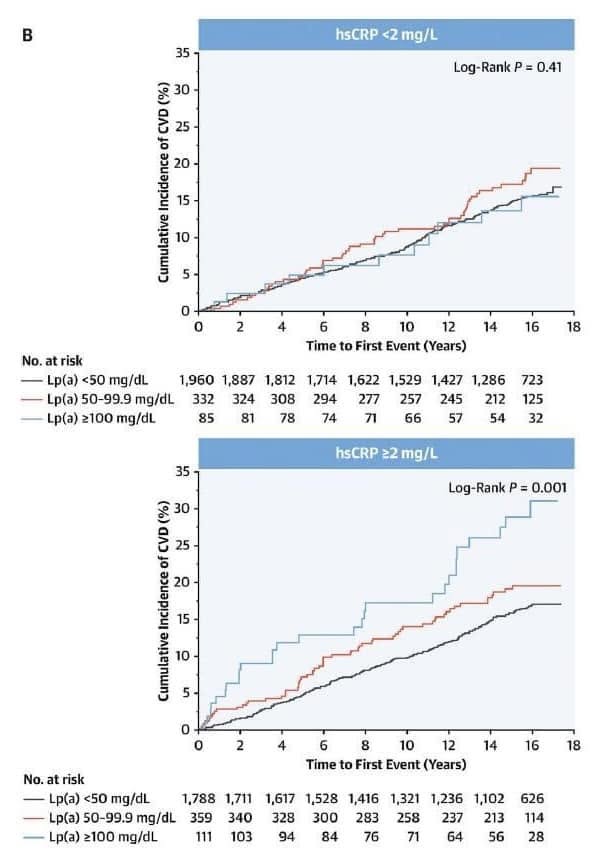
MESA: high Lp(a) raised CVD risk only when hsCRP was 2 mg/L or higher

Jul 12, 2024 · Louis Nervegna ♥ 16 · 💬 12 ↩ 4 Lp(a)

In MESA (mean follow-up 13.6 years, 684 CVD events), high Lp(a) conferred no significant risk when hsCRP was below 2 mg/L. With hsCRP of at least 2, Lp(a) of 50-99.9 mg/dL had HR 1.36 and 100 or more had HR 2.09. Participants were lower-risk, averaged age 62, so applicability to others is unclear.

NEJM: hs-CRP, LDL and Lp(a) each predicted 30-year CVD risk in women, best combined

Aug 31, 2024 · Louis Nervegna ♥ 8 · 💬 14 Risk assessment & lab tests

Louis highlights a NEJM Women's Health Study analysis of initially healthy women followed 30 years with 3,662 first major cardiovascular events. Top versus bottom quintile hazard ratios were 1.70 for hs-CRP, 1.36 for LDL and 1.33 for Lp(a), each independent, with the combination predicting best. The authors argue prevention should extend beyond 10-year risk estimates.

What CRP and hs-CRP actually measure, and why a single reading is unreliable

Oct 27, 2025 · Louis Nervegna ♥ 11 · 💬 5 Inflammation & CRP

Louis clarifies that CRP and hs-CRP are the same marker, with hs-CRP simply more sensitive for the low levels relevant to heart disease. Both reflect inflammation anywhere in the body, spike temporarily with infections, vaccination, injury, surgery or intense exercise, and fluctuate day to day, so the aim is to capture the quiet background level and not rely on one test.