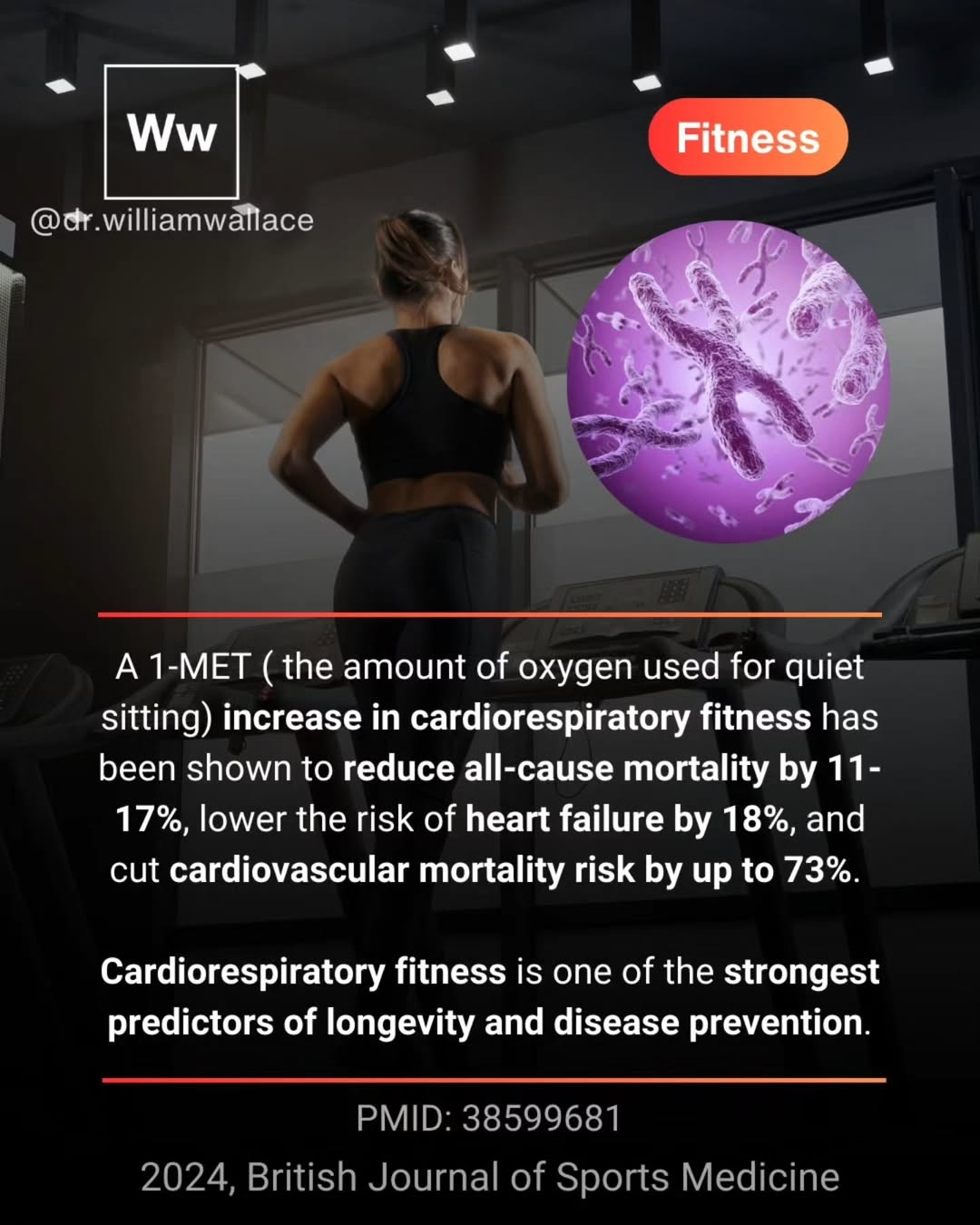
Cardiorespiratory fitness is associated with decreased cardiovascular mortality.
(Lots of potential risk for reverse causality here, but some of the causality is almost certainly in the forward direction.)
Louis shares a meta-analysis (PMID 38599681) showing higher cardiorespiratory fitness tracks with lower mortality in a dose-dependent way, while noting reverse causality is possible. A 1-MET increase was associated with large reductions in heart failure and cardiovascular mortality.
Cardiorespiratory fitness is associated with decreased cardiovascular mortality.
(Lots of potential risk for reverse causality here, but some of the causality is almost certainly in the forward direction.)
A Meta-Analysis (PMID: 38599681) of 20.9 million observations finds that better cardiorespiratory fitness may slash death from any kind by close to 20%
The Metabolic Equivalent of Task (“MET”) is a standardized physiological measure representing the rate of energy expenditure relative to resting metabolic rate. 1 MET = 3.5 mL O₂/kg/min, corresponding to the oxygen consumption at rest.
A recent studtThe study found that every 1-MET Increase = 11-17% Reduction in All-Cause Mortality. It suggests that incremental gains in cardiorespiratory fitness confer a dose-dependent reduction in mortality risk.
In addition, A 1-MET elevation in cardiorespiratory fitness is associated with an 18% decrease in heart failure incidence and up to a 73% reduction in cardiovascular mortality.
🟩 To help put it in perspective:
- 1 MET: Resting state (sedentary behavior).
- 3 METs: Moderate-intensity activity (e.g., brisk walking).
- 6+ METs: Vigorous-intensity exercise (e.g., high-speed treadmill running).

A study of 5,416 US women aged 63-97 without prior heart disease, using accelerometers, links more time spent on housework, gardening, cooking and self-care with lower cardiovascular risk. Louis notes that reverse causality is likely but that avoiding sedentary time probably lowers risk.

An AHA story about Jason Shaw, 39, who ran seven marathons and kept exercising through chest tightness before a heart attack. It illustrates that exercise does not rule out heart attack and symptoms should not be ignored.
Summarises a Rhonda Patrick video: moderate exercise is ineffective for many, so vigorous HIIT such as the Norwegian 4x4 (four 4-minute efforts at about 80-90% max heart rate with 4-minute recovery) improves VO2 max. She cites a two-year study that reversed about 20 years of cardiac aging in sedentary 50-year-olds, and exercise reducing glycation-driven heart stiffness (Asif et al., PNAS 2000).
Louis points to prior posts collating randomized trials showing plaque regression with statins, ezetimibe, PCSK9 inhibitors, colchicine and high-dose EPA. Tags reference trials such as ASTEROID, GLAGOV, PACMAN-AMI, EVAPORATE and LODESTAR. The post itself is mainly a pointer to those earlier posts.
Describes the 20-year follow-up of the West of Scotland Coronary Prevention Study: 5 years of pravastatin in middle-aged men with high cholesterol and no prior CHD produced a lasting legacy effect, with reduced all-cause, CV and coronary mortality and fewer heart failure and MI hospitalizations. No excess cancer or non-CV mortality was seen.
A summary of observational research finding that oatmeal two or more times a week was linked to about 21% lower coronary heart disease risk versus under once a month, with whole oat intake linked to lower all-cause mortality. The authors note these studies cannot prove cause because oat eaters may differ in other habits.