The Long-Term Trajectory of Coronary Artery Calcium Under Statin Therapy
Executive Summary
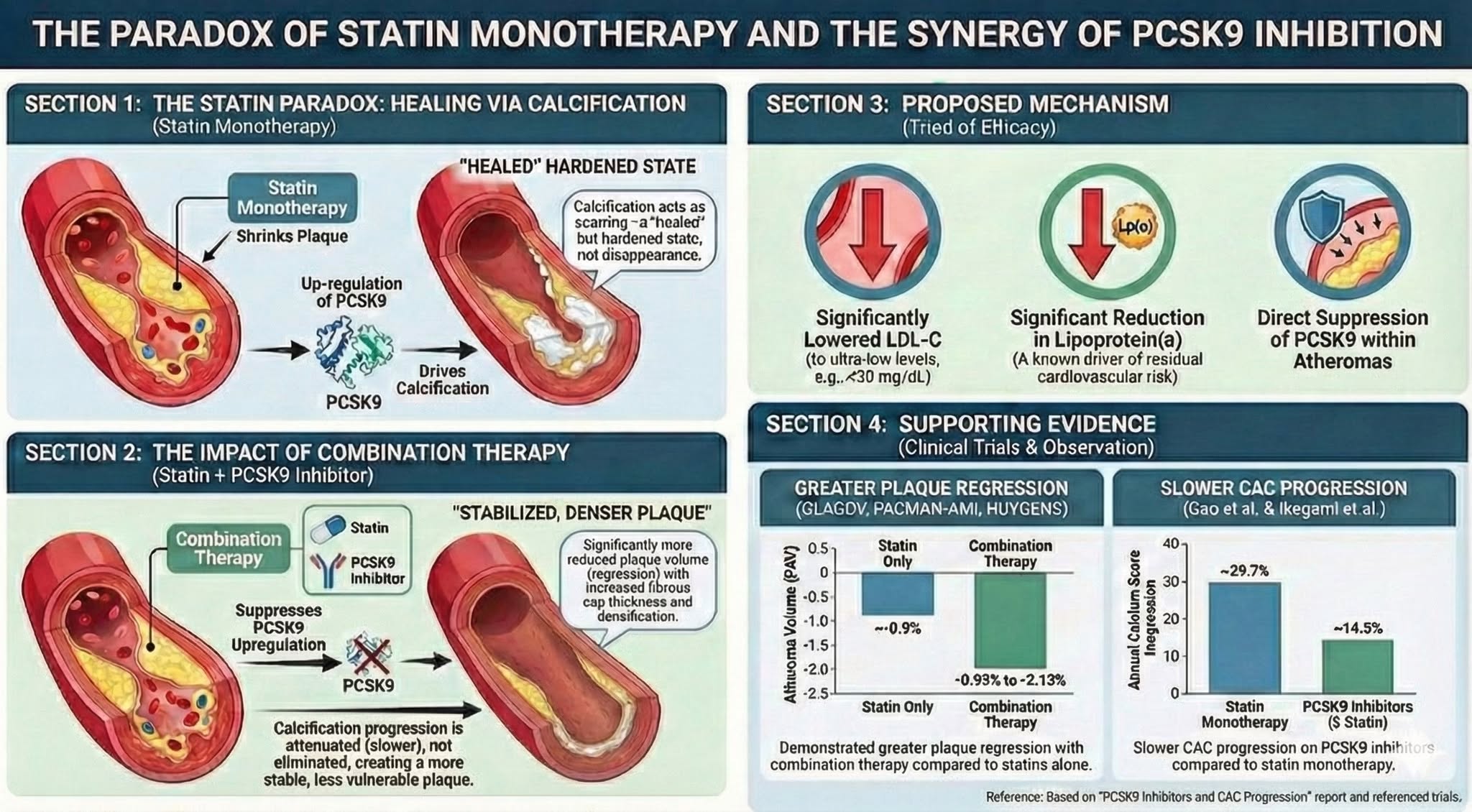
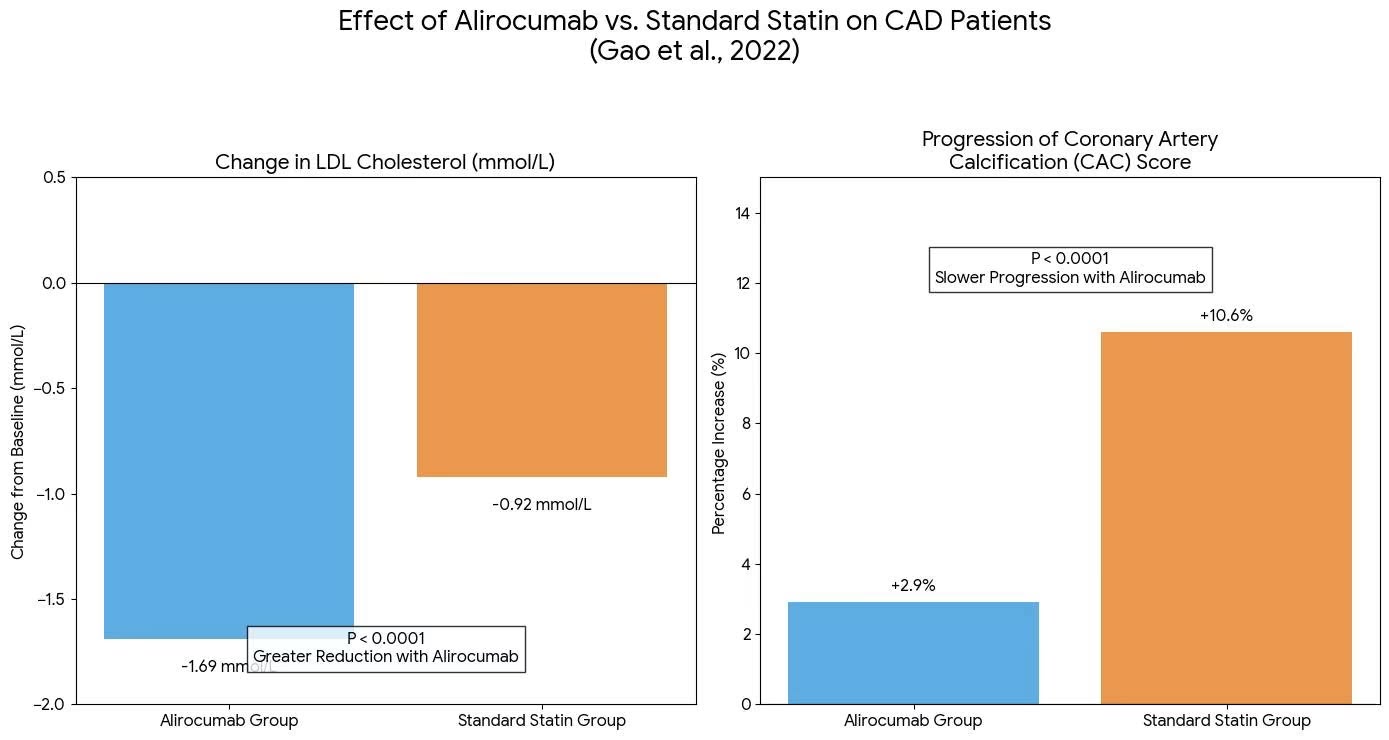
The relationship between HMG-CoA reductase inhibitors (statins) and Coronary Artery Calcium (CAC) represents one of the most distinct paradoxes in cardiovascular medicine. While statins are unequivocally proven to reduce major adverse cardiovascular events (MACE) and induce the regression of soft atherosclerotic plaque volume, they do not slow the progression of the Agatston calcium score.
On the contrary, the weight of evidence—ranging from short-term Randomized Controlled Trials (RCTs) to observational cohorts spanning over a decade—indicates that statin therapy accelerates the calcification of coronary arteries. This acceleration continues indefinitely over the very long term (>= 10 years) without plateauing. However, this phenomenon is now understood not as a failure of therapy, but as a mechanism of plaque repair and stabilization, transforming high-risk vulnerable plaque into inert calcified scar tissue.
I. The Clinical Evidence: From RCTs to Decade-Long Cohorts
1. Short-to-Intermediate Term (1–5 Years): The Failure to Slow CAC
Early hypotheses suggested that because statins lower LDL-C and reduce inflammation, they would arrest calcium accumulation. RCTs consistently disproved this.
- St. Francis Heart Trial (4 years): Despite significant LDL reduction with Atorvastatin 20 mg, there was no reduction in CAC progression compared to placebo. However, clinical events were reduced by 33%, creating the first major divergence between biomarker progression and clinical outcome.
- SALTIRE Trial (2 years): Aggressive lipid lowering with Atorvastatin 80 mg reduced LDL by ~53%. Yet, the annual CAC progression rate was numerically higher in the statin group (26%) compared to the placebo group (18%). The study concluded that even intensive therapy has no major effect on slowing calcification rates.
- BELLES Trial (1 year): Compared high-intensity (Atorvastatin 80 mg) vs. moderate-intensity (Pravastatin 40 mg) therapy.2 Both arms showed similar progression rates (~ 11-14%), indicating that increasing statin intensity does not blunt calcification.
2. Very Long-Term Data (>= 10 Years): No Plateau in Sight
The user specifically inquired about the "very long term." Data from the Veterans Affairs (VA) healthcare system and the Multi-Ethnic Study of Atherosclerosis (MESA) provide the most granular view of this timeframe. These studies demonstrate that the acceleration of CAC is a continuous, cumulative process.
The VA Cohort Analysis:
In a large retrospective study of high-risk patients, researchers stratified CAC severity by the duration of statin use.3 The data reveals a clear dose-response relationship between the years of statin therapy and the odds of developing severe calcification.4
Duration of Statin Therapy
Adjusted Odds Ratio for Severe CAC
Statistical Significance
0 – 5 Years
1.49 (95% CI: 1.16 – 1.92)
p = 0.002
5 – 10 Years
2.38 (95% CI: 1.70 – 3.35)
p < 0.001
> 10 Years
4.48 (95% CI: 2.70 – 7.43)
p < 0.001
This table illustrates that calcification does not plateau. If statins eventually halted progression, the Odds Ratio (OR) would stabilize. Instead, the OR nearly doubles between the 5-10 year window and the >10 year window. This suggests that as long as statin therapy is maintained, the remodeling of the arterial wall toward calcification persists.
II. Mechanisms: Why Statins Increase Calcium
The increase in CAC score is driven by a biological shift in plaque phenotype, often described as "defatting" the plaque.
1. Plaque Stabilization (The Healing Process)
A "vulnerable" plaque is characterized by a large, lipid-rich necrotic core and a thin fibrous cap.5 Rupture of this cap leads to thrombosis and myocardial infarction.
- Lipid Depletion: Statins aggressively lower intra-plaque LDL and inflammation. As the lipid core is resorbed (regression of soft plaque), the space is replaced by fibrosis and calcium.
- Scar Formation: Calcification in this context is analogous to a scar forming over a healed wound. By increasing the density of the plaque, statins mechanically stabilize it, making it resistant to rupture.
- PARADIGM Registry Data: Serial Coronary CT Angiography (CCTA) has shown that while statin users have higher calcified plaque volumes (9.0 mm^3 annual increase vs 3.3 mm^3 in non-users), they have significantly slower progression of non-calcified (dangerous) plaque.
2. Cellular Pathways
Statins exert pleiotropic effects on Vascular Smooth Muscle Cells (VSMCs) and macrophages:6
- Osteoblast Differentiation: Statins may promote the differentiation of VSMCs into osteoblast-like cells, which actively lay down calcium matrix.
- Inhibition of Rac1: By inhibiting the prenylation of the Rac1 protein (a small GTPase), statins may remove a natural suppression mechanism on calcification, allowing mineralization to proceed.7
- Apoptosis: High-dose statins can induce VSMC apoptosis; the resulting cellular debris serves as nucleation sites for calcium crystallization (microcalcifications) which eventually coalesce into macrocalcifications.
III. The Density Artifact and Risk Attenuation
A critical component of this report is understanding how the CAC score (Agatston score) is calculated, as this explains why the score rises even if the plaque burden stabilizes.
1. The Agatston Scoring Artifact
The Agatston score is weighted by density.8 It uses a stepwise multiplier based on Hounsfield Units (HU):
- 130–199 HU: Multiplier = 19
- 200–299 HU: Multiplier = 210
- 300–399 HU: Multiplier = 311
- >= 400 HU: Multiplier = 4
If statin therapy increases the density of a plaque from 390 HU to 410 HU (making it safer and harder), the Agatston multiplier jumps from 3 to 4. This results in a 33% increase in the calculated score solely due to densification, even if the plaque volume did not grow.
2. The "Statin Interaction" on Risk
Because statin-induced calcium is denser and more stable, a high CAC score in a statin user does not carry the same risk as a high CAC score in a statin-naive patient.
- Risk Dissociation: In the CAC Consortium analysis (12N=28,025), researchers found a significant negative interaction between statin use and CAC score for predicting mortality (13p=0.025).14
- The Flatter Curve: While higher CAC still correlates with risk, the curve is flattened. A statin user with a CAC of 1000 has a significantly better prognosis than a non-user with a CAC of 1000, because the former represents stable scar tissue and the latter represents active, exploding disease.
IV. Subgroup Variations
While the trend of "inevitable progression" holds true generally, baseline factors influence the rate (velocity) of this progression.
- Baseline Burden: "Calcium begets calcium." Patients with high baseline scores (e.g., CAC >300) experience the most rapid absolute increases. The PARADIGM registry confirmed that statins accelerate this process specifically in those with existing plaque.
- Diabetes and CKD: These conditions are characterized by aggressive metabolic calcification. In these high-risk groups, statins do not mitigate the rapid accumulation of calcium. Studies in Type 2 diabetics have shown "more frequent statin use associated with accelerated progression," likely because statin users survive long enough to develop extensive calcification, whereas non-users succumb to events earlier.
- Gender: Men typically show faster CAC progression than women.15 However, the effect of statins is consistent: both sexes experience plaque stabilization via calcification.
V. Clinical Implications and Guidelines
The consensus among major cardiology bodies (ACC, AHA, SCCT) is that the dissociation between CAC progression and risk renders serial testing obsolete for treated patients.
1. The "One-Way Ticket"
The 2018 ACC/AHA Guidelines classify serial CAC testing as Class III (No Benefit).
- Rationale: Since successful statin therapy is expected to increase the score (via healing/calcification), a rising score creates confusion. Clinicians cannot distinguish between "malignant" progression (new disease) and "benign" progression (plaque hardening) using a standard CAC scan.
- Management: A rising score in a patient on optimal medical therapy should not trigger a change in management. There is no therapy "higher" than high-intensity statins + ezetimibe/PCSK9 inhibitors, which are prescribed based on LDL targets, not calcium scores.
2. The Athlete Analog
The "Statin Paradox" is mirrored in the "Athlete's Paradox." Long-term endurance athletes frequently have very high CAC scores (>= 300) due to hemodynamic stress and repair, yet they have low event rates. In both statin users and athletes, the calcium represents a stable phenotype.
Conclusion
To answer the user's inquiry directly: Statins do not slow the long-term progression of coronary artery calcium.
Evidence from over two decades of research confirms that statin therapy is associated with a continuous, time-dependent increase in CAC scores that extends well beyond the 10-year mark. This acceleration is mechanistically linked to the transformation of lipid-rich, rupture-prone plaques into dense, calcified, and stable lesions.
While the numeric score rises, the biological risk falls. This decoupling of biomarker (CAC) and outcome (events) underscores that in the context of statin therapy, calcium progression is a marker of therapeutic success—a scar formed over a healed arterial wound—rather than a sign of treatment failure. Consequently, current medical consensus advises against using serial CAC scans to monitor statin efficacy, as the results are confounded by this reparative calcification process.
Detailed references:
docs.google.comGoogle Docdocs.google.comPS: This is a Gemini 3.0 generated summary, which is faithful to the original research as best as I can tell.