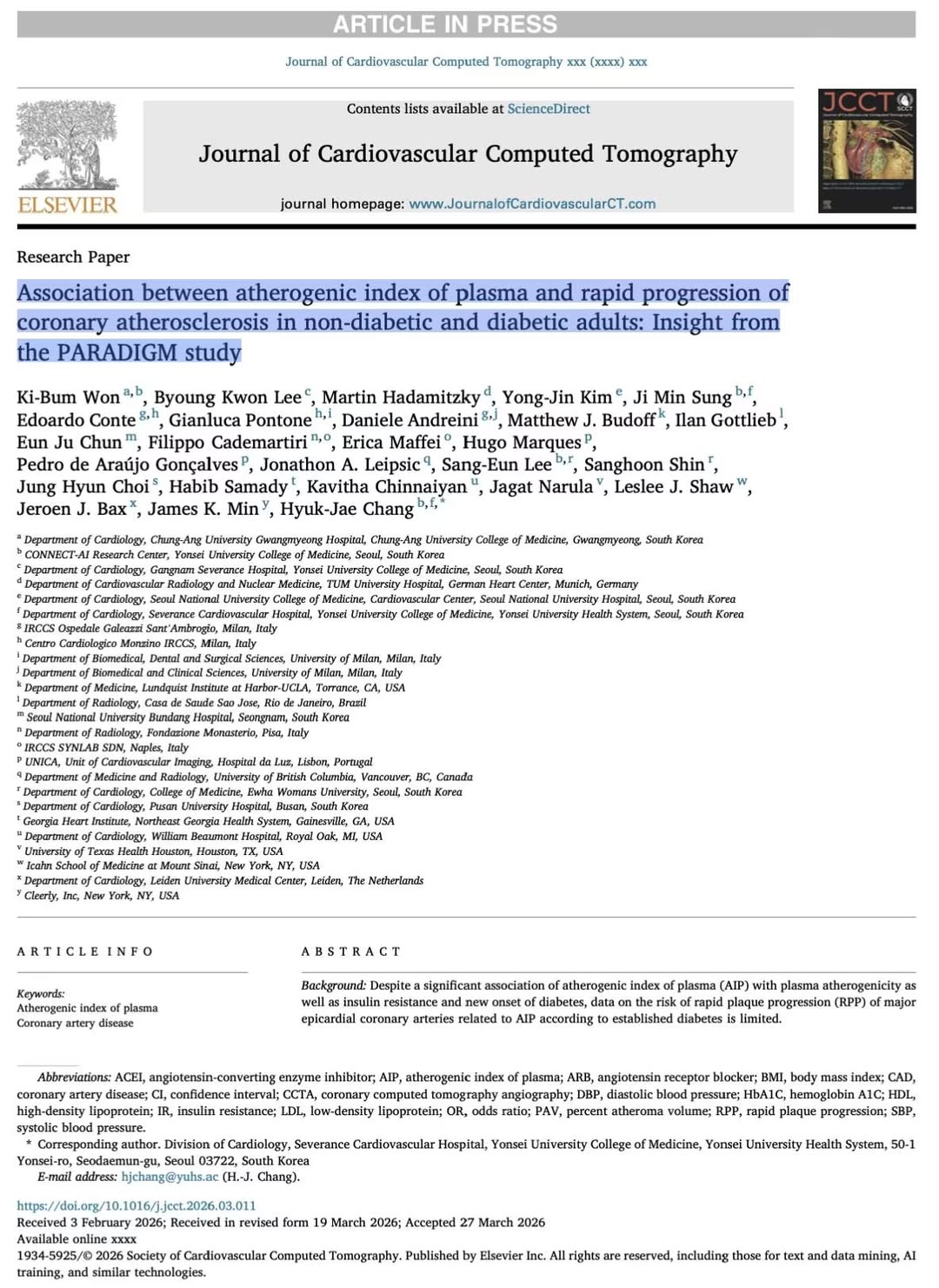
The ratio of triglycerides to HDL is associated with the rate at which plaque progresses in non-diabetics.
These results come from the PARADIGM study.
Link to journal paper:
“Association between atherogenic index of plasma and rapid progression of coronary atherosclerosis in non-diabetic and diabetic adults: Insight from the PARADIGM study” (JCCT, Apr. 2026)
journalofcardiovascularct.comLink to journalofcardiovascularct.comjournalofcardiovascularct.comTechnically, they used a marker called AIP, which is the base 10 logarithm of TG/HDL:
AIP = log10(TG/HDL)
See comments for more details. The acronym AIP stands for Atherogenic Index of Plasma.
Quoted from the journal paper:
“During a median follow-up of 3.4 years, the incidence of RPP [Rapid Plaque Progression] was 26.1%. Compared with non-diabetic subjects, diabetic subjects exhibited significantly higher AIP levels, larger baseline plaque burden, and higher RPP incidence. After adjusting for age, sex, hypertension, overweight or obesity, current smoking, low-density lipoprotein cholesterol and creatinine levels, baseline total PAV, and the use of aspirin, beta-blockers, angiotensin-converting enzyme inhibitors or angiotensin receptor blockers, or statins, AIP (per 0.1-unit increase) was associated with the risk of RPP in non-diabetic subjects (odds ratio [OR] 1.07, 95% confidence interval [CI] 1.01−1.13; p < 0.05) but not in diabetic subjects (OR 1.04, 95% CI 0.95−1.14; p = 0.430).”
“AIP is independently associated with the risk of RPP [Rapid Plaque Progression] in the absence of established diabetes. This finding suggests that AIP may be an effective biomarker for predicting RPP in the population of non-diabetic adults.”
My note:
This is only an association. AIP and TG/HDL can be used to help assess risk, but they are likely not causal in and of themselves. They act as a crude proxy for insulin sensitivity and metabolic health (which are causal), both of which can be measured more accurately by other tests (such as an OGTT with insulin). The best way to improve AIP and TG/HDL is to lose visceral fat and clear the liver and pancreas of ectopic fat. See this post on the subject: ↪ Triglycerides and TG/HDL as markers of insulin resistance and visceral fat.
Higher AIP and TG/HDL do predict smaller LDL particle size, but smaller particle size loses its ability to determine risk once total number of particles is properly accounted for (e.g. by measuring ApoB). See this post: ↪ LDL particle size adds nothing once LDL-P or ApoB is known. In other words, what higher AIP and TG/HDL is really doing when acting as a marker for small particle size is that they are predicting higher ApoB overall.
#tghdlratioHD #paradigmHD #aipHD #plaqueHD #triglyceridesHD #hdlHD #liverfatHD