Vitamin D, vitamin K2 and magnesium are often grouped together because they are popular, inexpensive and all linked to bone, calcium handling and the arteries. The group's posts show a gap between the biological theory and the outcome data. Vitamin D has produced mixed trial results, with its best-supported signal in autoimmune disease rather than heart disease.12 Vitamin K2 slows the rise in coronary calcium in several trials, but calcium score is a surrogate marker and no trial shows it prevents heart attacks.34 Magnesium has modest effects on blood pressure and heart failure risk, and its form-by-form marketing is largely unsupported.567
The admins hold a consistent stance: these are reasonable supplements with limited, specific benefits. Louis Nervegna writes that he takes vitamin D, but that it is "definitely not the panacea that influencers make it out to be".2 Gokhan Can says nobody in the group would be against K2, but that expectations should stay grounded in what the evidence supports.4
This article explains each nutrient, what the trials found, where the debates are, and how members approach doses. It summarizes what was posted in the group and is not medical advice.
Vitamin D
Why it matters and who is low
Vitamin D is converted in the body into a steroid hormone. In a summary of a Rhonda Patrick keynote, it is said to influence over 5% of protein-coding genes, and about 70% of people have blood levels at or below 30 ng/mL, because of sunscreen, melanin, northern latitudes, age-related decline in skin synthesis and indoor lifestyles.8 Another post says about half the global population is insufficient.11 The same summary suggests an optimal range of 40-60 ng/mL based on mortality data, and 4,000 IU/day as generally safe and effective for most people, with testing because individual response varies.8
Louis also notes that magnesium is required for vitamin D production and use, and suggests low magnesium intake can contribute to chronically low vitamin D even with regular sun; the post gives no source.12
Dosing: form, baseline and body weight
- D3 versus D2. A FoundMyFitness-based post says vitamin D2 supplementation can lower circulating 25(OH)D by about 18 nmol/L (7 ng/mL) because D2 enhances the breakdown of D3, and that D3 raises serum levels 40% or more compared with D2. The post suggests 2,000-4,000 IU/day of D3 for most adults.11
- Baseline matters. Louis summarizes Heaney and colleagues (2003, American Journal of Clinical Nutrition): in healthy men, about 1,000, 5,500 and 11,000 IU/day produced levels of roughly 30, 60 and 84 ng/mL, so ten times the dose did not give ten times the level. As a rule of thumb, 1,000 IU raises the level by about 11, 8 or 5 ng/mL when starting from 10, 30 or 50 ng/mL, with little rise once baseline reaches about 70.13 (The post's own text writes the units as ng/dL in places, but describes the Heaney results in ng/mL.)
- Body weight. A VITAL reanalysis of 16,515 participants found a blunted rise in vitamin D biomarkers with higher BMI, and Louis concludes people who are overweight may need more.14
- Personal regimens. Patrick and Attia are each reported to take 5,000 IU/day.1516 These are individual choices, not recommendations from trials.
Safety: more is not always better
Louis stresses that sun-made vitamin D has a built-in negative feedback loop, whereas supplements do not, so taking 20,000 IU of D3 daily for months or years risks hypercalcemia (high blood calcium), which can cause sudden cardiac arrest and arterial calcification.10 He also shared a UK coroner's warning about an 89-year-old man who died of hypercalcemia after at least nine months of vitamin D supplements, with a vitamin D level at the laboratory's upper limit.17 Louis notes that severe hypercalcemia can cause cardiac arrest, coma or kidney failure.17 A post on a depression meta-analysis mentions that the upper limit is 4,000 IU/day.18
What the trials show for the heart
Pooled and large trials. A JACC systematic review of 884 randomized trials (883,627 participants) found that vitamin C, D, E and selenium showed no effect on cardiovascular disease or type 2 diabetes risk, although vitamin D (and magnesium) were among the nutrients with moderate-to-high-quality evidence for improving cardiovascular risk factors.19 The Harvard Gazette profile of JoAnn Manson says that in the VITAL trial of about 25,000 people aged 50 and older, vitamin D appeared to have little effect on heart disease, but there was a significant 17% reduction in advanced cancer and a 22% reduction in autoimmune diseases.1 Louis summarizes: the big trials "failed to meet their primary endpoints", with some benefits in secondary endpoints and subgroups.2
TARGET-D. This randomized trial followed 630 adults (average age 63, 78% male) after acute coronary syndrome for about 4.2 years. Over 85% began with levels below 40 ng/mL. Doses were adjusted every three months to reach 40-80 ng/mL, and nearly 52% of the treated group needed more than 5,000 IU/day. The primary composite of death, heart failure hospitalization or stroke was not significantly reduced, but heart attack risk was 52% lower, which the authors say needs validation in a follow-up cohort to rule out data mining.20 Another post gives the second heart attack rates as 3.8% versus 7.9% in controls, with total major cardiovascular events not reduced.21
Autoimmune disease. Louis considers autoimmune protection the strongest human evidence and his main reason for taking vitamin D.222 He cites VITAL, where 2,000 IU for over two years was said to cut autoimmune disease risk by about 40%, while the CNN summary of the same trial gave about 30% lower risk with vitamin D and fish oil; the two figures differ in the posts.2223 A 2025 JAMA trial found oral vitamin D3 100,000 IU every two weeks significantly reduced disease activity in early multiple sclerosis.24
Vitamin D and aging markers
- Telomeres. In a VITAL ancillary study of about 1,000 participants, 2,000 IU/day of D3 preserved about 140 base pairs of leukocyte telomere length over four years versus placebo, while omega-3 had no effect.25 One summary presented this as roughly 3.5-4.5 years of reduced biological aging, but a later post says the study actually found about 140 base pairs out of roughly 7,000 (about 2%), not "3.5 to 4.7 years younger".2526 Louis notes that such subtle effects may not show up within trial durations, and calls telomere length a surrogate marker.26
- DO-HEALTH. In this three-year trial of 2,157 adults aged 70 and older, the combination of vitamin D3 2,000 IU/day, omega-3 1 g/day and home exercise was linked to a 61% reduction in invasive cancer (4 cases versus 12 on placebo), a small number of events.2728 Separately, omega-3 slowed three epigenetic clocks, and vitamin D plus exercise added to the effect in one clock.29
Other findings
- A Harvard-led trial, VIVID, found high-dose D3 did not reduce COVID-19 severity, with a borderline signal for less long COVID (21% versus 25% reporting a persistent symptom).30
- A 2026 BMJ review of nearly 154,000 people found calcium and vitamin D supplements offered little meaningful benefit for fractures and falls in older adults.31
- A Framingham cohort of 793 adults found higher midlife vitamin D was linked with lower brain tau 16 years later but not amyloid. Louis notes cohorts cannot prove causation, but a 20-year randomized trial is unlikely.3233
- Posts also describe a dose-response meta-analysis for depression, in which benefit appeared only in people with existing depression and levels below 30 ng/mL,18 and an 800 IU/day cognition claim in mild cognitive impairment from a video summary without data.34
Vitamin K2
The theory
Vitamin K2 (menaquinone) activates matrix Gla protein (MGP), a protein made by vascular smooth muscle cells that helps stop calcium crystals from depositing in artery walls. When vitamin K status is low, more MGP stays inactive, and inactive MGP has been linked to arterial stiffness, vascular calcification, aortic valve calcification, heart failure severity and cardiovascular mortality.35 A review also includes a 3-year trial in 244 healthy postmenopausal women in which 180 mcg/day of MK-7 improved measures of arterial stiffness versus placebo.35 Louis points out that this is a narrative review, not outcome-trial evidence.35
Coronary calcium trials
Coronary artery calcium (CAC) is a score from CT imaging, measured in Agatston units.
- 2023 meta-analysis. Gokhan summarizes 14 randomized trials (1,533 people) in which vitamin K slowed CAC progression by 17.3 Agatston units per year (95% CI -34.2 to -0.56), with safety comparable to placebo.36
- Largest earlier trial, men with high calcification. In 389 older men given 720 mcg MK-7 plus 1,000 IU vitamin D or placebo for two years, CAC rose by 203 versus 254 units, not statistically significant overall (p=0.089), but significant in those with baseline CAC of 400 or more (+288 versus +380; p=0.047). Clinical events were 1.9% versus 6.7%, though the study was not powered for hard endpoints.36 A second post describes a trial of the same doses as 398 adults, with calcium score rising 196 versus 248 points (about 21% less progression), while total plaque volume rose similarly in both groups among 143 assessed.37 The posts differ in participant numbers and results, and the group does not reconcile them.
- JAMA Cardiology 2026 trial. Vossen and colleagues randomized adults with symptomatic coronary artery disease and existing calcium to 360 mcg/day MK-7 or placebo for two years. Median CAC rose 69 Agatston units on placebo versus 49 on MK-7, a roughly 29% smaller increase; calcium was not removed.3 The trial reported no effect on stenosis severity or total plaque volume, the difference was most evident in new calcification within noncalcified plaques, and no relevant adverse effects were seen.9
- Mixed and null findings. Gokhan's summary notes some trials in chronic kidney disease populations showed no benefit,36 and a hemodialysis trial linked in that post (Trevasc-HDK) reported no beneficial effect at the dose and duration studied.36 A smaller trial of 360 mcg/day in people with moderate calcium (100-400) reported about 6% versus 12% progression.36
Show data
| Vitamin K2 | Placebo | |
|---|---|---|
| Largest earlier trial, 389 older men (720 mcg + vitamin D) | 203 | 254 |
| Same trial, baseline calcium score 400 or more | 288 | 380 |
| 2026 JAMA Cardiology trial (360 mcg, median) | 49 | 69 |
| Trial of 398 adults with severe calcification (720 mcg + D3) | 196 | 248 |
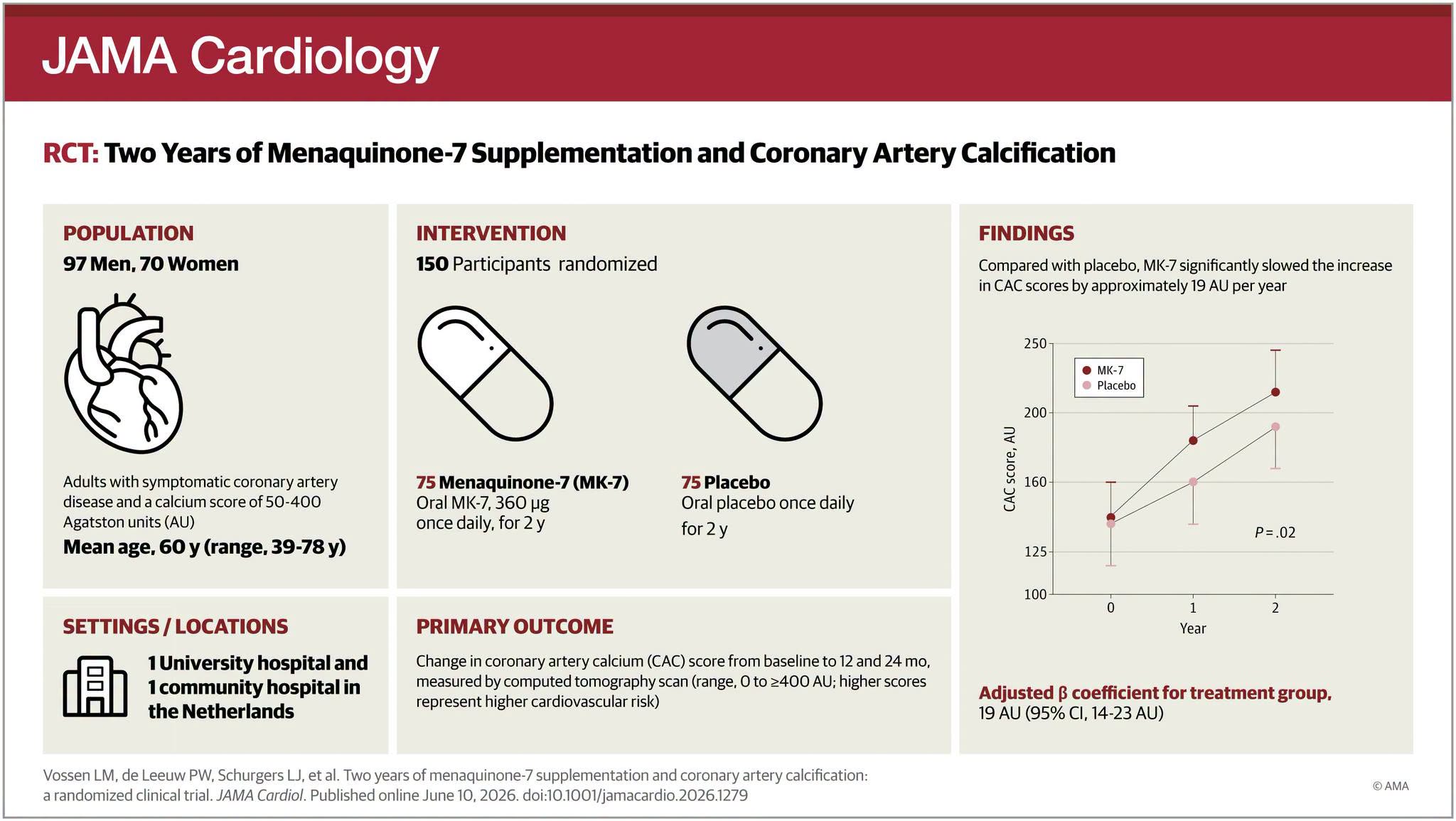
Gokhan concludes there is now "solid evidence" that K2 slows coronary calcification, especially in people with existing calcification, but that the effect on cardiovascular events is unknown.9 In an earlier summary he stated it is not yet a standard recommended therapy and that the BASIK2 trial (400 patients, Denmark) is ongoing.36
The skeptical view
Slowing calcium is not the same as preventing heart attacks, and several posts make the point:
- Dr. Gil Carvalho, in a video summarized by Gokhan, argues arterial calcium is a marker of long-standing plaque, not the cause of risk, so a lower calcium score can mislead, much as statins can raise calcium while lowering risk. He notes that no large, properly powered trials show K2 reduces heart attacks or strokes and warns the main danger is false reassurance, with people forgoing proven treatments.4
- Carvalho analyzing a newer trial says calcification slowed but total plaque did not fall, and plaque merely became less calcified. He argues calcium acts as a stabilizing "scar", so slowing calcification without reducing plaque could potentially be harmful.38
- A shared post on the MK-7 trial makes a similar caution: calcified plaque is generally considered more stable, soft plaque was not measured, and the trial was not designed to show fewer cardiovascular events.39 The summary of the 180-person trial also stresses that CAC is a surrogate and an outcomes trial is needed.3
Other reasons people take K2
- Insulin sensitivity. Louis says his main reason for taking K2 is insulin sensitivity, not calcification.4041 In a 2011 Diabetes Care trial, 42 participants given 30 mg MK-4 for four weeks improved insulin sensitivity and disposition index, apparently via osteocalcin.40 A Life Extension summary, which is a supplement-industry source, reports three MK-7 trials (90-360 mcg/day for 3-6 months) with lower fasting glucose and HbA1c in type 2 diabetes, including fasting glucose down 13.4% and HbA1c down 7.4% at 90 mcg/day.42 Louis notes the 360 mcg dose that slowed calcification also improved glucose control in earlier trials.43
- Leg cramps. A JAMA Internal Medicine trial reported fewer, less painful and shorter nocturnal leg cramps with K2 in adults 65 and older, in a small trial.44
- Food source. Natto is described as having about 200-1,200 mcg of vitamin K2 per 50 g serving, alongside nattokinase and spermidine.45
Safety note: Gokhan says K2 is not recommended with warfarin, and to check with your doctor.9
Magnesium
Intake and status
A FoundMyFitness summary says nearly 45% of the US population has inadequate magnesium intake. RDAs are 310-320 mg/day for adult women and 400-420 mg/day for men, with athletes possibly needing 10-20% more.46 The same summary says blood tests are poor indicators of status in healthy people, that the upper safe limit for supplemental magnesium is 350 mg/day (above which diarrhea may occur), and that smaller doses spread through the day absorb better.46 The Patrick keynote summary suggests increasing leafy greens plus 200-400 mg of supplemental magnesium.8
Blood pressure, heart failure and the heart
- An umbrella meta-analysis found that magnesium at 400 mg/day or more for at least 12 weeks lowered systolic pressure by 6.38 mmHg and diastolic by 3.71 mmHg, mostly in people with prior metabolic disorder and probably inadequate magnesium status. Louis describes the effect as modest, and magnesium is not strong enough to be monotherapy for hypertension.5
- A 2016 BMC Medicine meta-analysis (Fang and colleagues) pooled 40 studies of over a million people. Magnesium intake was not linked to total cardiovascular disease or coronary heart disease, but each extra 100 mg/day was linked to about 22% lower heart failure risk, 7% lower stroke risk, 19% lower type 2 diabetes risk and 10% lower all-cause mortality.6 The post stresses that the claim that magnesium protects against heart disease in general does not survive the data.6
Which form?
Opinions differ in the posts. The FoundMyFitness summary says organic salts (glycinate, citrate, malate) are more bioavailable than oxide, and that threonate should not count toward the RDA because its elemental magnesium is low.46 A later piece shared by Louis argues that every magnesium salt dissociates in stomach acid, so the form mostly affects dissolution, and that claims like threonate for the brain or taurate for the heart lack human data; Louis says differences between forms are fairly minor.7 That post does say organic forms produce modestly higher blood levels.7
Sleep, mood and cognition
- A four-week preregistered trial in 153 adults with sleep problems, using 250 mg magnesium bisglycinate before bed, found a real but small sleep improvement.47
- In adults with type 2 diabetes and insomnia, 250 mg magnesium plus 250 mg potassium daily for two months gave the biggest improvement, with morning cortisol down about 45%, and magnesium or potassium alone improved less.48
- A six-week trial of 2 g/day magnesium L-threonate (145 mg elemental magnesium) in 100 adults aged 18-45 reported better cognition and a cognitive age about 7.5 years lower. Louis's post said six months, but the trial was six weeks.49
- A crossover trial of 248 mg/day magnesium chloride in 126 adults with mild-to-moderate depression showed a net PHQ-9 improvement of about 6 points.50 A claim of rapid recovery from major depression with magnesium glycinate came from a 2006 case series with no control group, which Louis calls hypothesis-generating only.51
- Gokhan suggests potassium or magnesium citrate for mild metabolic acidosis (low blood CO2 on labs), but cites no studies.52
What this means for you
This summarizes what the group's posts say; it is not individual medical advice.
- Vitamin D: test, then dose. The posts favor measuring blood levels and adjusting, with D3 rather than D2, and a target around 40-60 ng/mL in Patrick's framing.81113
- Avoid very high doses without monitoring. Group posts warn about hypercalcemia with 20,000 IU/day over long periods.1017
- Keep expectations realistic. Louis takes vitamin D mainly for autoimmune protection and says "betting your life on vitamin D is a big mistake".2
- K2: calcium slowing is not event prevention. Discuss with a doctor, particularly if you take warfarin.9 The doses used in calcium trials were 360-720 mcg/day MK-7.336
- Do not drop proven therapy. Carvalho's warning about false reassurance applies; supplements do not replace proven treatments.4
- Magnesium: food first, modest supplements. Leafy greens and other magnesium-rich foods are emphasized, and the supplemental upper limit cited is 350 mg/day.846 Higher doses such as 400 mg/day were used in the blood pressure trials, which is a discussion to have with your doctor.5
- Do not over-pay for form. Evidence for specific brain or heart claims by form is thin.7
Frequently asked questions
Does vitamin D prevent heart attacks?
Large trials mostly did not show it. VITAL reported little effect on heart disease, and a JACC review found no effect of vitamin D on cardiovascular disease.119 The TARGET-D trial found 52% fewer heart attacks in a tailored-dose arm but missed its primary endpoint and needs validation.20
Does vitamin K2 remove calcium from arteries?
No. In the MK-7 trial it slowed new calcium and did not remove existing calcium, and total plaque volume did not change.39
Is a lower calcium score always better?
Not necessarily. Carvalho argues calcium reflects long-standing plaque and may stabilize it, so slowing calcification alone may not mean lower risk.438
How much magnesium is too much?
The summary of a FoundMyFitness episode gives 350 mg/day as the upper limit for supplemental magnesium, with GI side effects such as diarrhea above it.46 The blood pressure trials used 400 mg/day or more, so doses should be discussed with a doctor.5
Do I need to combine all three?
The group does not present the combination as proven. The trials in the posts test them separately or in specific pairs, such as K2 with vitamin D in calcification trials, and DO-HEALTH combined vitamin D, omega-3 and exercise.2736