Same Plaque. Same Risk? Not Quite.
We often talk about coronary atherosclerosis as if the same anatomical disease carries the same prognostic meaning in everyone.
This large Danish population study suggests the story may be more complex.
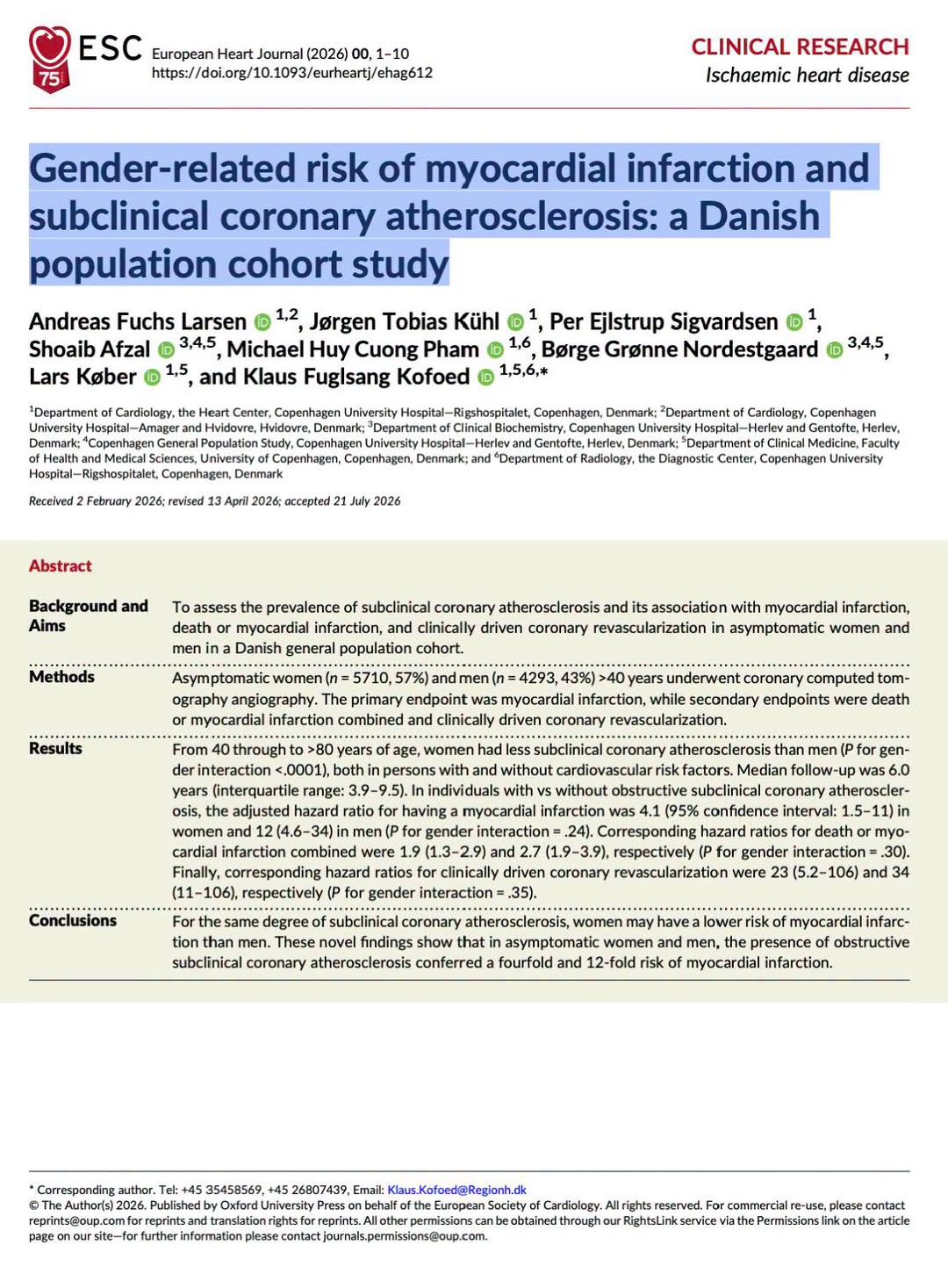
Among 10,003 asymptomatic adults >40 years undergoing CCTA, subclinical coronary atherosclerosis was substantially less frequent in women than in men across virtually the entire adult lifespan. At age 40–44, plaque was present in 6% of women vs 20% of men; at 75–79, in 73% vs 92%. Importantly, the same pattern persisted even among individuals without conventional cardiovascular risk factors.
The Critical Point
The most interesting finding is not simply that women develop coronary atherosclerosis later.
It is what happens once disease is present.
Over a median 6-year follow-up, obstructive subclinical CAD was associated with a 4.1-fold higher risk of MI in women but a 12-fold higher risk in men. Any high-risk plaque feature was also associated with increased MI risk in both groups.
However, the interaction by gender was not statistically significant.
So the correct conclusion is not that identical plaque is definitively less dangerous in women.
It is that the same apparent anatomical burden may not necessarily translate into identical biological risk—and we still do not fully understand why.
My Take
This paper reinforces two important concepts.
First:
Risk factors are not the disease. Atherosclerosis is.
The sex difference in plaque prevalence remained visible even in people without conventional risk factors.
But there is a second, more provocative message:
Even plaque burden may not be the whole disease.
If apparently similar anatomical disease produces different outcomes, we need to move beyond simply asking how much plaque is there?
We need to understand what kind of plaque it is, how it behaves, and in whom it exists.
Where PCCT Fits
This is where the next generation of CCTA becomes particularly interesting.
The study used conventional CCTA to classify stenosis, disease extent and plaque morphology.
Photon-Counting CT could push this much further.
Higher spatial resolution, improved plaque characterization and spectral information may allow us to move from:
plaque detection → plaque burden → plaque phenotype → individualized plaque biology.
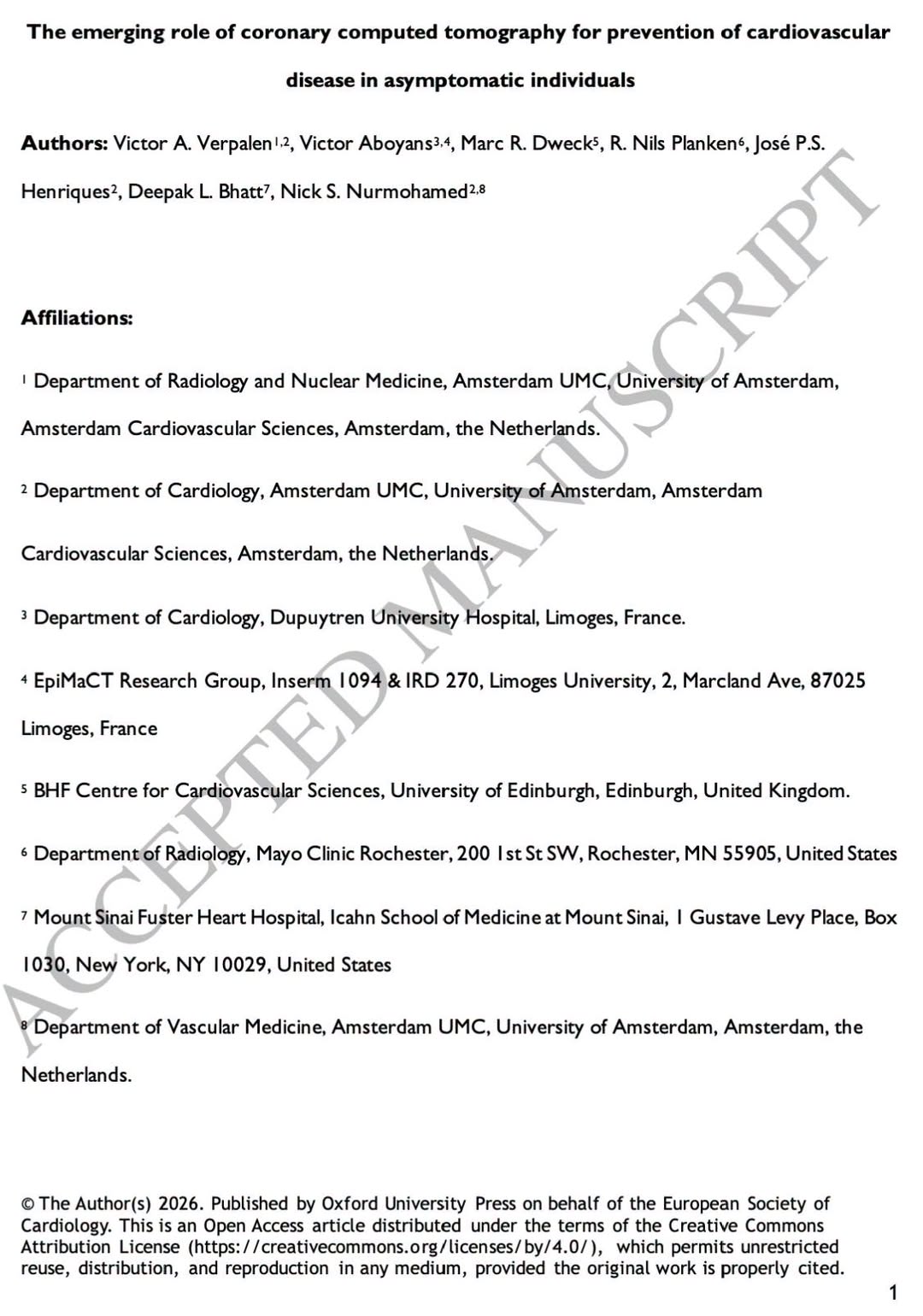
Interestingly, the authors themselves conclude that CCTA could eventually guide preventive treatment, a hypothesis now being tested in DANE-HEART and SCOT-HEART 2.
Perhaps precision prevention should ultimately ask neither:
“What are your risk factors?”
nor simply:
“How much plaque do you have?”
But:
“What does your plaque mean for you?”
#Atherosclerosis #CardiacCT #CCTA #PhotonCountingCT #PCCT #CoronaryPlaque #PreventiveCardiology #WomensHeartHealth #PrecisionMedicine #TreatThePlaque