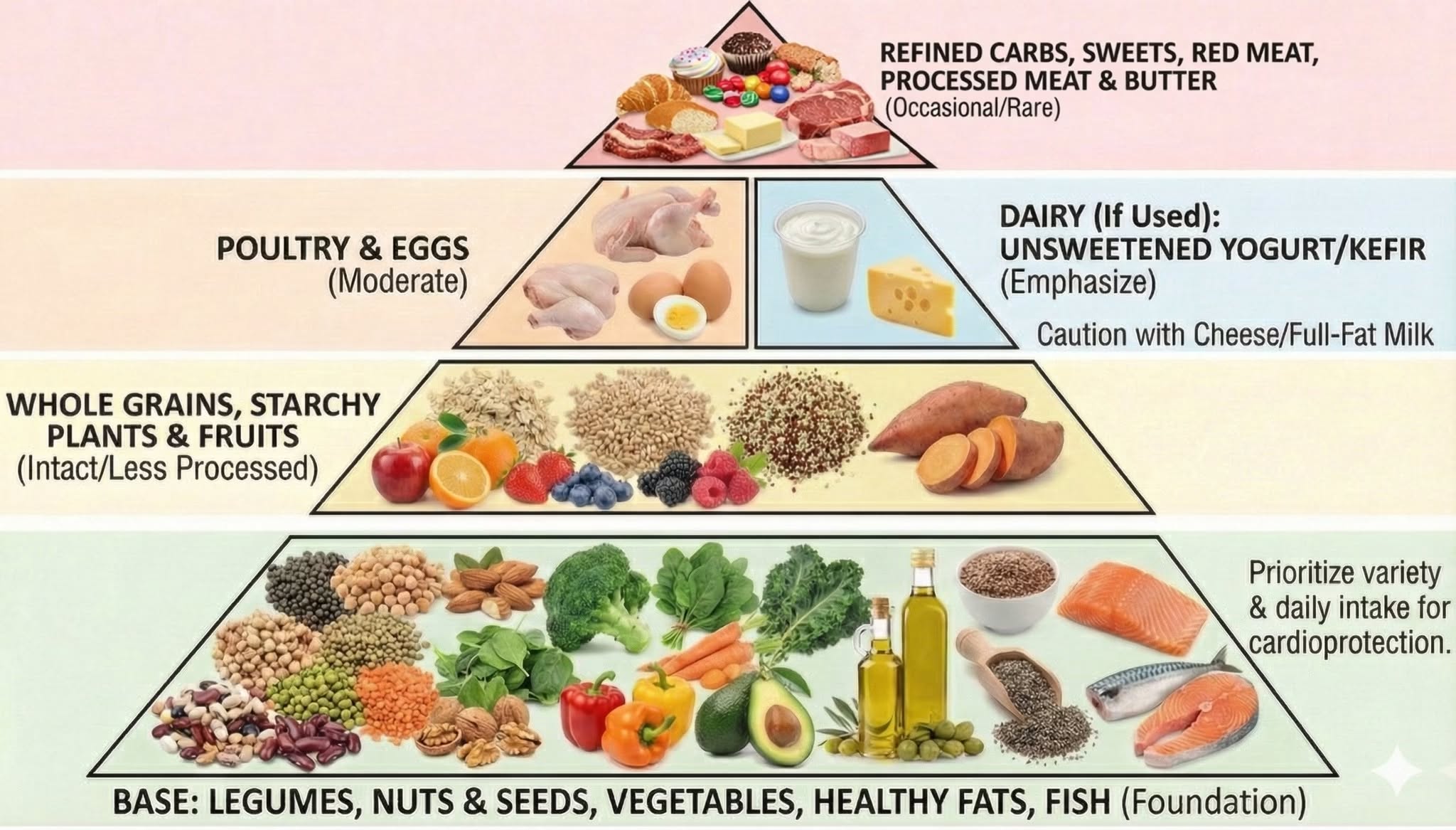
The HD-OPM (Heart Disease Optimal Prevention and Management) food pyramid is the daily eating pattern that Gokhan Can, one of the group's admins, proposed for members in January 2026. He described it as heavily inspired by Mediterranean diet principles and "fully informed by science", with no food-industry connections.1 The pyramid itself was posted as an image, so its exact tiers and serving counts do not appear in the post text; what the group has written around it makes the pattern clear enough to describe in practice.
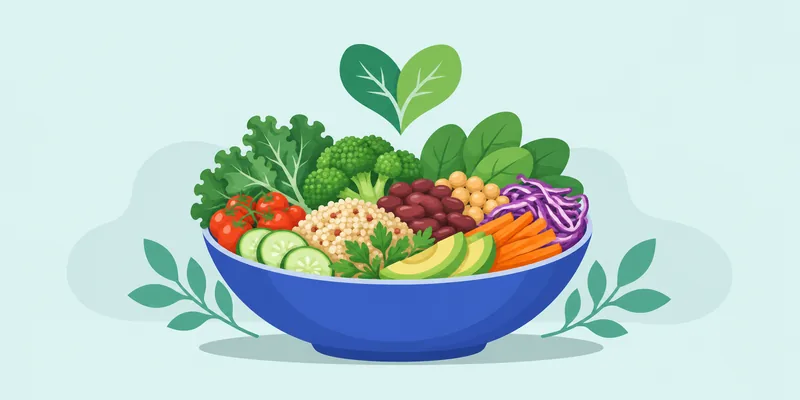
In plain terms, it is a traditional Mediterranean-style plate: mostly plants (vegetables, fruit, whole grains, legumes, nuts, seeds), extra virgin olive oil as the main fat, fish and poultry rather than red meat, modest dairy, and very little in the way of processed foods, sugar and salt. In April 2026 Louis Nervegna reported that the group's pyramid closely matches the latest American Heart Association dietary guidelines.2
This article walks through that pattern food group by food group, summarizes what the group's posts say about the evidence, and flags where the evidence is stronger or weaker. It is a summary of group discussion, not medical advice; the admins encourage members to discuss dietary changes with their own doctor.
Where the pyramid comes from
The traditional Mediterranean diet
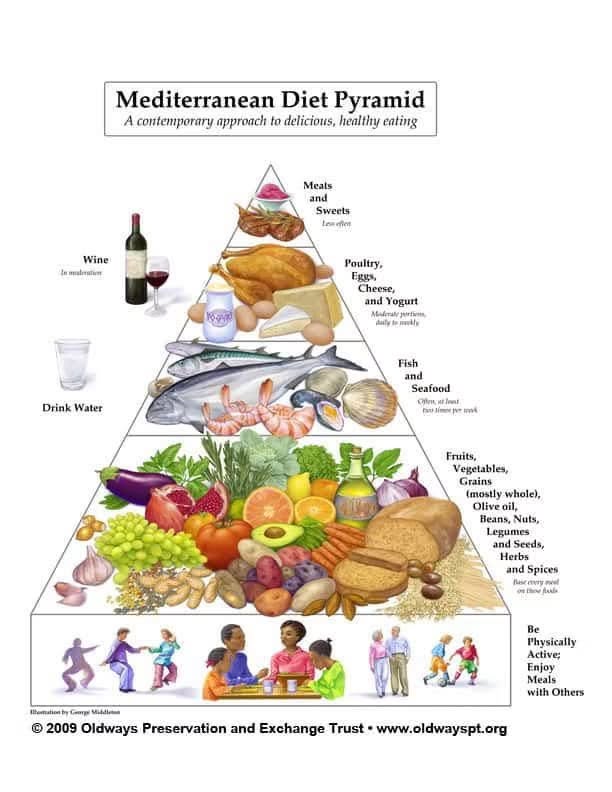
Louis has repeatedly pointed members to the traditional Mediterranean diet as described by Ancel Keys and Margaret Keys in their 1975 book, How to Eat Well and Stay Well the Mediterranean Way. A summary he shared lists these core elements: plenty of vegetables, fruit, whole grains, legumes, nuts and seeds; extra virgin olive oil as the main fat, replacing butter; small amounts of cheese and yogurt; red meat sparingly (poultry preferred); regular fatty fish such as sardines, anchovies and mackerel; whole-grain or minimally processed bread; herbs and spices instead of salt; fresh fruit for dessert; wine in moderation; and an active, social lifestyle.910
Louis says the Keys diet was built simply by copying what people ate traditionally in parts of the Mediterranean where life expectancy was high and heart disease rates were low, and that it is "almost the exact same diet" he eats 50 years later.10 He also says it is now the most recommended diet among practicing cardiologists.10 That is his characterization; the same post links the diet to four large randomized trials as both treatment and prevention for heart disease.10
The group has also shared the Oldways traditional Mediterranean diet pyramid twice as a visual guide1112, and an updated Mediterranean Lifestyle Pyramid for children and adolescents, which keeps fruit, vegetables, legumes, nuts, whole grains and extra virgin olive oil at the base while emphasizing adequate fish, dairy and meat during growth.13
The guideline convergence
Several posts show other bodies landing in the same place:
- The European Society of Cardiology scientific statement calls diet a primary factor in cardiovascular prevention. It says plant-based patterns rich in minimally processed foods lower risk; ultra-processed foods, processed and red meat, salt, sugar and saturated fat raise it; and the Mediterranean, DASH and vegetarian diets reduce risk, with no additional benefit shown for strict vegan diets.8
- The American Society for Preventive Cardiology (ASPC) released an "upside-down" food pyramid based on cardiology guidelines from around the world, with ten points: more than 5 servings of fruit and vegetables a day; minimize processed foods and added sugars (sugar-sweetened beverages should be zero); emphasize fish and plant proteins such as legumes, nuts, seeds and whole grains; limit processed and red meat; whole over refined grains; sodium of 2,300 mg or less, lower for people at high risk; lower-fat over full-fat dairy; unsaturated plant oils like olive oil instead of animal fats; and alcohol, if any, at moderate limits.6
- Gokhan's do's and don'ts summary, which Louis shared as the best answer for people asking how to follow the diet properly, lists at least five servings of fruit and vegetables a day, mainly whole grains, olive oil, nuts and fatty fish, legumes as a regular food, and limited red meat.514
What the evidence shows
Randomized trials of Mediterranean-style eating
Lyon Diet Heart Study. More than 600 patients who had had a heart attack were randomized between 1988 and 1992 to an AHA diet or a Mediterranean-style diet. After a mean follow-up of 27 months, there were 16 cardiac deaths in the control group versus 3 in the Mediterranean group, and 17 versus 5 nonfatal heart attacks, a combined risk ratio of 0.27 (95% CI 0.12 to 0.59). Overall mortality was 20 versus 8.3 Louis summarizes this as a 73% reduction in heart attacks and cardiovascular deaths and a 70% reduction in total deaths in about 2.5 years, and calls it a result no drug or other diet has matched.3 That is a strong statement from an admin about a single, fairly small trial, so it is best read alongside the other trials below.
Show data
| AHA diet | Mediterranean | |
|---|---|---|
| Cardiac deaths | 16 | 3 |
| Nonfatal heart attacks | 17 | 5 |
| Deaths from any cause | 20 | 8 |
PREDIMED. This large multi-year randomized trial compared a control diet (similar to AHA recommendations at the time), a Mediterranean diet with extra virgin olive oil, and a Mediterranean diet with nuts. The nut group was given about 30 g of nuts a day (15 g walnuts, 7.5 g hazelnuts, 7.5 g almonds). In a carotid ultrasound substudy of 164 people, carotid intima-media thickness progressed 0.052 mm in the control group but regressed 0.084 mm in the Mediterranean-plus-nuts group (P = 0.024). The post also reports that the Mediterranean diet reduced major cardiovascular events by 30% versus control, and that the nut group had about 50% lower stroke risk.4
Other trials. Louis also says the same Mediterranean diet is backed by four large, long-running randomized trials as both a treatment and a preventive for heart disease, with Lyon producing the largest reduction in total mortality ever reported in a prevention trial.10 The posts here do not itemize the other two trials.
Population patterns
A post on Hong Kong, where life expectancy is about 86 years versus 76 in the US according to the post, describes a different but related pattern. A government dietary survey of 5,008 people aged 20 to 84 found daily intakes of about 491 g of grains, 177 g of vegetables, 147 g of fruit, 113 g of meat, poultry and game, and 71 g of fish and seafood, with dairy, eggs, sugars, snacks and added fats low.15 This is a descriptive survey, not a trial, so it illustrates a pattern rather than proving it.
Louis also notes that three of the 18 scientists in the Seven Countries Study group, who adopted the diet, reached age 100.9 This is a striking anecdote, not controlled evidence.
Fiber
A post by Gokhan summarizes a WHO-commissioned meta-analysis (Reynolds et al., 2019) of 185 prospective studies and 58 trials: intakes of 25 to 29 g of fiber per day were associated with 15% to 30% lower all-cause mortality and 16% to 24% lower incidence of coronary heart disease, type 2 diabetes and colorectal cancer, with further benefit per extra 8 g a day. A 2025 NHANES analysis suggested the benefit plateaus at about 30 g a day.7 Fiber is one reason the plant-heavy base of the pyramid matters.
The pattern in practice, food group by food group
Daily and weekly amounts quoted in the group's posts:
| Food | Amount quoted | Source |
|---|---|---|
| Fruit and vegetables | At least 5 servings a day | Gokhan's guide and the ASPC pyramid56 |
| Nuts | About 30 g a day | PREDIMED4 |
| Beans | At least half a cup cooked a day; Louis aims for a cup | Blue Zones message and Louis1617 |
| Fiber | 25 to 30 g a day | WHO-commissioned meta-analysis and NHANES7 |
| Fish | At least twice a week | Baylor fatty-liver guide18 |
| Eggs | Up to one a day is fine for most people | Harvard guidance19 |
| Red meat | A few times a month | Gokhan's guide5 |
| Sodium | 2,300 mg a day or less, lower for high-risk people | ASPC pyramid6 |
| Alcohol | Optional; at most 1 drink a day for women, 2 for men | ASPC pyramid6 |
Vegetables and fruit
The consistent target is at least five servings a day, in a wide variety.56 Gokhan suggests reaching for low-sugar berries (blueberries, blackberries, raspberries, strawberries) when craving sweets.5 Louis points to Jack LaLanne and his wife Elaine, who he says ate at least 10 fruits and vegetables a day, two meals a day, and fish as their main animal protein; Elaine turned 100 in March 2026.2021 This is an example, not a controlled finding.
In a small prediabetes trial, one avocado and one cup of mango daily for eight weeks raised flow-mediated dilation (a measure of blood vessel function) to 6.7% versus 4.6% in controls, with no change in cholesterol, blood sugar or inflammation.22 Another small study of daily bananas for 12 weeks reported modest drops in fasting glucose and LDL/HDL ratio.23
Whole fruit differs from juice. Walter Willett, whom Louis cites, has one small glass of orange juice a day but notes that juice has a lot of sugar.24 The Baylor liver-fat guide Louis shared says to avoid fruit juice and limit dried fruit.18
Whole grains and oats
The Mediterranean guidance is to choose whole grains and treat white bread, regular pasta and potatoes "as if they're desserts."5 Louis says slow-cooked steel-cut oats are among the heart-healthiest foods and rejects the claim that oats are "the same as eating sugar."25 The study he shared was a small trial in 19 healthy adults in which 4 g of oat beta-glucan (roughly three-quarters to one cup of oats) cut the breakfast glucose peak by 28% and the lunch glucose response by 24%; the limitations include small size, short duration and a liquid test format.25
Legumes
Louis says it is hard to find any long-lived population that did not regularly eat legumes.16 A shared Blue Zones message recommends at least half a cup of cooked beans a day.16 Louis aims for a cup a day and reviews ready-to-heat bean packets with olive oil as a convenient option.17
Nuts and seeds
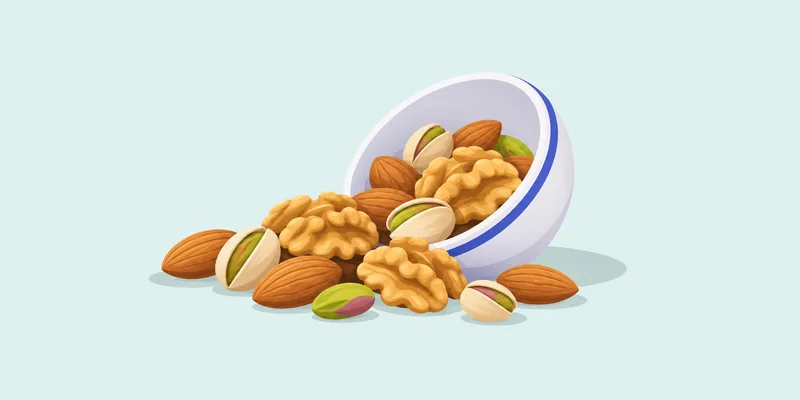
Nuts are among the best-supported foods in the group's posts. PREDIMED used about 30 g a day.4 Smaller trials shared by Louis include 60 g of pistachios a day for 12 weeks in 120 people with prediabetes (HbA1c down 0.2%, LDL down 10 mg/dL, triglycerides down 12 mg/dL, with blood pressure and fasting glucose unchanged)26, and 60 g of skin-roasted peanuts a day for 16 weeks in 31 older adults, which raised cerebral blood flow by about 3.6%, improved verbal memory by 5.8% and lowered systolic blood pressure by 5 mmHg.2728 Louis suggests the nitric oxide-supporting amino acid arginine may be part of the explanation, which is a hypothesis.28
A six-month trial of 43 g a day of peanut butter in 120 older adults improved muscle power with no significant weight gain.29 A shared piece also describes a 30 g daily serving of nuts or seeds as helpful for blood sugar, but it cites no specific studies.30
Olive oil and other fats
Extra virgin olive oil is the main fat in the Keys pattern.9 In Willett's account, shared by Louis, the Harvard cohorts found total fat irrelevant, trans fats bad, and unsaturated fats associated with substantially lower rates of heart disease and mortality; he says unsaturated fats lower LDL without raising triglycerides or lowering HDL.24 Louis comments that even a plant-based cardiologist's meal was higher in fat than a traditional Mediterranean diet.31
Two cohort and clinical-practice posts give amounts. An observational Italian study (Moli-sani, 22,895 people) linked more than 3 tablespoons of olive oil a day, compared with less than 1.5, to 28% lower cancer mortality, noting the diet was self-reported and might be specific to an Italian population.32 A University of Chicago liver clinic recommends patients with fatty liver disease drink three cups of coffee and eat four tablespoons of olive oil a day alongside a Mediterranean diet.33
Fish, poultry, eggs and dairy
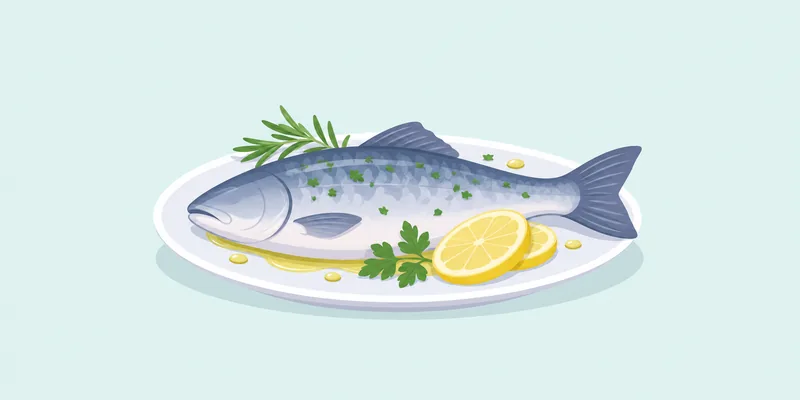
Fish and seafood, especially fatty fish such as salmon, mackerel and sardines, are the preferred animal protein.59 The ASPC pyramid emphasizes fish and plant proteins.6 The Baylor liver guide, written for fatty liver disease, suggests fish at least twice a week.18
For eggs, Louis shares Harvard guidance that up to one egg a day does not raise heart attack or stroke risk for most people, with the caveat that a neutral food is fine but the overall pattern should focus on lowering risk.19 A randomized trial he shared found that four eggs a day did not raise TMAO (a gut-derived compound linked to cardiovascular risk), while choline bitartrate supplements did.34 Dairy, where eaten, is low-fat or fat-free and moderate.56
Red and processed meat
The group's guidance is to limit red meat to a few times a month and avoid excessive processed meat.5 The ASPC pyramid also lists limiting processed and red meat.6
Sweets, drinks and salt
Added sugars and sugar-sweetened beverages should be minimal, and the ASPC pyramid says sugary drinks should be zero with water as the default.6 For salt, the ASPC guideline sets a limit of 2,300 mg of sodium and lower for high-risk people.6 Gokhan suggests herbs, spices and a no-salt sprouted bread.535
Coffee has encouraging observational data. The ESC statement says moderate coffee is not associated with increased cardiovascular risk.8 Nurses' Health Study data from more than 47,000 women found that 1 to 3 cups a day of caffeinated coffee in the 50s was linked to healthier aging 30 years later.36 A UK Biobank analysis of more than 500,000 people linked 3 cups a day to 48% lower risk of cardiometabolic multimorbidity.37 These are associations; they do not prove that coffee itself caused the benefit.
For alcohol, the guidance varies. The Keys summary mentions 1 to 2 glasses of wine a day9, Gokhan's do's and don'ts allow optional red wine up to one glass a day for women and two for men5, the ASPC pyramid sets a maximum of 1 drink for women and 2 for men if drinking6, and the ESC statement says about one unit per day (half a standard serving by their definition) may be associated with reduced cardiovascular risk.8 They agree that drinking is optional and that heavier intake is not recommended.
Optional extras
Gokhan and Louis have shared many smaller items that fit within the pattern but have limited evidence:
- Green tea and hibiscus. Gokhan drinks both daily. He cites an acute trial in which hibiscus extract raised nitric oxide markers and flow-mediated dilation, and a meta-analysis of 17 randomized trials with a systolic blood pressure reduction of about 7 mmHg.38 He notes green tea improved endothelial function in a small study of 14 people.39
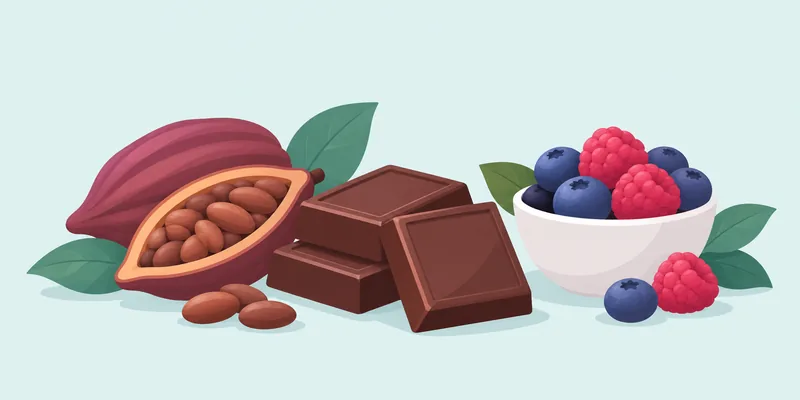
- Cocoa. The COSMOS trial (21,442 older adults, 500 mg a day of cocoa flavanol extract) found a 27% lower cardiovascular death rate, but the 10% reduction in the primary endpoint was not statistically significant and the death result was secondary.4041
- Prunes. In a 12-month trial in 235 postmenopausal women, 50 g of prunes a day preserved hip bone density versus control, and 100 g gave no extra benefit.4243
- Natto and black cumin. Gokhan lists natto as a source of spermidine, vitamin K2 and nattokinase, with some claims resting on animal or small studies44; a shared trial reported 27% lower LDL with a gram a day of black cumin in postmenopausal women, rising again after stopping.45
A day of eating
Louis shared a Washington Post account of Walter Willett's day, which illustrates the pattern at its simplest. Breakfast is steel-cut oats with a cup of Greek yogurt, nuts and fruit (blueberries most days). Lunch is a plant-based meal: a large Mediterranean salad with greens, chickpeas, nuts, hummus, tofu, olive oil and vinegar, or a whole-grain bread sandwich with peanut butter and a carrot. Dinner is usually fish or poultry with whole grains and vegetables. Willett's own summary of 40 years of research is to "eat a variety of healthy, mostly plant-based foods, and find a way to do it that's enjoyable."2446
On timing, Louis shared Satchin Panda's advice to wait at least two hours after waking before eating and to finish the last large meal at least three hours before sleep, on circadian grounds.47 A small six-week crossover trial in type 2 diabetes found that delaying breakfast to mid-morning or midday lowered the 2-hour post-breakfast glucose response.48
Nuances and where posts disagree
- Keto versus Mediterranean for liver fat. Gokhan shared a 2026 Cell Metabolism randomized feeding trial (Petersen et al.) in 42 completers with obesity, prediabetes and fatty liver. At matched weight loss of about 10%, a very-low-carbohydrate ketogenic diet (4% carbohydrate, 73% fat) gave superior liver fat and glycemic results compared with a Mediterranean diet (50% carbohydrate, 35% fat, 15% protein) and a very-low-fat plant-forward diet.49 This is a small, liver-focused study that does not address plaque or events, but it shows that the best diet for a specific metabolic goal can differ from the general heart-health pattern.
- Strict plant-based versus Mediterranean. The ESC statement found no added benefit of a vegan diet beyond Mediterranean, DASH or vegetarian patterns.8
- Evidence quality. The strongest evidence comes from randomized trials (Lyon, PREDIMED) and large cohorts; many single-food posts are small, short or mechanistic, which is why they are best treated as optional extras.
- The "six-food plate" story. A magazine article about a 43-year-old who reported reversing plaque in 16 weeks with salmon, leafy greens, olive oil, berries, garlic and flax was shared by Louis, who pointed instead to the randomized-trial evidence for this kind of diet.50 It is an individual report, not a trial.
- Individual response. A commentary shared with the ESC statement says the best approach and macronutrient ratio are highly individual, and that people should stay flexible and judge how their bodies respond using objective measures such as lipids and inflammation.8
What this means for you
- Think of the HD-OPM pyramid as a traditional Mediterranean pattern: mostly plants, olive oil as the main fat, fish and poultry over red meat, and few processed foods.110
- The group's guides suggest at least five servings of fruit and vegetables a day, mainly whole grains, legumes as a regular food and red meat only a few times a month.5
- Nuts have among the best support: PREDIMED used about 30 g a day.4
- Beans: half a cup of cooked beans a day is the Blue Zones guidance Louis shared, and he aims for a cup.1617
- Use extra virgin olive oil in place of butter and animal fats.69
- If you drink alcohol, the sources shared suggest moderate amounts at most; it is optional.68
- Keep sodium down (the ASPC limit is 2,300 mg, lower for high-risk people) and use herbs and spices.56
- Aim for fiber in the 25 to 30 g a day range via whole plant foods.7
- The group's admins encourage discussing significant dietary changes with your own doctor.
Frequently asked questions
Is there a published list of exactly what is in each tier of the HD-OPM pyramid?
The pyramid was shared as an image, and the post text gives only its purpose and Mediterranean inspiration.1 The food guidance in this article draws on the group's Mediterranean guides and cardiology guidelines shared alongside it.
Do I have to avoid red meat entirely?
Not according to these guides, which suggest limiting red meat to a few times a month, favoring fish and poultry.5 The ASPC pyramid says to limit processed and red meat.6
Are eggs allowed?
Harvard guidance Louis shared says up to one egg a day does not raise cardiovascular risk for most people, and the Mediterranean pattern allows eggs in moderation.19
Is coffee fine?
The ESC statement says moderate coffee consumption is not associated with higher cardiovascular risk, and several large observational studies link regular coffee to favorable outcomes.83637 Those are associations.
Does the diet have to be low in fat?
Willett's account of the Harvard cohort data was that total fat was irrelevant and unsaturated fats were linked to lower heart disease and mortality.24
What about the Lyon and PREDIMED results?
Both are randomized trials of Mediterranean-style eating: Lyon in people who had already had a heart attack, PREDIMED in people at high cardiovascular risk, with a nut or olive oil supplement.34 Louis cites them as the evidence base for the group's recommendations.10