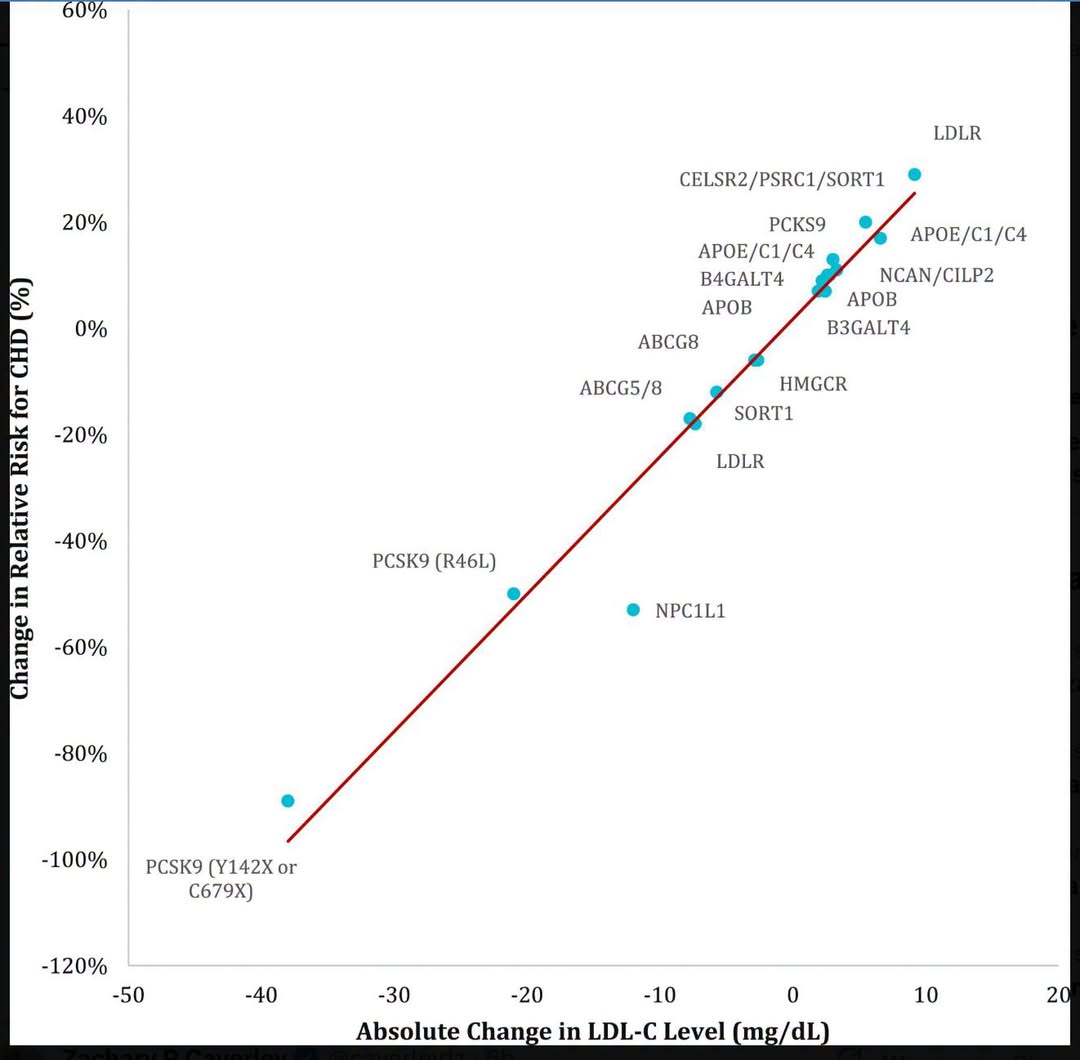
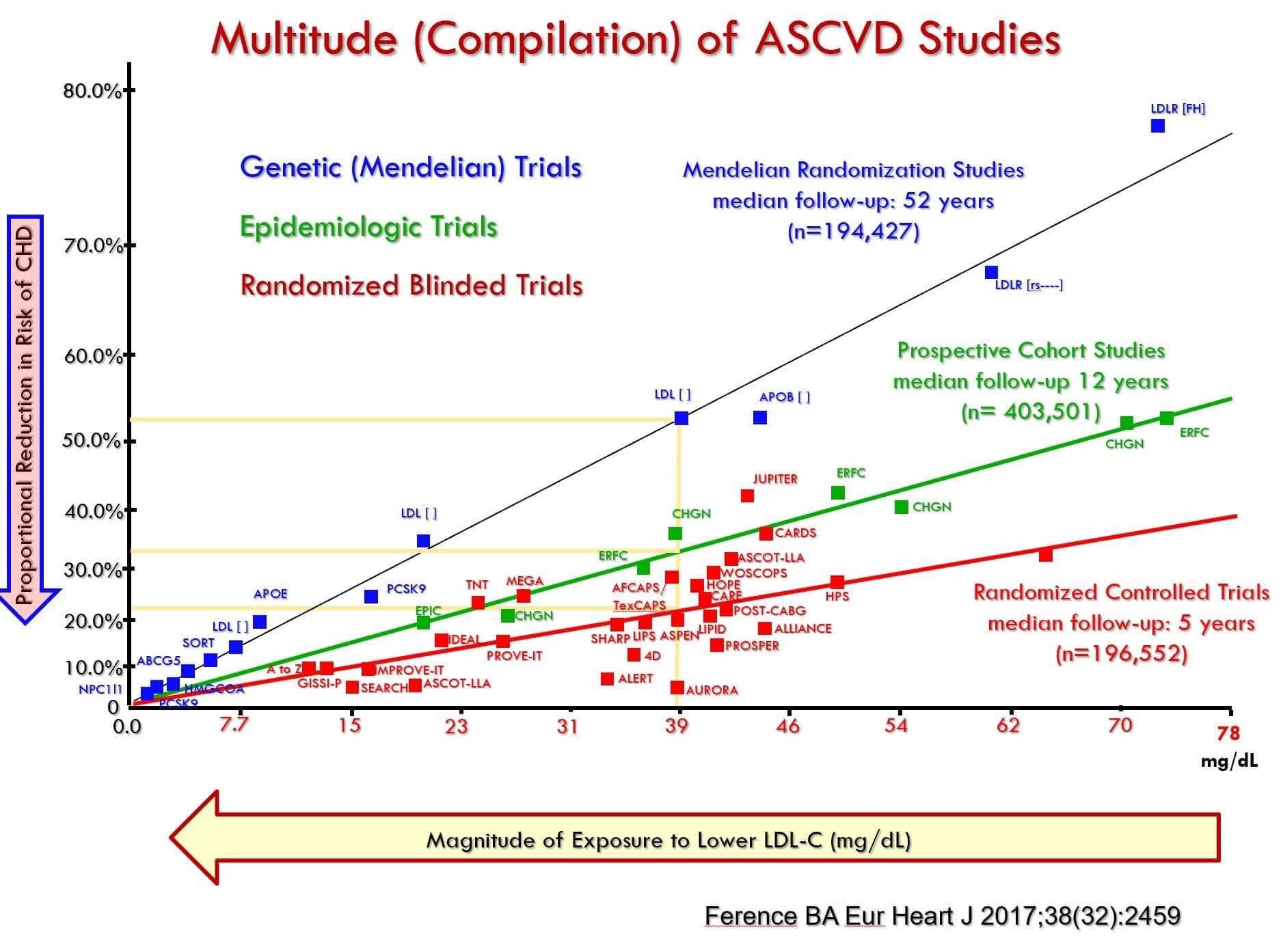
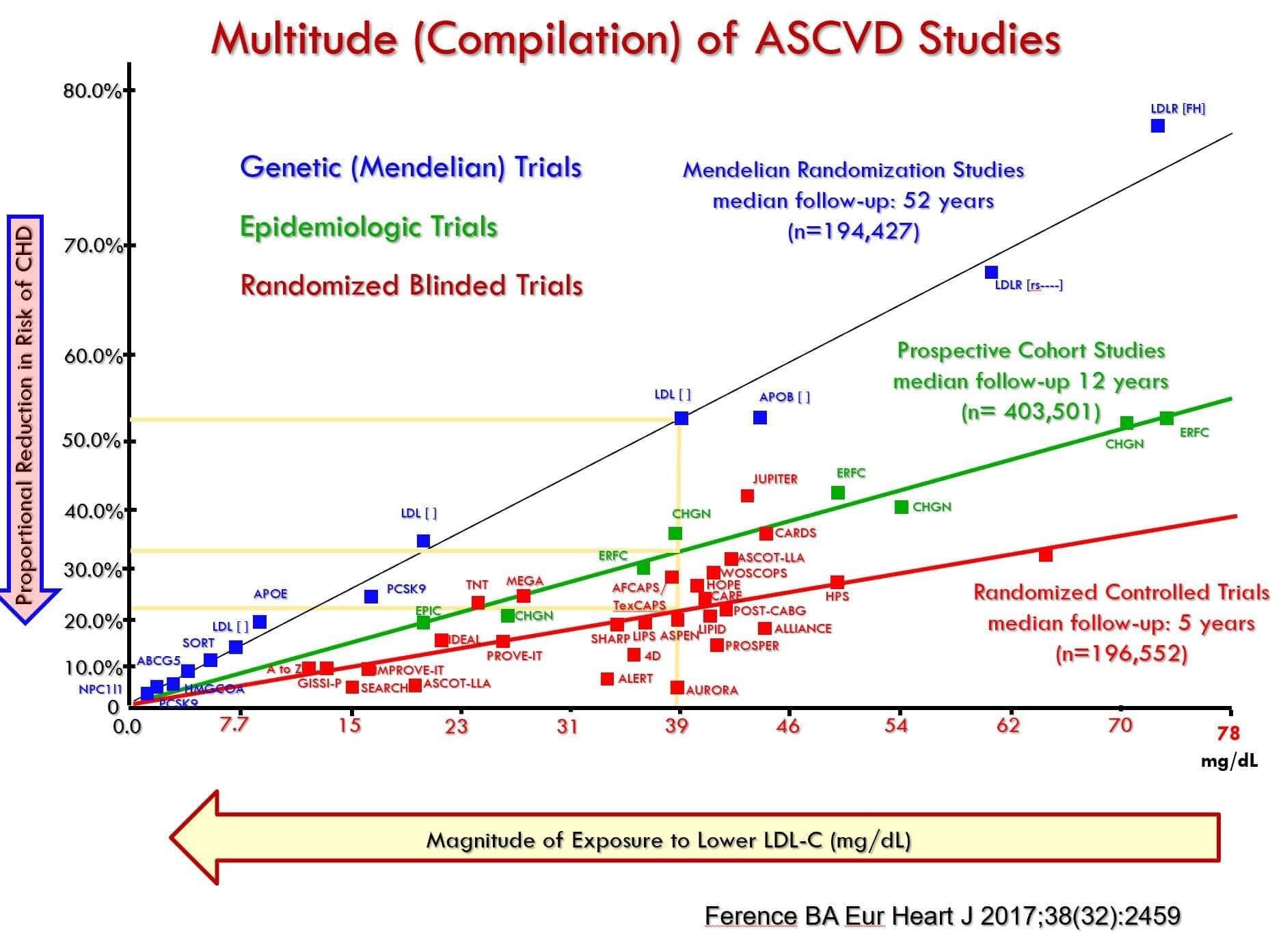
This graph nicely summarizes the results from Mendelian (genetic) randomization studies on LDL and heart disease.
As the post explains:
Each dot represents a genetic variant that affects LDL through a different biological pathway: LDLR, PCSK9, AB, HMGCR, NPC1L1, SORT1, ABCG5/8, etc.
The dots show that genetic variants which produce the lowest lifelong LDL are related to the lowest lifelong risk of heart disease. Conversely, genetic variants that produce higher LDL are related to higher risk.
If you are lucky enough to be born with genetic variants that keep your LDL low for life, then you are at much lower risk of developing heart disease than if you are born with variants that keep your LDL high for life.
The change in risk tracks linearly with the change in LDL that results from having the individual genetic variants.
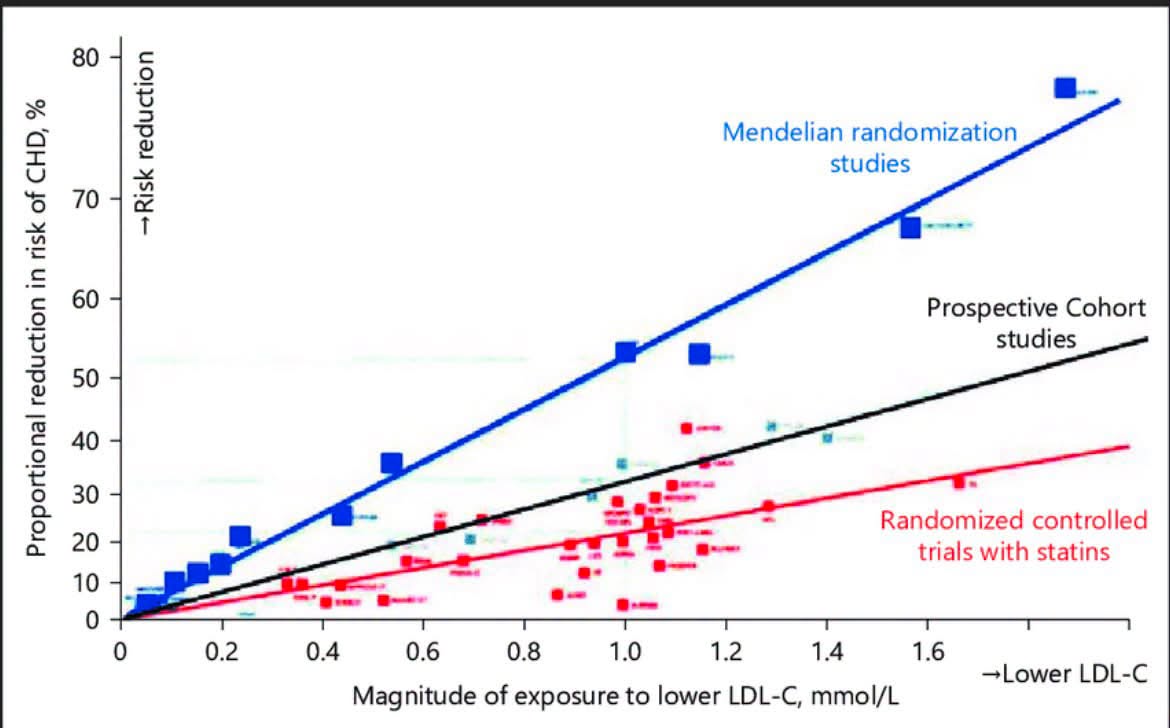
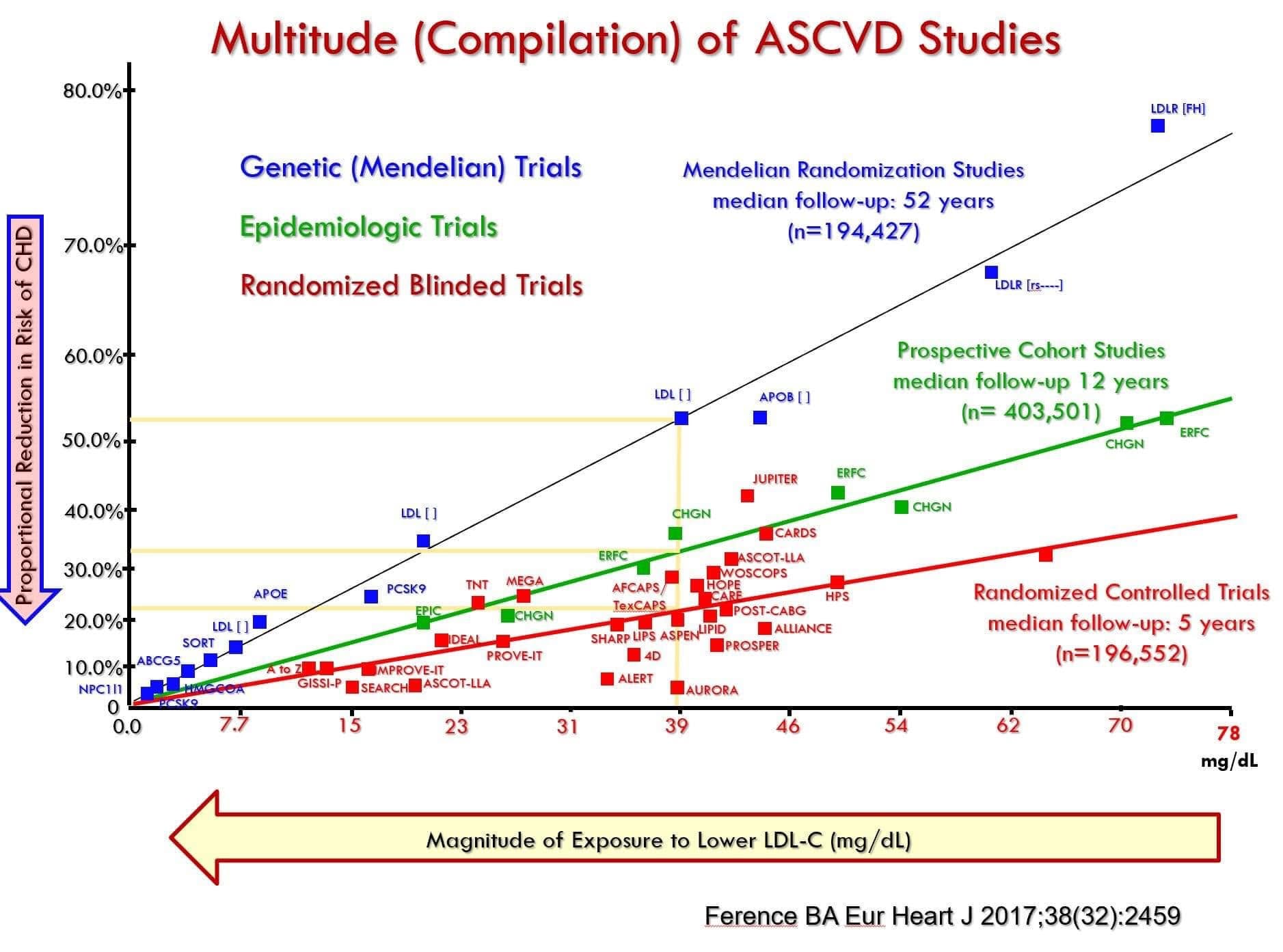
This is the same linear relationship that you see in large randomized trials testing interventions which lower LDL like statins. For example, see this post: ↪ LDL down 39 mg/dL: 20%+ fewer heart attacks in RCTs, 30%+ in cohorts, 50%+ genetically.
Note on absolute risk:
It is trivially simple to translate relative risk on this chart into absolute risk:
The lifetime absolute risk of a heart attack for the average American is around 20%. (About 1 in 5 will have a heart attack in their lifetime.)
This chart shows genes that a person has for their entire life. So these are lifetime reductions in relative risk anywhere from 5% to 90% for genes that lower LDL, as shown on the chart.
With simple arithmetic you can translate this into reduction in lifetime absolute risk.
For example, a 90% reduction in lifetime relative risk due to PCSK9 (Y142X or C679X) translates into an 18% reduction in lifetime absolute risk, out of a total lifetime absolute risk of 20%.
0.9 x 20% = 18%
This leaves only a 2% lifetime absolute risk of a heart attack! This is an enormous drop in absolute risk. People with this particular PCSK9 variant that lowers LDL are very lucky.
#statinrctsHD #ldlrctsHD #mendelianrandomizationHD #mrHD #statinsmrHD #ldlmrHD #ushapedcurveHD #lowldlHD #ldlHD
————-
EVEN MORE INFO ON LDL??
I swear I want to post more about other aspects of cardiovascular disease prevention but the LDL-denialist community out there won't let me. They keep posting misinformation and my personality won't allow me to let it slide. To that end, in an effort to further help inform those who still have an open mind on this topic, let's look at the question of LDL's relationship to plaque development from yet another angle.
Take a look at this graph. It's from the European Atherosclerosis Society consensus statement on the causal relationship between LDL and atherosclerotic cardiovascular disease. What you're looking at here is human genetics, so essentially, nature running randomized controlled trials on humans over an entire lifetime (too long a time to do an actual interventional trial), and seeing what happens. Low-density lipoproteins cause atherosclerotic cardiovascular disease. 1. Evidence… (Eur Heart J, 2017)
Each dot on this graph represents a genetic variant in a different gene that affects LDL through a different biological pathway: LDLR, PCSK9, APOB, HMGCR, NPC1L1, SORT1, ABCG5/8, etc.
What is happening?
In absolutely clear as day fashion, genetic variants that produce the lowest lifelong LDL in people directly, and linearly related to the lowest coronary heart disease risk in those people. On the flip side, genetic variants that produce higher LDL show higher risk.
Most importantly to me, the magnitude of the change in risk tracks essentially exactly with the magnitude of the change in LDL. In other words, the relationship we see between the two is continuous and dose-dependent. This typically will only happen if there is a causal effect at play. Low-density lipoproteins cause atherosclerotic cardiovascular disease. 1. Evidence… (Eur Heart J, 2017)
This info is so important because these aren't people who decided to eat differently, exercise more, take statins, or follow some particular lifestyle. They were, again, essentially randomized at conception to genetic variants that caused them to have slightly higher or lower LDL throughout life, while other potential confounding factors like differences in diet, lifestyle, etc were evenly split amongst everyone.
Also crucially, this isn't one gene. It's MANY DIFFERENT genes affecting LDL through MANY DIFFERENT biological mechanisms, but still ALL pointing in the EXACT SAME DIRECTION. The odds of this happening by chance are astronomically low, if even possible at all.
Also, meta-analyses of Mendelian-randomization studies involving more than 300,000 people and 80,000 CHD cases found that when these genetic effects are standardized for the amount of LDL reduction, their effects on CHD risk are remarkably similar, and even for variants involving HMGCR (the target of statins), NPC1L1 (the target of ezetimibe), and PCSK9 (the target of PCSK9 inhibitors), further providing evidence that the reduction in event risk etc we see with these different drugs is likely specifically to do with the LDL lowering they cause, and not some other factor. Link to openaccess.hacettepe.edu.tr (openaccess.hacettepe.edu.tr)
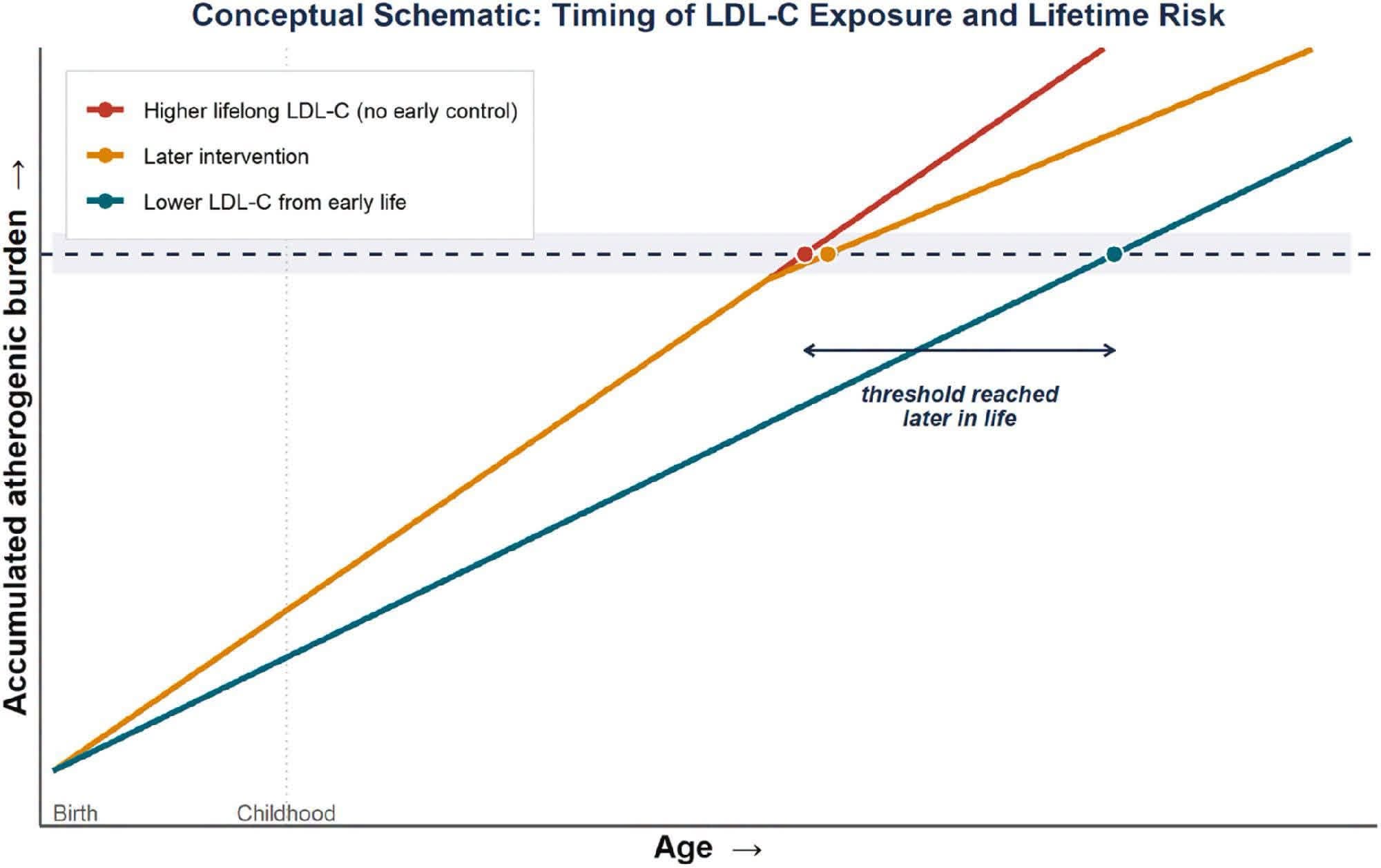
IMPORTANT QUESTION: Why is the reduction in disease so huge relative to the LDL reduction? Because of what we call "exposure over time". The idea is basically that even modestly lower LDL, when maintained for decades, prevents way more cumulative arterial exposure than lowering LDL by the same amount or even more for a few years late in life. That's one of the major lessons genetics has taught us about atherosclerosis. Test yourself as early as possible and start taking steps to lower levels asap. Also of note here- the early you start, the less aggressive you need to be in lowering LDL, which means it increases the chances you can do well without having to take meds.
This is yet another piece of evidence showing why the evidence for LDL causality doesn't even need to rest on statin trials.
If we look for evidence of this relationship, we have epidemiology. We have pathology. We have animal experiments. We have familial hypercholesterolemia. We have randomized trials using multiple completely different LDL-lowering mechanisms. AND we have human genetics, where dozens of genetic variants affecting LDL through different pathways repeatedly produce the same basic result.
PLEASE ALSO BE CLEAR: As I say all the time, none of this info means I'm claiming LDL is the ONLY thing that matters in cardiovascular disease. It isn't. Blood pressure, smoking, insulin resistance, inflammation, thrombosis, obesity, diet, exercise, sleep, environmental exposures and many other factors can massively impact risk too. In fact, genetics has also identified pathways leading to the disease that involve inflammation, vascular remodeling, thrombosis and nitric-oxide signaling in addition to lipid metabolism.
BUT, just because "other things matter", this is NOT evidence that LDL therefore doesn't matter, or should be mostly ignored, or downplayed, like so many health influencers out there these days are trying claim.
SAY IT WITH ME NOW: Atherosclerosis is multifactorial, BUT LDL/apoB-containing particles are still causal, because both statements can be true at the same time.
So, at some point, if someone's hypothesis requires explaining away or ignoring epidemiology, experimental biology, randomized trials AND DOZENS of naturally occurring human genetic experiments all independently pointing in the same direction, it may be worth considering whether THEIR hypothesis is actually the problem.