The Cumulative Burden of LDL Cholesterol: A Lifelong Predictor of Atherosclerotic Progression and Cardiovascular Risk
#
A growing body of research, detailed in three pivotal studies, establishes a powerful argument that the cumulative, long-term exposure to low-density lipoprotein cholesterol (LDL-C) is a more potent and accurate predictor of atherosclerotic cardiovascular disease (ASCVD) than a single LDL-C measurement taken later in life. This "cumulative exposure hypothesis" reframes atherosclerosis not as a consequence of a single high reading but as the result of a lifelong burden. These studies, conducted across different populations and using various methodologies, collectively demonstrate a clear dose-dependent and time-dependent relationship between LDL-C exposure and the progression from early vascular damage to subclinical atherosclerosis and, ultimately, to major cardiovascular events. The findings strongly advocate for a paradigm shift in cardiovascular prevention, emphasizing the critical importance of maintaining optimal LDL-C levels from a young age.
From Initial Damage to Plaque Formation: Defining the Thresholds
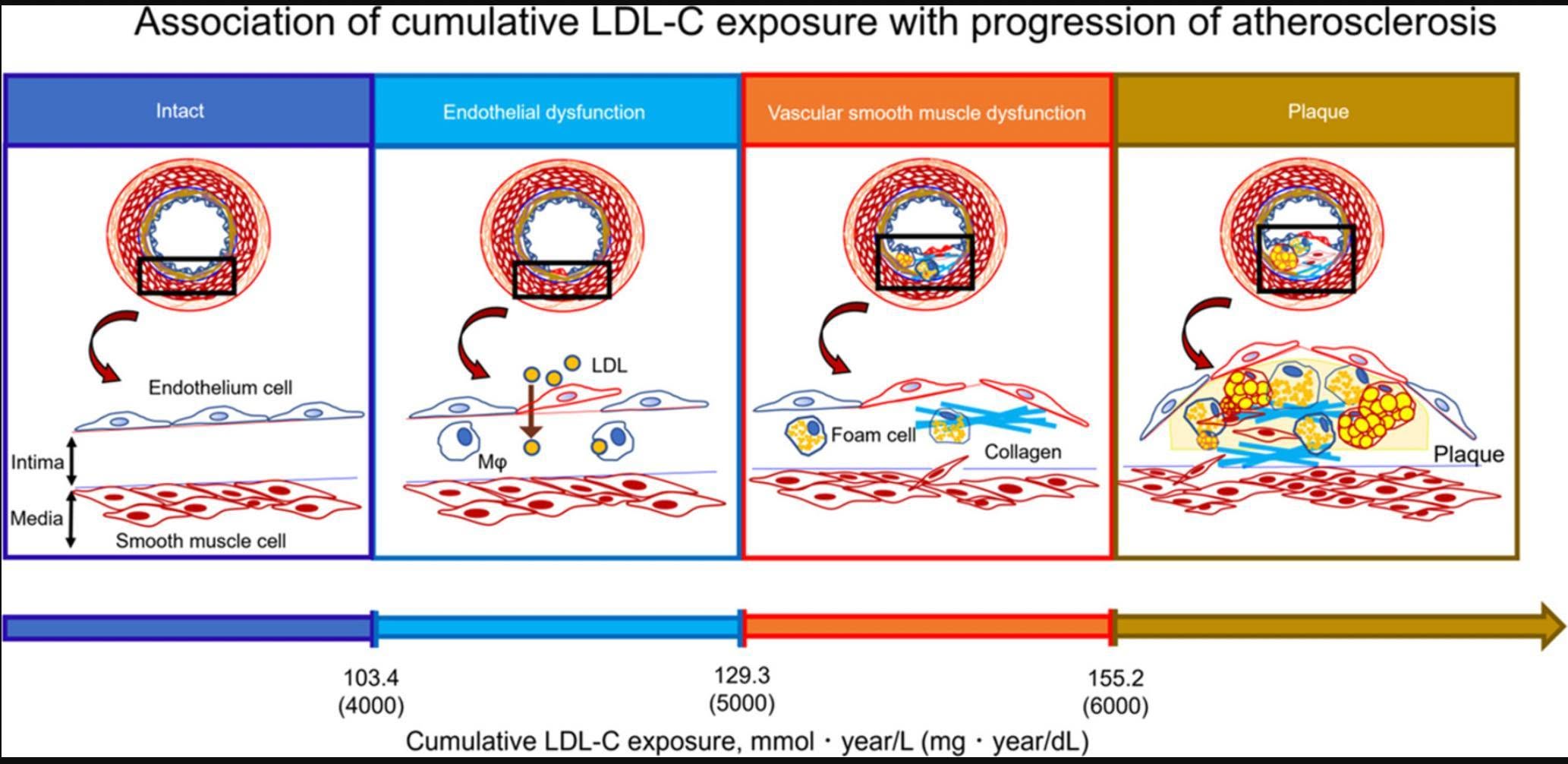
The research by Yamaji et al. (2024), published in the Journal of Clinical Lipidology, provides a granular look at how cumulative LDL-C exposure relates to the step-by-step breakdown of vascular health in individuals not taking lipid-lowering medications. This cross-sectional study meticulously measured different markers of vascular function and structure to pinpoint specific thresholds at which damage begins to occur. The researchers calculated cumulative LDL-C exposure using a simple yet effective formula: Age × LDL-C level, expressed in units of mg·year/dL.
Their analysis of over 8,000 subjects revealed a clear, progressive cascade of damage as cumulative LDL-C increased:
- Endothelial Dysfunction (>4000 mg·year/dL): The very first sign of atherosclerosis is endothelial dysfunction, where the inner lining of the blood vessels loses its ability to function properly. The study assessed this using flow-mediated vasodilation (FMD), a measure of how well an artery dilates in response to increased blood flow. The researchers found that significant endothelial dysfunction began to appear once cumulative LDL-C exposure surpassed 4000 mg·year/dL.
- Vascular Smooth Muscle Damage (>5000 mg·year/dL): As atherosclerosis advances, the damage extends beyond the endothelium to the underlying smooth muscle cells of the artery wall. This was measured using nitroglycerine-induced vasodilation (NID). The study determined that this deeper level of vascular damage became evident at a cumulative LDL-C exposure of over 5000 mg·year/dL.
- Structural Artery Changes (≥6000 mg·year/dL): The final stages of subclinical disease involve visible structural changes to the artery. The study measured carotid intima-media thickness (IMT), a marker of artery wall thickening, and the presence of plaque. A significant increase in both IMT and plaque formation was observed once cumulative LDL-C exposure reached or exceeded 6000 mg·year/dL.
This study provides crucial, quantifiable evidence that the damage from LDL-C is not an all-or-nothing event but a gradual process with distinct tipping points. It suggests that even moderately elevated LDL-C levels, sustained over decades, can quietly push an individual past these critical thresholds, initiating a disease process long before any symptoms appear.
The Potential for Reversal: Lowering the Burden
Building on this foundational work, a subsequent study by Yamaji et al. (2025) in JACC: Asia explored a critical follow-up question: What is the optimal target for cumulative LDL-C exposure to improve endothelial function in patients already receiving lipid-lowering drugs? This retrospective cohort study followed 203 subjects over three years, measuring their FMD at the beginning and end of the period.
Instead of just a single measurement, this study calculated cumulative LDL-C exposure using multiple metrics, including the time-weighted cumulative LDL-C and the time spent in a target range. The key finding was that maintaining a mean LDL-C level of <89.5 mg/dL was significantly associated with an improvement in FMD.
The statistical analysis underscored the importance of both the level and duration of LDL-C control:
- Patients with a time-weighted cumulative LDL-C of <89.2 mg/dL had an odds ratio (OR) of 3.01 for FMD improvement compared to those with higher levels.
- Similarly, patients who spent at least 1.5 years with their LDL-C below the 89.5 mg/dL target had an OR of 3.13 for improvement.
- For every one-year increase in time spent with LDL-C below 89.5 mg/dL, the odds of FMD improvement increased by 39% (OR: 1.39).
This research is significant because it demonstrates that the harmful effects of cumulative LDL-C are not necessarily permanent. By aggressively lowering LDL-C and maintaining it at an optimal level over time, it is possible to see measurable improvements in vascular health, effectively reversing the earliest stage of atherosclerosis. It provides a specific, evidence-based target (<89.5 mg/dL) for clinicians aiming to improve endothelial function in their patients.
Impact on Young Adults: Early Onset of Atherosclerosis
The study by Huang et al. (2024) in BMC Cardiovascular Disorders shifts the focus to a younger demographic (18-45 years old) from the Chinese Kailuan Study cohort, examining the link between cumulative LDL-C and carotid IMT. This is particularly important as it investigates the very early stages of subclinical disease in a population that is often considered low-risk.
Using time-weighted average (TWA) LDL-C, the study analyzed data from 3,651 young adults over a period of approximately 6.3 years. The results showed a direct and statistically significant positive correlation between cumulative LDL-C exposure and the thickening of the carotid artery wall.
Key numerical findings from this study include:
- Linear Correlation: After adjusting for numerous confounding factors, linear regression analysis showed that for every 1 mmol/L·year increase in TWA LDL-C, the carotid IMT increased by 0.017 mm. While this number may seem small, over the course of a lifetime, this steady thickening contributes directly to plaque buildup and arterial narrowing.
- Risk of Thickening: The study divided participants into three groups (tertiles) based on their TWA LDL-C. Logistic regression revealed that the group with the highest cumulative exposure (TWA > 2.63 mmol/L·year) had a significantly higher risk of having a thickened IMT (>0.9 mm). The odds ratio for the highest group was 1.812 compared to the group with the lowest cumulative exposure. This means they were 81% more likely to have early signs of structural artery disease.
This research powerfully illustrates that atherosclerosis is a pediatric disease that manifests clinically in adulthood. The process of arterial wall thickening begins early in life and is directly driven by the cumulative burden of LDL-C. It highlights the missed opportunity for prevention in young adults, who are rarely screened or treated for dyslipidemia unless their levels are extremely high.
The Ultimate Outcome: Cumulative Exposure and Heart Disease Events
The most definitive evidence for the cumulative exposure hypothesis comes from the large-scale cohort study by Zhang et al. (2021) published in JAMA Cardiology. This study pooled data from 18,288 participants across four major US prospective cohorts (ARIC, CARDIA, Framingham Offspring, and MESA), providing a robust and diverse sample with long-term follow-up (median of 16 years).
The primary objective was to determine if cumulative LDL-C exposure during young adulthood and middle age (ages 18 to 60) was a stronger predictor of future cardiovascular events than the standard LDL-C level measured in middle age alone. The study looked at three main outcomes: coronary heart disease (CHD), ischemic stroke, and heart failure.
The central conclusion of the study was unequivocal: cumulative LDL-C and TWA LDL-C were significantly associated with the risk of future CHD, independent of the midlife LDL-C level. This means that two people with the exact same LDL-C reading at age 55 could have vastly different risks for a heart attack, depending on their cholesterol history. The person with a long history of moderately elevated LDL-C would be at a much higher risk than someone whose LDL-C only recently increased.
The hazard ratios (HR) from the fully adjusted models (which controlled for midlife LDL-C and other risk factors) powerfully illustrate this point:
- Comparing the highest quartile of cumulative LDL-C exposure to the lowest, the HR for developing CHD was 1.57.
- Comparing the highest quartile of TWA LDL-C to the lowest, the HR for CHD was even more pronounced at 1.69.
- Conversely, the rate of change in LDL-C (the slope) was not associated with CHD risk after adjusting for the midlife level, suggesting it's the total burden, not how quickly it rose, that matters most.
Interestingly, the study did not find a significant association between any of the cumulative LDL-C metrics and the risk for ischemic stroke or heart failure, suggesting the pathogenic link is strongest for the atherosclerotic process leading to CHD.
This study provides compelling evidence that a person's "cholesterol history" or "cholesterol-years" are a critical, and currently overlooked, component of risk assessment. Relying solely on a contemporary LDL-C measurement misses the accumulated arterial damage that has been occurring for decades. The findings suggest that understanding a patient's long-term LDL-C trajectory could significantly refine primary prevention strategies and help identify high-risk individuals who might otherwise be missed.
References
- Association of cumulative low-density lipoprotein cholesterol exposure with vascular function (2024) by Yamaji, T.
- Effects of Cumulative Low-Density Lipoprotein Cholesterol Exposure on Endothelial Function in Subjects Receiving Lipid-Lowering Drugs (2025) by Yamaji, T.
- The association of cumulative low-density lipoprotein cholesterol exposure and carotid intima-media thickness in a young adulthood population (2024) by Huang, W.
- Association Between Cumulative Low-Density Lipoprotein Cholesterol Exposure During Young Adulthood and Middle Age and Risk of Cardiovascular Events (2021) by Zhang, Y.