He is right about this.
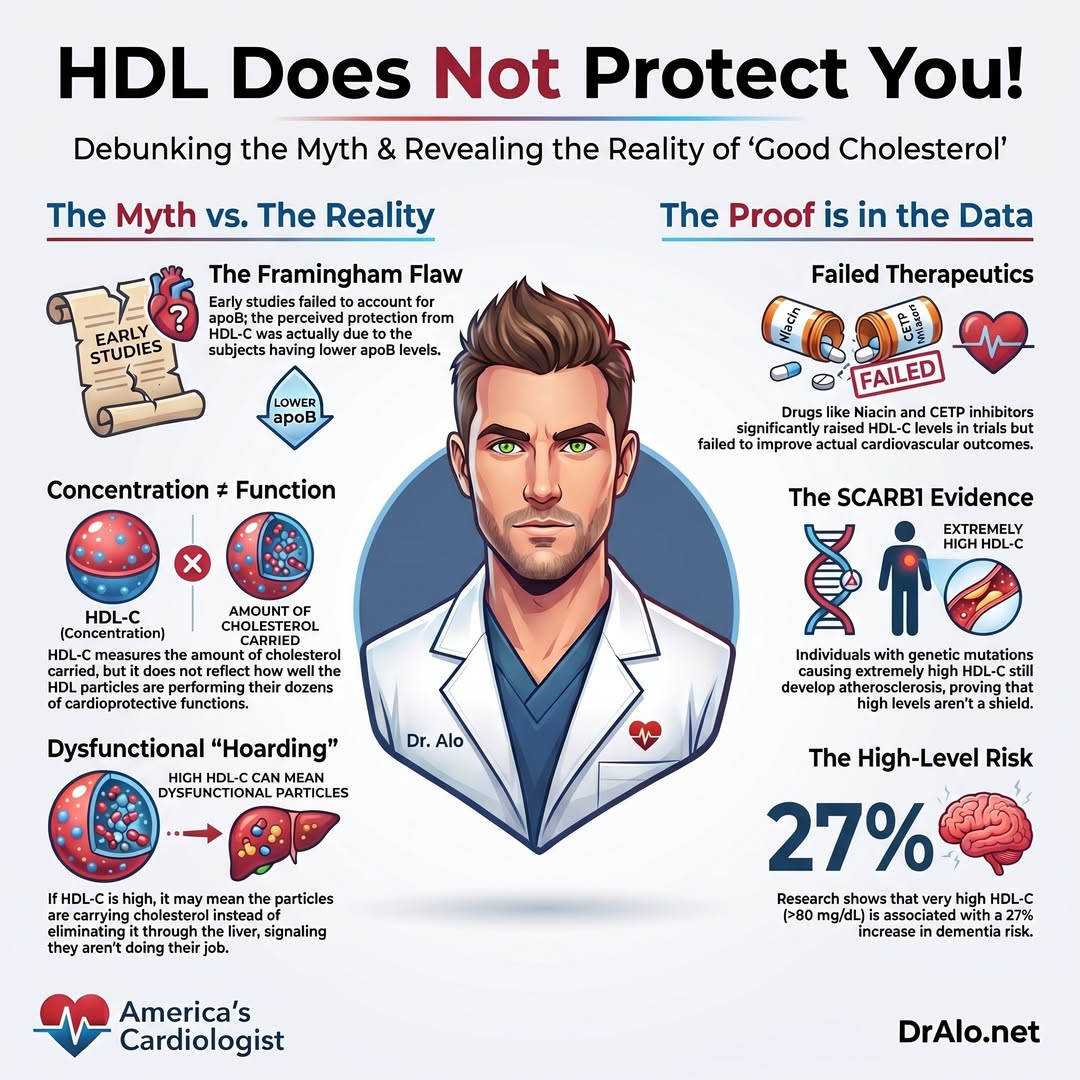
Pharmaceutical interventions to raise HDL have repeatedly failed to lower risk in large trials.
See this previous post: ↪ HDL and ApoA-I raising therapies repeatedly failed, so HDL is probably not directly causal.
The one scenario where risk really does go down is when HDL increases as a side effect of improving insulin sensitivity. In this case, it is really the improvement in insulin sensitivity that is causally lowering risk, not the higher HDL itself.
One important thing to note:
Maybe there are certain subtractions of HDL that are protective. There is still some serious research interest in that.
But as a whole, it seems like a dead end now.
🚨 Raising your HDL does not protect your heart.
Every major trial that tried to increase HDL cholesterol failed to reduce heart attacks or cardiovascular death.
But the data says otherwise than what your doctor may have told you for the last 30 years.
And no, HDL is not just "the good cholesterol" that needs to be higher.
🫀 What Is HDL Cholesterol?
HDL stands for high-density lipoprotein. For decades, the medical community told patients that higher HDL meant lower heart risk. It made biological sense. HDL removes cholesterol from artery walls and carries it back to the liver. The concept is called reverse cholesterol transport.
The theory was clean. The clinical reality was not.
Here is what the science actually says.
💓 The Trials That Broke the HDL Hypothesis
✅ AIM-HIGH (niacin): Niacin raised HDL by 25%. Cardiovascular events did not decrease. The trial stopped early for futility.
❌ HPS2-THRIVE (niacin + laropiprant): HDL went up. Major vascular events did not go down. Serious adverse events went up.
❌ DAL-OUTCOMES (dalcetrapib): CETP inhibitor raised HDL by 31%. No reduction in cardiovascular events. Trial terminated.
❌ ILLUMINATE (torcetrapib): Raised HDL by 72%. Cardiovascular death increased. The drug killed people.
❌ ACCELERATE (evacetrapib): Raised HDL by 130%. Zero reduction in major adverse cardiovascular events.
That is not one failed trial. That is five consecutive failures across different drug classes, all targeting the same goal of raising HDL.
The question is no longer whether raising HDL protects the heart. The question is why medicine kept chasing this hypothesis for 40 years.
🔬 Why HDL Fails As a Target
The biology breaks down here. HDL function matters more than HDL particle count. A dysfunctional HDL particle can actually become pro-inflammatory under oxidative stress conditions. Patients with metabolic syndrome and insulin resistance often have high HDL particle numbers but impaired reverse cholesterol transport function.
Mendelian randomization studies confirmed this. Genetic variants that raise HDL levels do not lower cardiovascular risk. That is the causal test. It failed.
HDL is a biomarker. It reflects metabolic health. It does not create it.
⚠️ What Actually Drives Atherosclerosis
🔸 ApoB-containing particles cause plaque. LDL particles, VLDL particles, and Lp(a) are the drivers.
🔸 Lp(a) is the most underdiagnosed cardiovascular risk factor in medicine right now. Most patients have never had it measured.
🔸 High triglycerides and low HDL together signal insulin resistance. The problem is the insulin resistance. Not the HDL number.
🔸 Inflammation, measured by hsCRP, predicts events independent of lipid levels.
That matters because treating the wrong target while the real one goes unaddressed costs patients decades of life.
🩺 I Am a Cardiologist.
I am Dr. Alo, America's Cardiologist.
I have patients who walk in with HDL levels of 70, 80, even 90 mg/dL and active coronary artery disease. They were told for years they had nothing to worry about because their good cholesterol was high.
I have patients who were never told their Lp(a) was 200 nmol/L. Never told their ApoB was driving plaque despite a normal LDL. Never told that the number their doctor celebrated was irrelevant to their actual risk.
That is the real story. And it is one of the most common failures in preventive cardiology today.
👤 Patient Scenario
A patient who eats a clean diet, exercises regularly, takes a statin, and has an HDL of 68 mg/dL can still have an elevated ApoB of 110 mg/dL and an Lp(a) of 180 nmol/L driving silent plaque progression for 15 years.
That is the difference between a false sense of security and a heart attack at 54.
The tools that matter. Know your ApoB. Know your Lp(a). Know your hsCRP. Treat the particles causing the damage.
❤️ Bottom Line:
HDL is not a treatment target. It never was.
Five major trials across different mechanisms all failed to show cardiovascular benefit from raising HDL.
Get your ApoB measured. Get your Lp(a) measured. Treat insulin resistance. Lower the particles building plaque in your arteries.
A patient who addresses the real drivers of atherosclerosis at age 40 can avoid the cardiac catheterization lab at age 60.
The question is not how high is your good cholesterol. The question is what is building plaque in your arteries right now.
Comment "blog" and I will send you the link.
#Cardiology #HeartDisease #HeartHealth #CardiovascularHealth #HDLCholesterol #ApoB #Lpa #CholesterolMyths #PreventiveCardiology #MetabolicHealth