Fish is one of the few animal foods that the group's admins consistently place in the "good" column. Posts quoting Harvard's Nutrition Source say there is strong evidence that eating fish is good for the heart and blood vessels, and that one to two small servings of fatty fish a week were linked to a 36% lower risk of dying from heart disease1. Louis Nervegna, one of the group's admins, argues that fish, poultry and fermented dairy are the animal protein sources linked to the lowest mortality, and better animal choices than red and especially processed meat89.
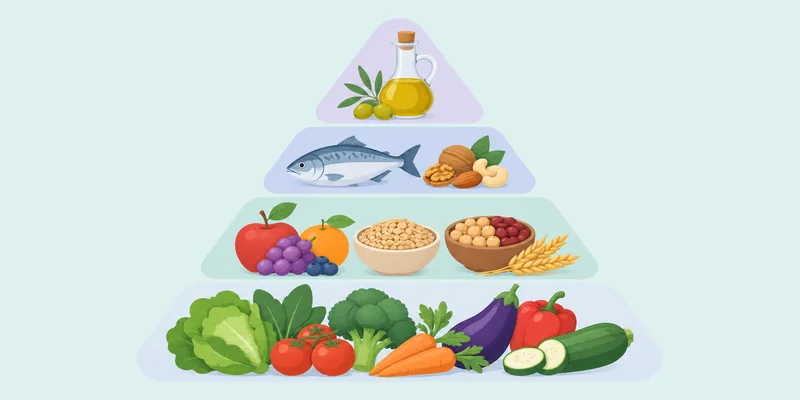
Fish is not a miracle food, and most of the evidence is observational. The best-supported message is about the whole dietary pattern: Mediterranean-style diets that include fatty fish, along with olive oil, nuts, vegetables and legumes, showed benefits in large randomized trials510. The 2026 American College of Cardiology (ACC) statement shared by Louis lists "fish/seafood" among the foods to emphasize11.
A word on scope. The group's posts say a lot about how much and which kinds of fish, and about omega-3 supplements. They say very little about mercury or microplastics, so those topics are covered only to the extent the posts allow (see the section on contaminants).
What omega-3s are and why fish matters
Omega-3 fats are a family of unsaturated fats. The two long-chain forms found in fish are EPA (eicosapentaenoic acid) and DHA (docosahexaenoic acid). One post describes EPA and DHA as coming from fish, seeds and certain oils or supplements, and notes that eating salmon delivers them into circulation quickly13. Harvard's Nutrition Source, quoted in a post on nuts and heart health, adds that omega-3s appear to help prevent erratic heart rhythms14.
The same Harvard material makes two points that are easy to miss. First, if you already have diabetes, eating fish can help protect you against a heart attack or dying from heart disease. Second, eating omega-3 fats from fish does not protect against developing diabetes, even though there is much evidence that marine omega-3s help prevent fatal heart disease15. The American Heart Association (AHA) also lists fish among the sources of unsaturated fats that can help lower LDL ("bad") cholesterol and triglycerides16.
What the evidence shows for eating fish
The Harvard analysis of 20 studies
The headline number comes from Harvard's Nutrition Source: an analysis of 20 studies involving hundreds of thousands of participants indicated that approximately one to two 3-ounce servings of fatty fish a week (salmon, herring, mackerel, anchovies or sardines) reduces the risk of dying from heart disease by 36%1. Note that the word "reduces" here describes an association in observational studies; the post does not report a randomized trial of fish.
Pescatarians in large cohorts
Louis has shared several posts on plant-based eaters who include some fish. In the Adventist Health Study-2, all participants eat a relatively healthy diet, which allows a head-to-head comparison of healthy patterns4. Pesco-vegetarians had 18% lower all-cause mortality than non-vegetarians, lacto-ovo-vegetarians 15% lower, and vegans only 3% lower34. The study analyzed data from more than 88,000 participants and about 12,500 deaths, and the paper also noted higher risks of stroke and dementia among older vegetarians4. A quoted passage from the study's principal investigator says the vegetarian advantage seems to fade by the 80s, with a small increase in neurological conditions that "we shouldn't ignore"4.
Louis says the same pattern appears in the Harvard Nurses' Health Study and Health Professionals Follow-up Study, where plant-based pescatarians outlived pure vegans, though the vegans still did very well317. He also shared a clip of Walter Willett discussing pescatarian versus vegan results in these cohorts18. Since these are cohort studies, people who choose a diet may differ in other ways, and the numbers do not prove that fish itself caused the difference.
Fish as a protein source
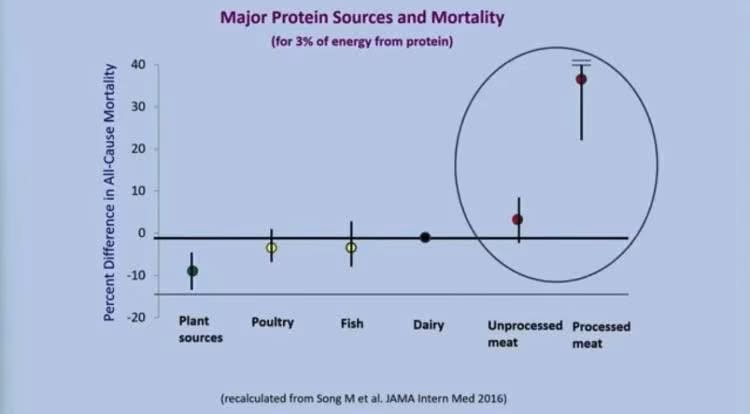
Harvard cohort data on nearly 300,000 people followed for over 30 years, summarized in the group from a Walter Willett talk, found that the type of protein matters more than the amount. Plant protein was protective, fish and poultry were slightly protective, dairy and eggs were neutral, unprocessed red meat modestly raised mortality and processed meat was far worse1920. Louis later restated that plant protein is only slightly better than fish, poultry and fermented dairy but much better than red meat and especially processed meat9. His advice to people worried about heart disease is to get most protein from whole plant foods, with smaller amounts from seafood and yogurt21. The Harvard Nutrition Source summary he shared lists seafood among healthier protein choices than red and processed meat22.
Whole-diet trials that included fish
Several randomized diet trials, which sit at the top of the evidence hierarchy, included fatty fish as part of a traditional Mediterranean pattern:
- Lyon Diet Heart Study. More than 600 heart attack survivors were randomized to a Mediterranean-style or AHA diet. After a mean of 27 months, cardiac death plus non-fatal heart attack fell with a risk ratio of 0.27, and overall mortality was lower; the trial was stopped early. The diet included olive and canola oil, nuts, seeds and fatty fish23.
- CORDIOPREV. In 1,002 coronary patients, a Mediterranean diet rich in extra virgin olive oil, fatty fish and nuts reduced carotid wall thickness at 5 and 7 years compared with a low-fat diet, and was associated with roughly 25% fewer recurrent major cardiovascular events over 7 years, all in people also receiving standard medical treatment1024.
- The six plaque-reversal diet trials. Louis lists the Lifestyle Heart Trial, STARS, SCRIP, PREDIMED, CORDIOPREV and DISCO as the only randomized diet trials to show plaque reversal. Their common themes included fruits, vegetables, legumes, whole grains, nuts, olive oil and fish and seafood, while all limited junk food, refined grains, butter and fatty red meat56. He notes that none was a strict vegan diet and that seafood was encouraged, especially fatty fish, in the Mediterranean and DASH-style trials625.
Because these trials changed many foods at once, they cannot show that fish was the active ingredient. The AHA recommends an overall pattern that includes fish and seafood, along with fruit, vegetables, whole grains and mostly plant proteins26. Nordic dietary guidelines, which also favor fish, were linked in a Swedish cohort of over 76,000 adults to 23% lower mortality among those who followed them most closely27.
Fish and the brain
A Swedish observational study found that carriers of APOE4 gene variants (3/4 and 4/4) who ate unprocessed meat or fish had a lower dementia risk, with no benefit in non-carriers. Louis notes that benefit was about the same for fish, poultry and red meat, that processed meat was linked to higher dementia risk in everyone, and that causality is not shown2829. He estimates that about 2.5 oz a day of fish or poultry reached the top group, which many people on Mediterranean or MIND-style diets already eat29.
How much fish, and which fish?
The posts give several consistent but not identical benchmarks:
- Harvard: one to two 3-ounce servings of fatty fish per week1.
- A shared longevity summary: fatty fish about 2 servings a week at roughly 4 oz each, such as salmon or mackerel2.
- A Baylor College of Medicine guide on fatty liver: fish at least twice a week, with olive or canola oil instead of animal fats30.
- A UChicago dietitian: fish and seafood at least a couple of times a week in a Mediterranean pattern31.
- Ancel Keys' 1975 Mediterranean diet book, as summarized by Louis: regular fish and seafood, including fatty fish such as sardines, anchovies and mackerel3233.
Which fish? The fatty, "oily" types are the ones named. Harvard lists salmon, herring, mackerel, anchovies and sardines1, and Harvard Health's anti-inflammatory food list names salmon, mackerel, tuna and sardines34. Gokhan Can, another admin, describes eating wild salmon or sardines every other day as part of his own Mediterranean low-carb menu, which he presents as a personal habit rather than a recommendation backed by trial data35. Gokhan also suggests a nut-, fish- and olive-oil-heavy version of low-carb eating for people who see LDL rise on keto36.
For scale, Louis points out that a palm-sized salmon fillet is about 3-4 oz29. In Hong Kong, a population with an 86-year life expectancy, the 2011 government Total Diet Study found average fish and seafood intake of 71 g a day, about fifth by weight behind grains, vegetables, fruit and meat; Louis presents this as an observation, not proof37. Jack LaLanne's longevity is credited by Louis, anecdotally, to exercise, a plant-heavy diet and fish as his main animal protein38.
Mercury, microplastics and other worries
Mercury and microplastics are common concerns, so this section is deliberately modest. The posts in the group's archive that touch on fish do not report levels of mercury or microplastics, or a safe weekly limit for them. The only direct statement is the subtitle of the Harvard page quoted in the first post: "Fears of contaminants make many unnecessarily shy away from fish"1. That is a general statement, not a quantified risk assessment.
What the posts do flag are other, more concrete caveats:
- Processed fish. In the Harvard cohort analysis of ultraprocessed foods, one of the two categories clearly linked to higher cardiovascular risk was processed meat, poultry and fish, such as breaded fish products, alongside sugar-sweetened drinks39. That points toward plain, minimally processed fish.
- High-dose fish oil and atrial fibrillation. Posts on EPA supplements repeatedly warn that very high doses can raise the risk of atrial fibrillation (AFib, an irregular heartbeat) and advise talking to a doctor71240.
People who are pregnant, who eat fish daily, or who are concerned about contaminants should discuss it with their doctor or dietitian, because this archive does not settle those questions.
Food versus fish-oil supplements
Many posts about omega-3s are really about supplements, and the evidence there is mixed.
Supporting evidence
- A 2021 meta-analysis in Mayo Clinic Proceedings, shared by Louis, covered 40 randomized trials with 135,267 participants. His summary reports that EPA/DHA supplementation reduced heart attack by 13%, CHD events by 10%, fatal heart attacks by 35% and CHD mortality by 9%, with the authors suggesting 1,000-2,000 mg/day of combined EPA and DHA7. The quoted abstract adds that the composite of all cardiovascular events was not significantly reduced (relative risk 0.95, confidence interval 0.90 to 1.00), that the effect on heart attack was dose-dependent (about 9% lower risk for each additional 1 g/day), and that such doses are rarely reached through diet even with routine fish consumption7.
- EVAPORATE was a randomized trial of 80 people with coronary plaque and triglycerides of 135-499 mg/dL, most with diabetes and on a statin. Four grams a day of icosapent ethyl (purified EPA) for 18 months led to less unstable plaque and lower total plaque volume than placebo12. Louis notes that the large REDUCE-IT trial showed the same drug lowers heart attack and cardiovascular events in people with triglycerides above 135 mg/dL12. A meta-analysis of lipid-lowering therapies on hsCRP (a blood marker of inflammation) put fish oil at about a 12.8% reduction41. In Louis's list of at least six strategies that have reversed plaque in randomized trials, high-dose EPA from fish oil is one42.
- A group member reported a soft plaque in a main heart artery shrinking on CT angiography after about 6 months of 6 g/day EPA with low-dose aspirin and no statin. The member said they do not recommend others copy this without medical supervision, and Louis added that this is a single case1240.
Cautions and negative results
- Atrial fibrillation. Louis states that high doses of fish oil can increase AFib risk and should be seriously considered with a doctor712.
- No effect on cognition. In the PREVENT-E4 randomized trial of 365 adults aged 55-80 who rarely ate fish, 2 g/day of DHA for two years did not change cognitive function or hippocampal volume versus placebo, though DHA reached spinal fluid equally in APOE4 carriers and non-carriers. Louis notes the trial was small and mainly designed to test brain delivery43.
- The omega-3 index claims are observational. A shared post claims an omega-3 index below 4% carries a mortality risk like smoking, and that about 2 g/day of EPA+DHA raises the index from about 4% to about 8%, associated with about 5 more years of life expectancy in Framingham cohort data. Louis himself says the research is primarily observational4445.
- Single-case anecdotes. Louis shared a video case in which Dr. Ford Brewer reversed carotid plaque while eating salmon daily, but he also added niacin and low-dose rosuvastatin, so the effect of salmon cannot be isolated46. A similar news story about a six-food plate (including wild salmon) is also anecdotal47.
What admins take
Gokhan describes his own aim as 3 g EPA and 1 g DHA a day (4.9 g total omega-3) from capsules, noting that EPA seems the main contributor to vascular health48. He also takes fish oil along with a low-dose statin, an ACE inhibitor and aged garlic extract49. A shared list of Rhonda Patrick's supplements includes fish oil, which Gokhan presents as context rather than evidence50. These are personal regimens, not group recommendations.
Nuances and common misconceptions
"Fish oil and fish are the same." Not quite. The 36% figure refers to eating fatty fish1, whereas the plaque results come from high-dose purified EPA, which delivers amounts hard to reach from food712.
"Only vegan diets reverse plaque." Louis rejects this, noting that none of the six randomized diet trials was strictly vegan and that even the Ornish diet allowed egg whites and nonfat dairy6. He adds that vegans can do very well617. This is his reading of the trials, and the group does not contain a head-to-head randomized comparison.
"More fish is always better." The posts do not support this. The benchmarks are modest (one to two servings a week, or about 2.5 oz a day in the APOE4 analysis) and results are mostly observational129.
"Fish or supplements can replace healthy habits." The ACC statement emphasizes overall dietary quality rather than a single food or nutrient11.
What this means for you
These points summarize the group's posts and are not personal medical advice. The group's admins recommend discussing changes, especially supplements, with your doctor.
- Eat fatty fish regularly. Benchmarks in the posts are 1-2 servings (3-4 oz) a week up to a couple of times a week, with salmon, sardines, mackerel, herring and anchovies as examples1230.
- Choose minimally processed fish. Breaded or processed fish products fall into a category linked to higher cardiovascular risk39.
- Use fish to replace red and processed meat. That swap is where Harvard cohorts and the University of Michigan modelling find the clearest gains2251.
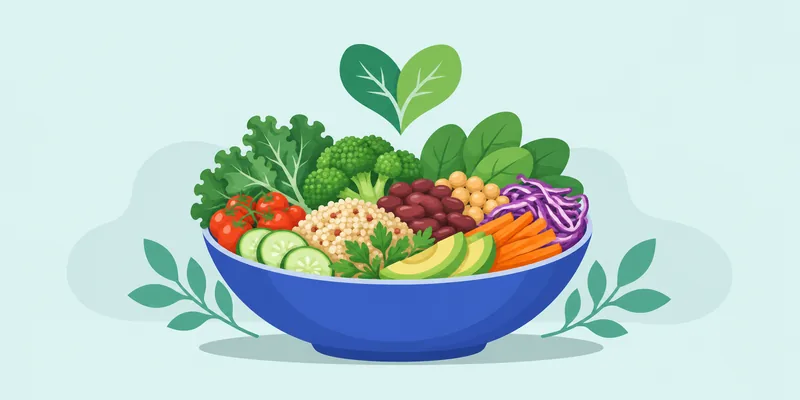
- Think in patterns. Pair fish with vegetables, legumes, whole grains, nuts and olive oil, as in the diets that showed plaque regression511.
- Treat supplements as a medical decision. Typical suggested doses are 1,000-2,000 mg/day of EPA+DHA in the meta-analysis, and higher doses carry an AFib warning712.
- Ask about contaminants. The posts do not quantify mercury or microplastics, so consider asking a clinician or dietitian1.
Frequently asked questions
How much fish should I eat for my heart?
The Harvard summary quoted in the group points to about one to two 3-ounce servings of fatty fish a week1. Another shared summary suggests about two servings of around 4 oz each2.
Which fish are best?
Fatty fish are emphasized: salmon, herring, mackerel, anchovies and sardines1. Harvard Health also lists tuna34.
Is fish oil as good as eating fish?
The posts treat them differently. Fish is linked with lower mortality in cohorts119, while supplement trials suggest fewer heart attacks, dose-dependent benefits and an AFib signal at high doses7. The posts do not include a head-to-head comparison of the two.
What about mercury and microplastics?
The group's posts do not provide data on either. The only related statement is Harvard's remark that fears of contaminants make many people unnecessarily shy away from fish1.
Do I need to eat fish to be healthy on a plant-based diet?
In Adventist data, pesco-vegetarians had the lowest mortality, but vegans still did well417. Louis says the vegan diet can be very healthy if done correctly6.
Can omega-3s protect memory?
A 2 g/day DHA trial in older adults at risk for Alzheimer's found no cognitive benefit over two years, though it was small and exploratory43.