"Is dairy good or bad for the heart?" is a question with no single answer, because dairy is a family of very different foods. Milk, yogurt, cheese, cream and butter share some ingredients but differ in how the fat is packaged, whether the food has been fermented, and what it is compared against in studies. The 2020 NEJM review (Willett et al.) that the group often cites describes dairy as "a mixed bag": there are benefits, particularly for fermented forms like yogurt and maybe cheese, but also risks.9
In the group's reading of the evidence, fermented dairy (yogurt and cheese) looks neutral to modestly beneficial in long-term cohort studies, and yogurt has the strongest record. Butter and cream look different: their saturated fat raises LDL and ApoB, and they offer no protection in the epidemiology. Unfermented milk sits somewhere in between, with no clear benefit.101112
Observational findings below show associations, not proof of cause.
Why "dairy" is not one thing
Saturated fat is not a single substance
Dairy is a source of saturated fat, which normally raises LDL cholesterol. But there are over a dozen different saturated fatty acids, and they have to be considered case by case.13 Louis explains that dairy contains more shorter-chain saturated fats (such as butyrate and propionate) and odd-chain fatty acids (C15 and C17), which studies link to lower cardiovascular risk than the long-chain saturated fats (stearic and palmitic acid) that are more abundant in red meat.14 He stresses that this research is still new and ongoing.
The food matrix and the milk fat globule membrane
Two dairy foods can contain the same grams of saturated fat and still affect blood lipids differently. This is attributed to the "food matrix", the physical structure of the food, which changes how it is digested and absorbed.15
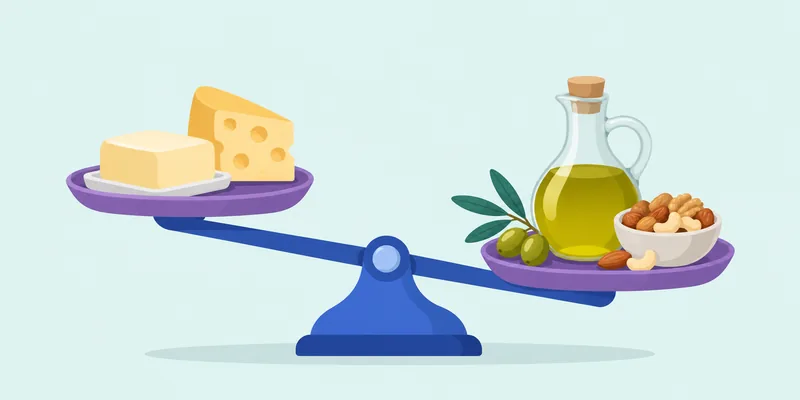
- Butter: churning breaks and strips away the natural wrapper around milk fat, the milk fat globule membrane (MFGM), leaving nearly pure fat that is absorbed quickly.215
- Cheese: the fat stays locked inside a solid mesh of protein and protective membranes, and the calcium in cheese may also modify how the fat is absorbed.15
- Yogurt: the MFGM remains intact.2
A shared summary adds that in one randomized trial full-fat cheese lowered LDL more than reduced-fat cheese supplemented with butter at similar saturated fat, protein and calories, and that cheese eaters in another study excreted more fat in their stool than butter eaters. The same summary admits that results are not perfectly consistent and that many variables remain unknown.16
Fermentation
Louis argues that the saturated fat in non-fermented dairy strongly raises LDL and ApoB and that fermenting dairy, as in yogurt and cheese, appears to attenuate this effect. He considers this one of the likely reasons fermented dairy does better than unfermented dairy in long-term prospective cohort studies.10 Fermentation is also part of how traditional Mediterranean peasants kept milk: turning it into yogurt and cheese preserved it far longer than fresh milk.17
There is also a second, more speculative argument. A 2013 review proposed that cow's milk works as a signaling system that activates the growth pathway mTORC1, in part through exosomes carrying microRNA-21, and a 2015 study found that fermenting milk into yogurt reduced microRNA levels to far below those of milk. Louis suggests this may partly explain why fermented dairy epidemiology is consistently better than non-fermented, and notes that pasteurization and homogenization help less.18 He presents this as a possible explanation, not as a proven mechanism.
What the evidence shows
Yogurt
Yogurt has the most consistent long-term record of any dairy food in the group's discussions. Louis points to a large body of long-term epidemiology and to major randomized heart trials (Lyon Heart Study, PREDIMED, CORDIOPREV) that encouraged yogurt and produced excellent outcomes after years of follow-up.7 The diets used in the plaque-reversal trials emphasized yogurt and some other dairy alongside vegetables, legumes, whole grains, nuts, olive oil and fish.1920 The Lyon trial diet allowed some low-fat yogurt and cheese while being very low in butter, cream and red meat.21
Key numbers on yogurt:
- Mortality: a dose-response meta-analysis in Public Health Nutrition (2023) pooled 17 cohort studies with 896,871 participants. Higher yogurt intake was associated with lower all-cause mortality (pooled relative risk 0.93) and CVD mortality (0.89). Per daily serving, risk was about 7% lower for all-cause and 14% lower for CVD mortality. The most benefit was seen around 0.5 servings a day, with no further reduction above that, and there was no significant association with cancer mortality.1
- Diabetes and weight: quoting the Harvard Nutrition Source, three cohorts totaling 120,877 people followed for up to 20 years suggested yogurt protects from weight gain, and two meta-analyses found 18% and 14% lower type 2 diabetes risk with daily yogurt. The source calls the epidemiology "still limited" and says the mechanism is unclear.22
- Regulatory view: in March 2024 the US FDA allowed a qualified health claim that eating at least 2 cups (3 servings) of yogurt per week may reduce type 2 diabetes risk, judging the evidence credible but limited.23
- Lipids (randomized): in a 4-week crossover trial, participants ate 1.5 to 2 servings a day of either full-fat yogurt or low-fat yogurt with 10 to 15 g of butter mixed in, matched for saturated fat. After 4 weeks the yogurt-plus-butter arm raised ApoB by 10 mg/dL, while full-fat yogurt lowered it by 4 mg/dL. The authors attributed the difference to the MFGM.21024
ApoB is the surface protein on atherogenic (plaque-forming) lipoproteins and is used as a biomarker of cardiovascular risk.2 Louis notes this may explain, in part, why yogurt epidemiology is better than for other dairy.2
Cheese
For cheese the picture is mildly favorable but more qualified.
- An umbrella review in Advances in Nutrition (2023) looked at 54 meta-analyses and found cheese linked to lower risk of all-cause mortality (RR 0.95), cardiovascular death (0.93), CVD (0.92), coronary heart disease (0.92), stroke (0.93), type 2 diabetes (0.93), fractures (0.90), dementia (0.81) and ER-negative breast cancer (0.89). Evidence quality was moderate, and there was no clear link for cancer mortality, hypertension or prostate cancer.3 Gokhan shared it as interesting given the group's usual caution about saturated fat, adding that cheese should be eaten sparingly by people whose LDL rises or who watch sodium.3
- A cohort study and meta-analysis in Nature Communications also found a small but statistically significant lower CVD risk with cheese. Louis's caveat is the comparison: these studies usually compare cheese against the standard American diet, which he says draws 40% of calories from refined sugar and starch. His reading is that replacing refined starch, sugar and ultra-processed foods with minimally processed cheese probably lowers risk, so a serving of cheese is probably better than a white-flour bagel or a pop tart.4
- Another shared summary suggests that cheese benefits may level off around 50 g a day, and that cheese is still high in calories and salt. It also warns that heavy melting can break down the protective structure.1516
Show data
| Relative risk (log scale) | 95% CI | |
|---|---|---|
| Yogurt: all-cause mortality | 0.93 | – |
| Yogurt: cardiovascular mortality | 0.89 | – |
| Cheese: all-cause mortality | 0.95 | – |
| Cheese: cardiovascular death | 0.93 | – |
| Cheese: cardiovascular disease | 0.92 | – |
| Cheese: stroke | 0.93 | – |
| Cheese: type 2 diabetes | 0.93 | – |
| Cheese: dementia | 0.81 | – |
Butter and cream
Butter is the clearest negative in the group's posts.
- A shared post notes that the butter literature shows neutral to slightly higher all-cause mortality and no protective effect for CVD, and that butter's saturated fat reliably raises LDL-C in controlled feeding trials. It also says randomized trials show butter raises LDL more than cheese, consistent with the food-matrix idea.12
- In the Harvard cohorts (Nurses' Health Study, Nurses' Health Study II and Health Professionals Follow-up Study, 221,054 participants), published in JAMA Internal Medicine, the highest butter intake was associated with a 15% higher risk of all-cause death than the lowest, and each additional 10 g a day of butter with a 12% higher risk of cancer death. The highest plant-oil intake was associated with a 16% lower risk of death.5625
- A modeled substitution of 10 g a day (just under a tablespoon) of butter with equivalent calories of plant oils was associated with 17% lower all-cause and 17% lower cancer mortality. This is an observational modeling analysis that "mimics" a feeding trial, not a trial itself.56
- In a randomized overfeeding trial in Diabetes Care (2018), people eating 1,000 extra calories a day for 3 weeks from butter and high-fat dairy saw liver fat rise by 55%, compared with 15% on olive oil and nuts and 33% on added sugar. Saturated fat also raised insulin resistance.26
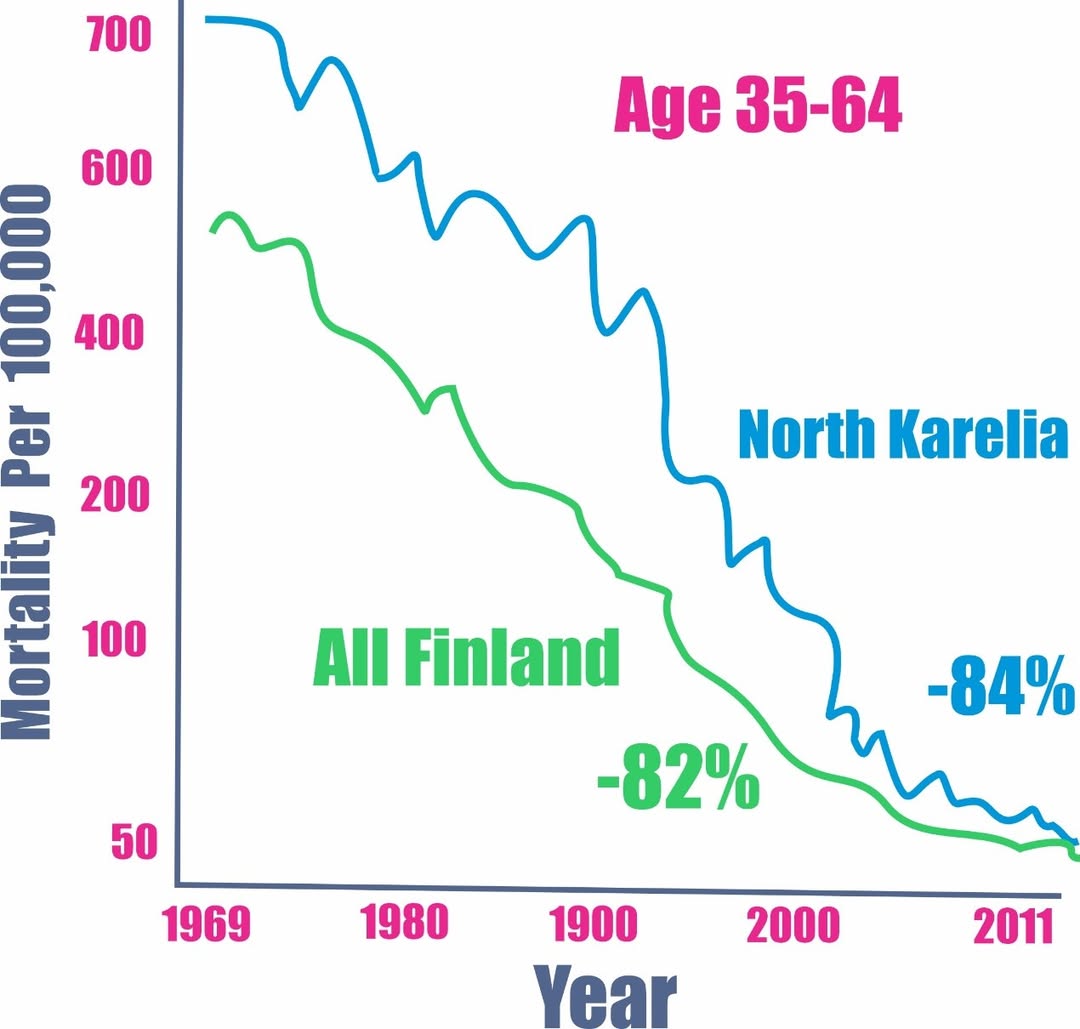
- The group often notes that North Karelia in Finland, which had a cardiovascular death rate of 700 per 100,000 in 1972 and about 18 kg of butter per person per year, saw coronary deaths in working-age men fall by 82% after a campaign that included replacing butter with vegetable oils. This is a population campaign, not a controlled trial, and it changed several things at once.27
Gokhan's opinion is that free saturated fat as found in butter and cream has uniquely different biological effects from the protein-bound saturated fat in cheese and yogurt, and that butter and cream should be avoided as much as possible.8
Milk
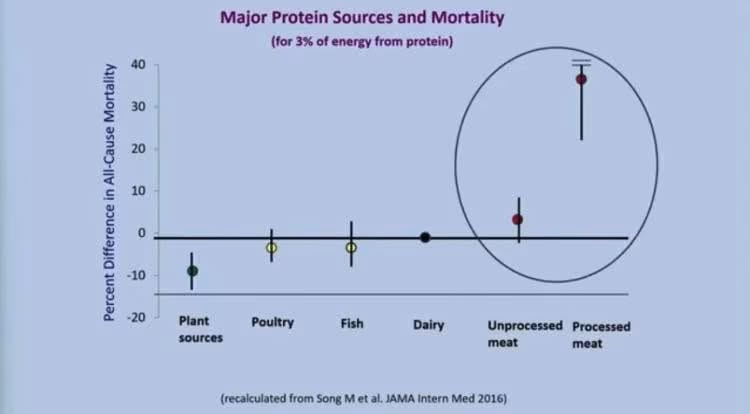
Evidence for plain milk is the weakest of the group. In the 25-year Swedish dementia study, milk, whether high- or low-fat, did not lower dementia risk.14 In the large Harvard analysis of protein sources, dairy overall comes out neutral: fermented forms confer a small benefit, unfermented forms tend to show the opposite, and the two cancel out.1128
The NEJM review concluded that the evidence does not support high dairy consumption for reducing fractures, that total dairy has not been clearly related to weight control, diabetes or CVD, and that high dairy intake is likely to increase prostate cancer risk and possibly endometrial cancer while reducing colorectal cancer risk.9 A Willett clip Louis shared notes that countries with the lowest milk intake, such as Indonesia and much of Asia, have the lowest fracture rates, and that calcium needs may be lower than official recommendations.29 On the other hand, an Oxford study funded by Cancer Research UK found that the calcium in a large glass of milk a day was linked to nearly 20% lower bowel cancer risk, with similar effects from dairy and non-dairy calcium. Louis adds that excess calcium may contribute to CVD, which he describes as controversial in cardiology.30
Dairy foods at a glance
| Food | Fermented | Fat structure | Effect on LDL or ApoB | Long-term cohorts |
|---|---|---|---|---|
| Yogurt | Yes | Milk fat globule membrane stays intact2 | Full-fat yogurt lowered ApoB by 4 mg/dL against a butter comparison2 | Lower all-cause (RR 0.93) and CVD mortality (RR 0.89)1 |
| Cheese | Yes | Fat locked in a protein mesh15 | Full-fat cheese lowered LDL more than reduced-fat cheese plus butter16 | Modestly lower CVD (RR 0.92)3 |
| Milk | No | Not discussed in the posts | Not discussed in the posts | No clear benefit; dairy overall neutral1428 |
| Butter and cream | No | Churning strips the membrane from butter fat15 | Raise LDL and ApoB; butter more than cheese1012 | No protection; highest butter intake 15% higher death512 |
Nuances, controversies and common misconceptions
"Dairy fat protects against dementia"
A Swedish study of nearly 28,000 people over 25 years, published in Neurology, linked 50 g a day or more of high-fat cheese (roughly a third of a cup) and at least 20 g a day of high-fat cream to lower dementia risk. It found no benefit from low-fat cheese, low-fat cream, butter or milk. Louis urges caution: it is one observational study and the first to report this, the Harvard Nurses' Health Study has 30 years of data and a cohort almost 10 times larger without reporting the effect, and replication is needed. He adds that the solid randomized and cohort evidence for dementia and CVD favors unsaturated fats from fatty fish, olive oil, nuts, seeds and avocados.14 Another admin-shared post called the same research "an imperfect study that needs to be validated or not."31
"Saturated fat studies show no harm"
Louis points out that studies finding no harm from saturated fat usually use the standard Western diet as the comparison, a diet with over 40% of calories from refined starch and sugar. When saturated fat is compared with fruits, vegetables, legumes, whole grains, olive oil, nuts, seafood or unsaturated fats, it consistently raises risk. He lists full-fat yogurt and cocoa butter in dark chocolate as exceptions that consistently do well.13 The same logic applies to cheese and ice cream: Louis notes that an apparent diabetes benefit of ice cream is compared against a poor baseline, that scientists interviewed mostly attribute it to reverse causality, and that the evidence for yogurt is much stronger.32 His short answer to the saturated-fat debate is to replace saturated fat with unsaturated fat, with yogurt and cheese as possible, still debated exceptions.33
Full-fat versus low-fat
The group is not unanimous in its practical wording. A do's-and-don'ts guide shared by Gokhan advises consuming dairy in moderation and choosing low-fat or fat-free yogurt, cheese and milk.3435 Gokhan's own comment elsewhere is that whole-fat cheese and yogurt appear benign, and the yogurt lipid trial used full-fat yogurt.28 Several of the major diet trials allowed non-fat or low-fat dairy (the Ornish diet permitted non-fat yogurt and non-fat milk), so low-fat dairy is not shown to be harmful either.2021 The larger distinction in the posts is fermented dairy versus butter and cream.
Trans fats in dairy
Dairy and beef contain small amounts of naturally occurring trans fat, produced in the stomachs of ruminant animals. The AHA is quoted as saying these do not seem to have the same adverse effects as artificially created trans fats, and a shared article reports that a large review suggests the same for dairy.3637 The post gives no numbers, so treat this as preliminary.
Chocolate and milk fat
Cocoa butter is high in stearic acid, which has a largely neutral effect on LDL, whereas milk fat contains palmitic and myristic acids that raise LDL. A post therefore advises avoiding chocolate with added milk fat.38 Louis says cocoa butter raises LDL about a quarter as much as milk fat. In Harvard cohorts of about 192,000 people, dark chocolate was associated with 21% lower type 2 diabetes risk at five or more servings a week, while milk chocolate showed no diabetes benefit and was associated with weight gain.39
Whey and other dairy proteins
Louis contrasts yogurt with processed whey supplements: yogurt has long-term epidemiology and trials behind it, while there is almost no long-term data on processed whey, and no multi-year randomized trials.7 In a 2026 trial in adolescent athletes, two daily 175 g servings of Greek yogurt (17 g protein each) matched whey isolate for performance, body composition, bone and inflammation over a season. Louis frames this as whole food equaling a supplement.40
Older age
In a 2026 case-control study of Chinese adults aged 80 and over, people who ate fish, eggs or dairy were as likely to reach 100 as meat eaters, while non-meat eaters were less likely to reach 100 only if they were underweight and frail. Louis cautions that case-control studies rank low in the evidence hierarchy. He suggests that in frail old age, protein sources that raise IGF1 (including dairy) may help, whereas for most people high IGF1 probably does more harm than good.41
The bigger dietary context
The traditional Mediterranean diet, according to Louis, was about 90% plant food, with the remaining roughly 10% made up of seafood, yogurt, some cheese, poultry and eggs.17 The 1975 Keys book advised small amounts of cheese and yogurt, preferably from sheep or goat's milk, and olive oil in place of butter.4243 The Lyon trial's Mediterranean-style diet, which was very low in butter and cream and allowed some low-fat yogurt and cheese, cut cardiac death and non-fatal heart attack combined (risk ratio 0.27) compared with an AHA diet.21 A Swedish cohort of over 76,000 adults found a 23% lower risk of premature death with closest adherence to updated Nordic guidelines, which include low-fat dairy among other foods.44
The lesson the admins draw is that dairy's role depends on the whole diet. Cheese and yogurt that replace refined carbohydrate and processed food look good; butter and cream that replace olive oil, nuts or fish do not.46
What this means for you
These are the group's recommendations and interpretations, not individual medical advice. The admins suggest discussing any major dietary change with your doctor, especially if you have established heart disease or very high LDL.
- If you include dairy, the group's admins favor fermented dairy, with yogurt as the best-supported option.7
- Yogurt benefit in the cohort meta-analysis was largest around half a serving a day, with no further gain above that.1
- Cheese can fit into a heart-healthy diet in moderation, though "more isn't necessarily better," and it remains high in calories and salt.1516
- Butter and cream are best minimized; Gokhan says to avoid them as much as possible, and the Harvard data suggest swapping butter for olive, canola or soybean oil.58
- Watch your own labs. Gokhan notes that whole-fat cheese and yogurt look benign "if they don't raise your cholesterol significantly", so checking LDL and ApoB after adding dairy is sensible.38 Gokhan reported an LDL of 71 mg/dL after about 30 days on a low-carb diet that included daily cheese, a personal anecdote.45
- Choose dark chocolate made with cocoa butter rather than added milk fat.3839
- Louis recommends unsaturated fats (olive oil, nuts, seeds, avocados, fatty fish) as the main fat sources rather than dairy fat.1433
- Prefer whole-food protein such as yogurt over processed whey powders, which have no long-term outcome data.7
Frequently asked questions
Is full-fat yogurt better than low-fat yogurt?
The only randomized lipid trial discussed used full-fat yogurt and showed ApoB falling by 4 mg/dL, but its comparison was against low-fat yogurt plus butter, not against low-fat yogurt alone.2 Gokhan has also shared a guide recommending low-fat options.34 The posts do not contain a head-to-head test of full-fat versus plain low-fat yogurt.
Why does butter raise LDL more than cheese if the saturated fat is the same?
The proposed reason is the food matrix. Churning butter removes the milk fat globule membrane and leaves highly absorbable pure fat, while in cheese the fat sits inside a protein structure, and cheese calcium and fermentation may also change absorption.1516
Does cheese protect against heart disease?
Observational data suggest a modest association with lower risk (for example RR 0.92 for CVD in the umbrella review), but these comparisons are usually against the standard American diet, so it does not show cheese is better than vegetables, legumes or nuts.34
Is milk bad for you?
The evidence is mixed. Milk is neutral for mortality in the Harvard protein analyses, did not reduce dementia risk in the Swedish study, and is not supported for fracture prevention by the NEJM review, though calcium from milk was associated with lower bowel cancer risk. Louis raises mTOR and IGF1 signaling as a concern for raw milk, which fermentation reduces.911141830
Is ice cream or other dairy dessert a good choice?
Louis says no: apparent benefits of ice cream for diabetes are likely largely reverse causality, and fruit, nuts and dark chocolate are better desserts.32
Should I stop dairy completely?
Nothing in the posts says dairy must be avoided. Several long-term diet trials and traditional Mediterranean patterns included yogurt and some cheese, and non-fat dairy was allowed even in the Ornish trial.171920 If you do not eat dairy, the posts do not suggest you are missing something essential for the heart, and plant-based and Mediterranean patterns without much dairy are also supported.929