Nuts are one of the few foods where the group's posts show both randomized-trial evidence and a very consistent body of observational evidence pointing in the same direction. People who eat a small handful several times a week have fewer heart attacks, fewer strokes and lower mortality in large cohorts, and when nuts were added to a Mediterranean diet in a randomized trial, cardiovascular events fell23. Louis Nervegna, one of the group's admins, has called nuts a "life extension drug" while carefully noting that the mortality data come from observational analyses9.
The practical amount is modest. The PREDIMED trial used about 30 g a day (a small handful), and a meta-analysis shared in the group found most of the benefit by around 15 g a day15. Despite being energy-dense, nuts did not cause measurable weight gain in trials, which is the most common worry people have about them6.
This article walks through what the evidence shows, what nuts do to cholesterol, plaque, blood sugar, weight and the brain, where the disagreements and misconceptions are, and what the group's admins suggest in practice.
Why nuts matter for the heart
Nuts are rich in unsaturated fats, fiber, arginine (an amino acid the body uses to make nitric oxide, a molecule that relaxes blood vessels), vitamin E, folate, potassium and polyphenols (plant compounds with antioxidant and other effects)3. Harvard's Nutrition Source, quoted in the group, notes that the unsaturated fats lower LDL ("bad") cholesterol, and that walnuts contain omega-3 fats that may help prevent erratic heart rhythms3. It also reports that the US FDA allows some nuts to carry the claim that one ounce of nuts daily can reduce heart disease risk3.
Louis adds a mechanical argument. Nuts are hard and fiber-filled, so they digest slowly, and he describes them as "time release arginine capsules" that keep nitric oxide elevated for longer11. In a ZOE podcast episode Louis shared, the speaker explains that around 30% of the calories in nuts pass through the gut undigested, one reason they cause less weight gain than their calorie count suggests12.
Peanuts are technically legumes, but the group treats them as "nut-like" because they act similarly in studies. Harvard's summary notes that both peanuts and walnuts were linked with lower disease risk313.
What the evidence shows
The randomized trial: PREDIMED
PREDIMED was a large, multi-year randomized trial in Spain of people at high cardiovascular risk but without established disease. Louis describes the three arms: a control diet similar to the American Heart Association advice of the time, a Mediterranean diet plus extra virgin olive oil, and a Mediterranean diet plus nuts1. The posts give the following results:
- Size and design. Ornish's summary of the trial, quoted in the group, says it was a 5-year randomized trial published in 2013 in the New England Journal of Medicine and tracked 7,216 patients at high risk of heart disease2.
- Nut dose. The nut group was asked to eat 30 g a day: 15 g of walnuts, 7.5 g of hazelnuts and 7.5 g of almonds1. NutritionFacts describes it as about half a pound of nuts per week for four years14.
- Events. Louis reports that the Mediterranean diet with nuts reduced major cardiovascular events (MACE) by 30% compared with the control diet, and that the nut group had about a 50% lower stroke risk1. Ornish's text likewise says the nut group "cut their incidence of stroke in half"2, and NutritionFacts says the added-nuts group appeared to cut stroke risk in half14.
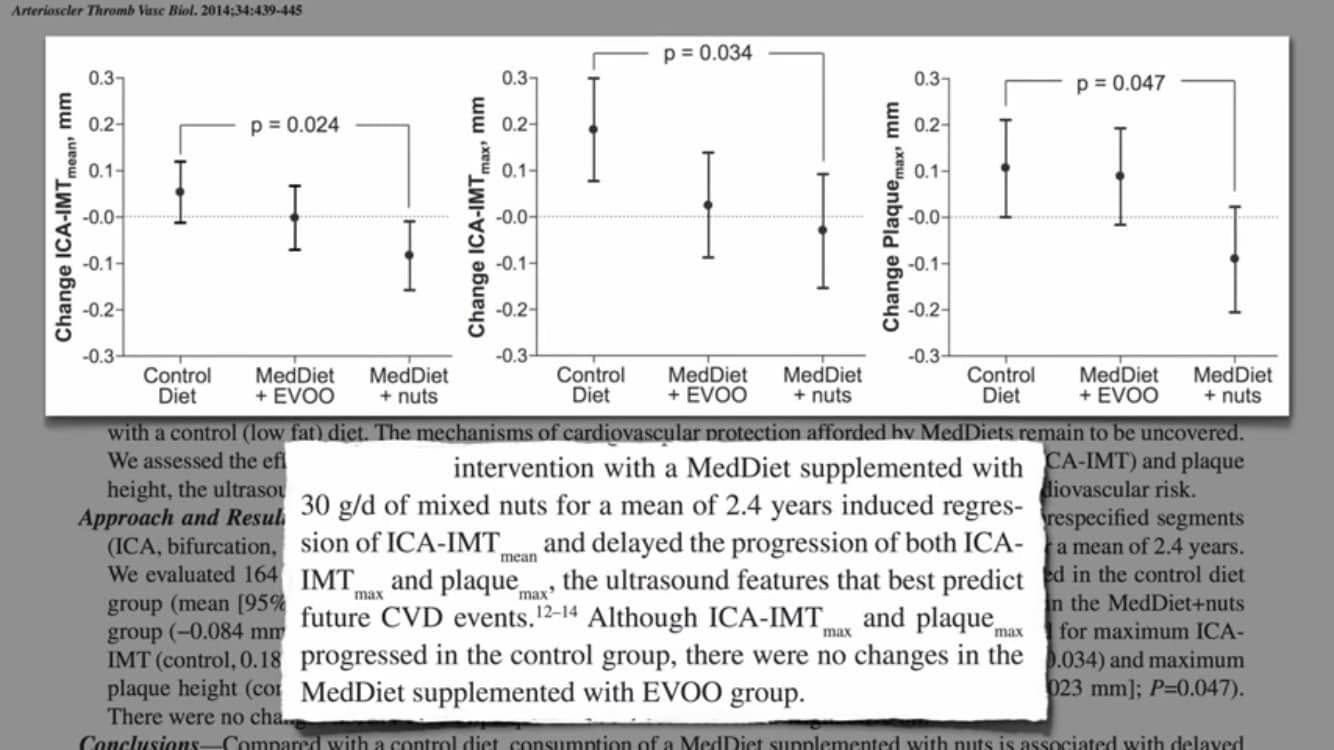
- Plaque. In a carotid sub-study of 164 people with complete data, the thickness of the carotid artery wall (intima-media thickness) progressed by 0.052 mm in the control group but regressed by 0.084 mm in the Mediterranean-plus-nuts group (P=0.024 versus control) after about 2.4 years1. Louis points out that this is consistent with the lower stroke rate1.
PREDIMED mortality analyses (observational)
Louis also highlights analyses of nut intake within the PREDIMED cohort, published in BMC Medicine in 2013. Over a median follow-up of 4.8 years, people who ate nuts more than three servings a week had a 39% lower risk of all-cause death than non-consumers (hazard ratio 0.61), with similar protective effects for cardiovascular and cancer mortality15. Participants in the Mediterranean-diet-plus-nuts group who ate more than three servings a week had the lowest mortality (hazard ratio 0.37, a 63% reduction), and the highest nut-intake category had about 55% lower cardiovascular and 40% lower cancer mortality15.
Show data
| Hazard ratio (log scale) | 95% CI | |
|---|---|---|
| All participants eating nuts more than 3 times a week | 0.61 | 0.45–0.83 |
| Mediterranean-plus-nuts group eating nuts more than 3 times a week | 0.37 | 0.22–0.66 |
The caveat, which Louis states himself, is that this was a prospective observational analysis within a randomized trial. It cannot prove causation, though he argues it "can strongly hint at it"915. He distinguishes it from the plaque and stroke results, which were seen in the randomized comparison itself15.
Large cohort studies
Louis compiled four large prospective cohorts that each reported lower fatal coronary heart disease or sudden cardiac death with higher nut intake4:
- Adventist Health Study: nuts more than four times a week was associated with a 48% lower risk of fatal coronary heart disease (relative risk 0.52) and a similar reduction in non-fatal heart attacks, compared with less than once a week4.
- Iowa Women's Health Study: women eating nuts twice a week or more had a hazard ratio of 0.73 for cardiovascular death versus non-eaters, roughly 27% lower4.
- Nurses' Health Study: women eating more than five 1-ounce servings per week had a 35% lower risk of total coronary heart disease (relative risk 0.65), and results did not change after adjusting for other fats, fiber, fruit and vegetables4.
- Physicians' Health Study: men eating nuts twice a week or more had a 47% lower risk of sudden cardiac death and 30% lower risk of coronary heart disease death4.
Harvard's Nutrition Source, quoted in the group, summarizes these cohorts as showing a consistent 30% to 50% lower risk of heart attack, sudden cardiac death or cardiovascular disease with nuts several times a week3. In one large study of over 210,000 health professionals followed up to 32 years, eating 1 ounce of nuts five or more times per week was linked to 14% lower cardiovascular disease and 20% lower coronary heart disease3. Among people with type 2 diabetes, five servings per week was associated with 17% lower cardiovascular disease, 34% lower cardiovascular death and 31% lower all-cause death, and those who increased intake after diagnosis also did better3.
How much, and what about mortality?
A shared summary of a meta-analysis on nuts and walnuts reports that nut consumption consistently tracked with lower all-cause mortality, that most of the benefit appeared near 15 g/day (about half a standard serving), and that the association plateaued beyond that5. None of the individual studies in the main meta-analysis showed higher mortality from nuts. For walnuts, the best estimate was 28 g two to four times a week, and the association held among people who already ate healthy diets5. Louis also shares a video making the case that the walnut mortality effect is hard to ignore16.
The Michigan Nature Food modelling analysis of more than 5,800 foods, which Louis quotes, estimated that 30 g of nuts and seeds added about 25 minutes of healthy life, while a can of soda cost about 12 minutes1718. This is a modelling exercise, not a trial.
Cholesterol, LDL and plaque
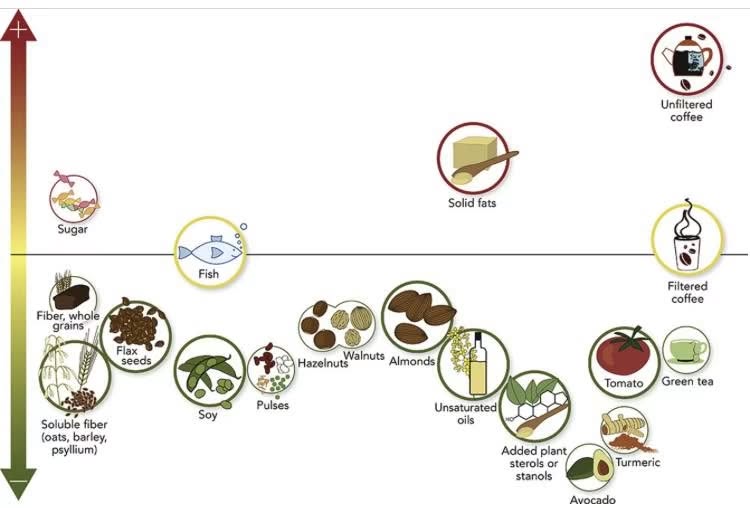
Louis shared a graph of foods' effects on LDL cholesterol relative to a typical Western diet, serving for serving. A serving of almonds lowers LDL against that baseline, whereas sugar raises it; he adds that eating too many calories raises LDL whatever the food19.
The Ornish article quoted in the group cites a 2015 meta-analysis of 61 controlled trials in which nuts (walnuts, almonds, pistachios, pecans, cashews) lowered total cholesterol, LDL and triglycerides, and a 2010 JAMA pooled analysis of 25 trials concluding that nut intake lowers LDL2. A newer meta-analysis shared in October 2026 (119 unique randomized trials, 102 in the quantitative analysis, median follow-up 21 weeks) found small reductions in total cholesterol, LDL and triglycerides and no significant effect on HDL6.
Gokhan Can shared a clinical review on small dense LDL, a particle type considered an independent risk factor because it is more prone to oxidation and arterial penetration. It says pistachios, hazelnuts and mixed nuts in a Mediterranean diet consistently reduced small dense LDL particles and improved particle size, with generally strong randomized-trial evidence20.
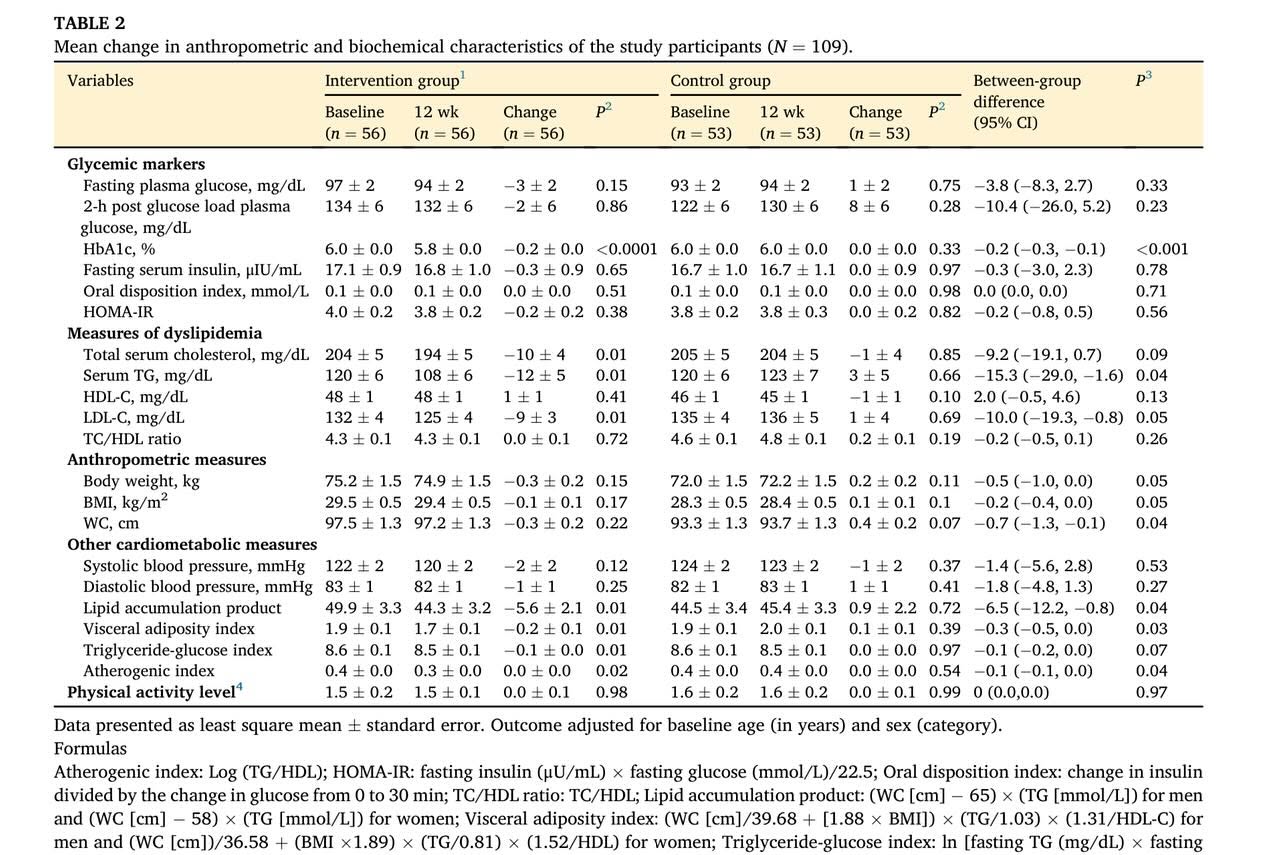
A 12-week randomized trial in 120 people with prediabetes tested 60 g of pistachios daily (30 g before breakfast and dinner). Pistachios lowered LDL by about 10 mg/dL and triglycerides by 12 mg/dL, and the LDL change reached P=0.0521.
A related plaque finding comes from CORDIOPREV, a trial of 1,002 coronary patients comparing a Mediterranean diet rich in extra virgin olive oil (which included nuts and fish) with a low-fat diet. Carotid wall thickness fell on the Mediterranean diet while the low-fat diet showed no change22. Because the diet included many foods, this cannot be attributed to nuts alone.
Louis also shared a small 2013 study in 10 healthy volunteers suggesting that a single large intake of Brazil nuts improved lipid profile. The shared claim was that four Brazil nuts once a month might improve LDL for up to 30 days, with daily intake of four risking selenium toxicity. Louis asked whether anyone had actually tried it, which signals this is preliminary23.
Weight, blood sugar and other effects
Weight
The 119-trial meta-analysis found that adding about 120 kcal/day of nuts did not significantly change body mass, BMI or waist circumference. Percent fat mass fell by about 0.3 percentage points and percent lean mass rose by 0.71 points, though absolute lean mass did not change significantly. The authors suggested participants may have adjusted what else they ate, but the trials did not establish why6. In a Deakin University trial, 120 older adults eating 43 g of peanut butter a day for six months added about 250 kcal/day without significant changes in weight, BMI or body composition24.
Blood sugar
In the pistachio trial, HbA1c fell by 0.2% and post-meal glucose spikes were 28% lower after breakfast and 17% lower after dinner on continuous glucose monitoring, while blood pressure, fasting glucose and insulin did not change21. A DIRECT-PLUS trial of 294 adults with abdominal obesity gave all Mediterranean-diet participants 38 g of walnuts a day; the "green" Mediterranean version (with green tea and Mankai) reduced liver fat by 39% versus 20% for the standard Mediterranean diet, and 12% for standard guidelines2526. Because the green version differed in several ways beyond walnuts, this does not isolate a walnut effect. Louis frames liver fat as a root cause of insulin resistance in most people26.
A shared piece in the group claims walnuts lead the clinical evidence for nuts in type 2 diabetes, citing a meta-analysis of 13 trials showing better fasting glucose and insulin sensitivity827. These shared pieces were largely uncited summaries, and Louis explicitly corrected one of their statements (see below)8.
Blood pressure, brain blood flow and memory
A Maastricht University randomized crossover trial of 31 healthy adults aged 60-75 found that 60 g/day of unsalted, skin-roasted peanuts for 16 weeks raised global cerebral blood flow by 3.6% and verbal memory by 5.8%, and lowered systolic blood pressure by about 5 mmHg1328. Executive function and reaction speed did not improve28. Louis suggests arginine-driven nitric oxide as the mechanism, and a summary he shared notes the roughly 4% flow gain is similar in size to what the brain loses over about 10 years of aging11. A follow-up from the same team reported improved insulin responsiveness in memory-related brain regions2930, with no broader changes in body metabolism or liver fat31. Louis calls this the third human randomized trial he knows of linking peanuts to better brain health or memory29. These are small trials in healthy volunteers.
The Adventist Health Study dementia analysis, as shared by Louis, found eggs linked to lower dementia risk but nuts and beans linked to just as large a benefit, with roughly 12 almonds matching the egg effect. He draws the lesson that eggs should replace red or processed meat, not nuts or beans32.
A polyphenol study of more than 3,100 TwinsUK adults followed for over a decade linked diets rich in tea, coffee, berries, nuts and whole grains to healthier blood pressure and cholesterol and lower predicted cardiovascular risk; it is observational33. In a different line of work, Louis notes that walnuts are among the foods that supply the precursors of urolithin A, a gut-produced compound he describes as a mild mitochondrial stressor34. A newly published mouse study found urolithin A improved heart function measures in a stiff-heart failure model, but human data are lacking35.
Nuances, controversies and misconceptions
"Nuts are bad if you already have heart disease"
Louis strongly disagrees with the claim, which he attributes to Caldwell Esselstyn, that nuts harm people with cardiovascular disease. He says there is now a consensus in academic cardiology and nutrition that nuts are protective36. He also notes that the Ornish reversal program, historically ultra-low-fat, now allows a limited amount of select nuts and seeds because of the evidence, and quotes Ornish's article236. In another post Louis argues that Esselstyn's published evidence consists of case series, with no randomized trial, while he says Ornish's randomized results were no better than the big Mediterranean-diet trials (Lyon Heart Study, PREDIMED, CORDIOPREV)37. Louis also reposted an Ornish graphic saying the evidence on nuts and seeds is "overwhelming"38. These are Louis's views and the group does not present a head-to-head trial of the two approaches.
"The omega-6:omega-3 ratio makes nuts and seeds dangerous"
Louis rejects claims that pistachios, Brazil nuts, pumpkin seeds, cashews, almonds and pecans are harmful because of their omega-6:omega-3 ratio. He says the ratio has not predicted heart disease or diabetes in studies and that nuts and seeds are associated with lower risk, with the possible exception of very high coconut intake7. In a separate correction he says more than 30 randomized trials show omega-6 does not raise inflammatory markers, and more than 100 show improved insulin sensitivity and glycemic control, and that nuts and seeds, loaded with omega-6, protect against cardiovascular disease and diabetes8. He makes a related point about seed oils and CRP39.
Observational versus randomized evidence
Much of the mortality evidence is observational. People who eat nuts may differ from those who do not, although in the Nurses' Health Study the result held after adjusting for dietary fats, fiber, fruit and vegetables4. PREDIMED's stroke, event and plaque results are from randomization, while its mortality figures are not15. Many of the newer mechanism and brain findings come from small, short trials.
"Nuts make you fat"
The meta-analysis of 119 trials and the peanut butter trial both found no significant weight gain despite added calories, though the authors could not say why624. Louis cites partial non-absorption of nut calories12. These trials generally add nuts to an existing diet and last months, not years. Louis also notes that excess calories raise LDL regardless of source19.
Nuts as a replacement for ultra-processed foods
Louis suggests nuts and seeds as a healthier alternative to ultra-processed protein powders, citing their fat and fiber as cardioprotective, insulin-sensitizing and filling40. Gokhan likewise recommends nuts in place of cheese when working to improve a Mediterranean diet score10.
What this means for you
The group's admins present nuts as a food worth eating regularly, and these points summarize their posts. As always, individual needs differ, so discuss changes with your doctor, particularly if you have a nut allergy or are on medication.
- A small handful most days. PREDIMED used 30 g/day1. The meta-analysis suggests most mortality benefit by about 15 g/day, or 28 g of walnuts two to four times a week5.
- Variety. Harvard's summary suggests different nuts supply different nutrients, so mix them3. PREDIMED used walnuts, hazelnuts and almonds1.
- Unsalted and skin-roasted where possible. The Maastricht peanut trials used unsalted, skin-roasted peanuts28. Gokhan, for example, eats no-salt sprouted bread and almond fruit bars as part of his Mediterranean diet41.
- Swap, do not just add. Nuts in place of cheese, or in place of red and processed meat, is the framing used by Gokhan and in the Michigan analysis1017.
- Do not fear weight gain at modest doses. Trials added about 120 kcal/day without weight change, though people with specific calorie goals should still count them6.
- Keep track of LDL. Gokhan's view is that people on keto diets should never ignore LDL and might use a nut-heavy, fish-heavy, olive-oil-rich version42.
- Eat the whole pattern. Walter Willett, in a shared interview, describes a daily diet that includes nuts alongside oats, blueberries and vegetables, and Gokhan's list of anti-inflammatory foods also includes nuts434445.
- Treat Brazil nuts with caution. The monthly-dose claim is preliminary, and the shared text warns that daily intake risks selenium toxicity23.
Frequently asked questions
How many nuts should I eat?
The PREDIMED nut group aimed for 30 g/day, and a meta-analysis found most of the mortality benefit near 15 g/day15. Harvard's summary cites benefits at about 1 ounce five or more times a week3.
Do nuts lower LDL cholesterol?
Modestly. Pooled trials found small reductions in total cholesterol, LDL and triglycerides, with no change in HDL26. A pistachio trial showed about 10 mg/dL lower LDL21.
Will nuts make me gain weight?
In 119 randomized trials, adding about 120 kcal/day of nuts did not significantly change weight, BMI or waist6.
Are peanuts and peanut butter included?
The group counts peanuts as nut-like. Trials found brain blood flow, memory and blood pressure benefits with 60 g of peanuts a day, and muscle power benefits with 43 g of peanut butter a day in older adults1324. Harvard's summary also reports lower disease risk with peanuts3.
Can people who already have heart disease eat nuts?
Louis argues yes and points to the Ornish program's shift to allow them, but the specific advice for any individual should come from their own clinician236.
Are nuts really a "life extension drug"?
Louis uses that phrase, but he stresses that PREDIMED's mortality results are post-hoc observational analyses that cannot prove causation9. They are consistent with the cohort studies and with the meta-analysis5.