Can a handful of kitchen herbs and plant extracts do something real for your arteries? The short answer from the group's discussions is that some of them have interesting, plausible and sometimes quite specific human data, but almost none of it comes from the large outcome trials that exist for statins or other drugs. Aged garlic extract has the best-developed imaging evidence of the group, hibiscus has the clearest blood-pressure signal, gotu kola has the most dramatic but least independently verified plaque results, and curcumin sits mostly in the anti-inflammatory and liver-fat territory.
The group's admins, Louis Nervegna and Gokhan Can, both use several of these products and are generally enthusiastic, but they are also candid about the limits. Louis repeatedly describes the studies as "small" and "lower quality" yet "promising"1. Gokhan's own plaque ranking places these herbs in a "promising but needs more study" tier, well behind the lipid-lowering drugs with imaging proof2.
Why herbs come up in heart-disease discussions
Atherosclerosis is the slow build-up of plaque inside artery walls. The studies below measure it in several ways: coronary artery calcium (CAC), which counts hardened, calcified deposits; coronary CT angiography, which can also see soft, non-calcified plaque; carotid intima-media thickness (CIMT), the thickness of the neck-artery wall measured by ultrasound; and flow-mediated dilation (FMD), a test of how well the artery lining, the endothelium, relaxes when blood flow rises. Most herb studies use these "surrogate" measures rather than counting heart attacks, which is the key reason the evidence is described as promising rather than proven.
One thread that links many of the posts is the endothelium and nitric oxide (NO), a gas that signals blood-vessel muscle to relax. Louis notes that ageing, smoking, a poor diet, insulin resistance and chronic inflammation can all impair endothelial function7, and he has described the endothelium as a target for which no drug currently exists6. Several of the herbs below are discussed precisely because they might act there.
A broader backdrop is a 2022 JACC systematic review of 884 randomized trials of 27 micronutrients. It found moderate-to-high quality evidence that supplements including curcumin, catechin, flavanol and quercetin reduced cardiovascular risk factors, but the reductions in actual events were for omega-3 (heart attack relative risk 0.85), folic acid (stroke 0.84) and CoQ10 (all-cause mortality 0.68), while beta-carotene increased mortality8. Risk-factor improvements are not the same as fewer heart attacks.
Aged garlic extract
The coronary calcium trials
The best-known garlic evidence in the group is three small, double-blind, placebo-controlled trials using Kyolic aged garlic extract (AGE), usually at about 1.2 g per day, with CAC progression over one year as the outcome3:
- Budoff 2004: 23 patients with known coronary disease or high risk (Framingham risk above 20% over ten years). CAC progressed 7.5 ± 9.4% with AGE versus 22.2 ± 18.5% with placebo3. The linked paper describes this as a small pilot study in patients receiving statin therapy3.
- Budoff 2009: 65 intermediate-risk patients (average age 60) with baseline CAC above 30. AGE was combined with vitamin B-12, folic acid, vitamin B-6 and L-arginine; CAC progressed 6.8% versus 26.5% on placebo (P = 0.005)3.
- Zeb 2012: 65 asymptomatic intermediate-risk men (average age 55) with baseline CAC above 10, treated with AGE plus coenzyme Q10. Mean CAC progression was 32 ± 6 versus 58 ± 8 with placebo (P = 0.01)3.
The Journal of Nutrition review quoted in the post is careful about the limits: all three studies used the same brand, and two of them added other nutrients, which could have influenced the results3. A later trial using 2.4 g of AGE reported 20% annual CAC progression versus 28% on placebo3.
Show data
| Aged garlic extract | Placebo | |
|---|---|---|
| Budoff 2004 (23 patients, on statins) | 7.5% | 22.2% |
| Budoff 2009 (65 patients, with co-supplements) | 6.8% | 26.5% |
| Later trial, 2.4 g/day | 20% | 28% |
Soft plaque and CT angiography
Calcium scoring only sees hardened plaque, so the more interesting studies use coronary CT angiography. Louis highlights a small randomized, double-blind trial from the Budoff group in 55 adults aged 40 to 75 with metabolic syndrome and measurable plaque at baseline. Participants took 2,400 mg of AGE daily or placebo for 12 months; the AGE group showed a marked slowing of total plaque accumulation and regression of low-attenuation plaque, the lipid-rich, soft type associated with vulnerability to rupture9. The paper that post links to is a related randomized, placebo-controlled study in patients with diabetes, reporting that AGE reduced low-attenuation plaque9. Louis summarizes both as showing that AGE "slows plaque growth, and reverses high-risk soft plaque", while also calling it a small trial910.
The same review mentions that garlic powder tablets versus placebo showed better prevention of CIMT progression after three months3. Gokhan's plaque-reduction ranking sums up the garlic literature as multiple placebo-controlled trials reducing CAC and CIMT progression, a couple of them combined with other nutrients, and rates AGE as "likely helpful" while saying studies using AGE alone and measuring plaque volume would strengthen the case2.
Where garlic sits relative to proven treatments
In that same ranking, statins, PCSK9 inhibitors and ezetimibe have the strongest imaging evidence for plaque regression, followed by high-dose EPA and pioglitazone; colchicine, AGE, Centella, pine bark, nattokinase and plant-based diets are "promising but need further study"2. Gokhan reports taking AGE for about five years alongside low-dose rosuvastatin, an ACE inhibitor and fish oil11, an addition to, not a replacement for, standard care.
Allicin: raw versus aged garlic
A recurring point of confusion is allicin. Louis explains that raw garlic does not itself contain allicin; it contains enzymes that make allicin when the garlic is cut or crushed. Allicin lasts only minutes, heat destroys the enzymes, and so cooked garlic and aged garlic extract pills contain no allicin, though they retain other beneficial compounds12.
This matters because the plaque trials above used aged garlic extract, not allicin. The allicin story rests on a different line of evidence: a paper in npj Biofilms and Microbiomes found that in people who make a lot of TMAO (a gut-bacteria product linked to cardiovascular disease), a week of raw garlic juice reduced TMAO formation, improved gut microbial diversity and increased beneficial bacteria, and that allicin ameliorated atherosclerosis in mouse models13. Louis's practical reading is that cooked garlic is still very good for you, but the allicin effect needs raw, freshly crushed garlic1213. The TMAO human data in the post come from a one-week intervention, and the atherosclerosis result is from mice.
A possible bonus: colon polyps
Louis also notes that a 2006 Journal of Nutrition trial found fewer colorectal adenomas with high-dose AGE (2.4 mL/day for 12 months): 0.68 on average versus 1.44 in controls, with total polyp size about 66% smaller in people who had adenomas at the start10. He frames this as a possible colon-cancer benefit, not a heart finding.
Gotu kola (Centella asiatica)
What the studies reported
Gotu kola is the most dramatic story in the group's herb discussions and also the one with the most caveats. Louis quotes a Life Extension magazine article describing studies using 60 mg of a Centella asiatica extract three times daily. In people with high-risk (soft) carotid plaque, carotid plaque was on average 30% denser (harder) after 12 months. In a randomized, placebo-controlled second phase, MRI showed reduced brain blood flow in 17% of controls but only 7% of the treated group, and the supplemented group had 41% fewer cardiovascular events6. A placebo-controlled study of soft plaque in the femoral (leg) arteries found plaque 63% harder in 12 months, while plaque size grew 23% in controls and not at all in treated patients6.
Show data
| Treated | Control | |
|---|---|---|
| Reduced brain blood flow on MRI | 7% | 17% |
| Growth in femoral plaque size over 12 months | 0% | 23% |
| Change in number of arterial calcifications (with pine bark, 84 patients) | -10% | 35% |
Gokhan's summary of a second Life Extension article adds combination studies with French maritime pine bark extract14:
- a 1-year study of 60 patients with soft plaque, where Centella plaque size did not increase versus a 23% increase on placebo14;
- a 3-year study of over 300 patients, with plaque progression in 5.3% on the combination versus over 20% in controls, and major events under 4% versus 22%14;
- a 4-year study of over 200 patients with mild atherosclerosis, with progression to worse plaque in 1.1% versus 21-48% with lifestyle counseling alone14;
- a 1-year study of 84 patients, where the number of arterial calcifications fell 10% with the extracts and rose 35% with aspirin alone14;
- a 6-month study of 40 patients, where a plaque stability index doubled versus no change with lifestyle counseling only14.
The original femoral-plaque trial (Angiology, 2001) tested whether the extract, by modulating collagen production, could make soft plaques look "harder" on ultrasound over 12 months14.
How cautious to be
Louis is explicit: "This needs to be tested in larger higher quality studies", but "if the result holds up, it could be very important"6. The summaries come from a supplement company's magazine, and the combination trials rely on a few moderately sized studies, several compared against lifestyle counseling or aspirin alone. Gokhan's ranking calls the Centella and pine bark evidence "likely helpful", noting it rests on "a handful of moderately sized trials"2.
Louis nevertheless names gotu kola as the most promising supplement in a video about seven plaque supplements, because in his opinion it has the most plausible mechanism of action, which he explained in the comments1. That is an opinion about plausibility, not a trial result.
Hibiscus tea
Gokhan drinks one to two mugs of hibiscus and green tea brewed together every day415. His post lays out three kinds of evidence4:
- Acute vascular effects. In a 2019 Nutrients randomized study, hibiscus calyx extract raised plasma total nitrites/nitrates over four hours (p = 0.016) and urinary nitrates at four hours (p = 0.048), suggesting more nitric oxide. Brachial-artery FMD rose by 2.29 percentage points at two hours and 2.02 at four hours versus baseline and water. The authors concluded the extract improved postprandial vascular function but that this requires confirmation4.
- Blood pressure. He cites a summary of 17 randomized trials in which hibiscus lowered systolic blood pressure by 7.10 mmHg more than placebo, with the largest drops in people with elevated blood pressure at baseline, and lowered LDL cholesterol by 6.76 mg/dL versus other teas and placebo4. The post says the reductions were similar to medication; that is the summary's claim, not a head-to-head trial.
- Mechanistic data. The post also mentions that a hibiscus compound, hibiscone C, inhibits the PI3K pathway, which is far from heart-disease outcomes4.
Louis shared a note that blood antioxidant power rises within an hour of drinking hibiscus tea and asked whether a concentrated supplement exists16. Gokhan lists 2-4 large cups of hibiscus, green and other teas daily17, and hibiscus is on his personal anti-inflammatory list18.
Green tea alongside it
Gokhan's longer write-up on green tea cites an acute endothelial improvement (FMD up 3.69% at a 30-minute peak in 14 healthy participants), and cohort associations: green tea intake was inversely related to all-cause and cardiovascular mortality in Chinese adults, in a pooled analysis of eight Japanese cohorts and in a dose-response meta-analysis19. These are observational and short-term findings.
Curcumin and turmeric
Inflammation and TNF-alpha
Curcumin, the main active compound of turmeric, features in the group mostly as an anti-inflammatory. Gokhan's personal list says it inhibits the inflammatory molecules TNF-alpha and NF-kB18. Louis states curcumin has the strongest evidence of any natural product for lowering TNF-alpha, an inflammatory cytokine he says plays a causal role in several chronic diseases including ageing itself20. He later adds, more cautiously, that there is "decent evidence" it lowers TNF-alpha in humans but the clinical implications remain unclear21. The shared FoundMyFitness material argues standard curcumin is poorly absorbed and rapidly metabolized, while phytosomal (phospholipid-complexed) forms are far more bioavailable2021. It also notes TNF-alpha inhibitors used for rheumatoid arthritis are observationally linked to lower Alzheimer's risk, which is a correlation in a different disease20.
Liver fat
The most concrete curcumin trial in the pack is a randomized trial in 87 people with non-alcoholic fatty liver disease (NAFLD). Patients took 1,000 mg/day of phytosomal curcumin (Meriva) or placebo for 8 weeks, with lifestyle advice in both groups. Ultrasound improved in 75% on curcumin versus 4.7% on placebo; 34.1% of the curcumin group had liver fat resolve completely to grade 0; BMI and waist circumference fell; liver enzymes AST and ALT fell with curcumin and rose with placebo; there were no serious adverse events5. Louis calls it a small human trial with "very impressive" results20, though it is not a cardiac outcome.
Safety and the liver-injury report
A media-reported case of liver damage in a woman taking turmeric capsules prompted a strong reaction from Louis. He argues she took 2.25 g of whole turmeric, close to the roughly 2.5 g per day he says is the average intake in India, that the capsules were apparently not tested for contamination, and that anecdotes are not clinical evidence22. In another post he argues that misuse of acetaminophen and ibuprofen is a larger liver and kidney danger than turmeric or green tea, and that reasonable amounts similar to traditional intake are very unlikely to be dangerous23. These are Louis's opinions. The case report itself, as the Ars Technica headline describes, involved hospitalization and a near transplant, so anyone with liver disease or on medicines might reasonably raise supplements with their doctor first22.
Other roles
Louis says turmeric, like broccoli sprouts, activates Nrf2, which raises the cell's own glutathione production, part of his argument against glutathione supplements24. Caffeic acid, also found in turmeric, thyme, sage and olive oil, was reported to activate a stress-protective receptor called NR4A125. A Scientific American article Louis shared cautions that most anti-inflammatory supplements lack solid evidence26, while Eric Verdin frames curcumin as a plant hormetic signal27.
Nattokinase and natto
Nattokinase is an enzyme from natto, a fermented soybean food, rather than a herb, but it is often discussed in the same breath. Gokhan quotes a 1,062-person clinical study in Frontiers in Cardiovascular Medicine in which nattokinase at 10,800 FU/day significantly improved the lipid profile and reduced carotid intima-media thickness and carotid plaque size, with improvement rates of 66.5 to 95.4%, while 3,600 FU/day was ineffective28. The post presents it as a clinical study and does not describe a placebo-controlled design. He also notes that a single 50 g serving of natto provides about 1-2k FU of nattokinase, compared with the 10,800 FU/day used in that study2829. His proposed mechanism is inhibition of PAI-1, a marker linking thrombosis, inflammation and ageing30. The group's ranking again puts nattokinase in the promising-but-unproven tier2.
Dietary nitrate, beetroot and leafy greens
Beyond supplements, the posts emphasize foods that supply nitrate. A shared explainer describes the pathway nitrate to nitrite to nitric oxide to vessel relaxation, with rich sources including beetroot, spinach, arugula and lettuce, and notes that some studies show modest blood-pressure reductions with beetroot nitrate7. Another shared post explains that bacteria on the tongue take part in the first conversion, so overuse of strong antiseptic mouthwash could interfere; the advice is to brush and floss, reserve strong mouthwash for medical need and eat nitrate-rich vegetables31.
Nitrates are not nitrosamines
The admins draw a firm line between vegetable nitrate and the nitrosamines that form when nitrite or nitrate cures meat. Louis argues that "uncured" or "nitrate-free" products use celery powder or sea salt as nitrate sources and form nitrosamines in the same way as sodium nitrite, and that nitrates themselves help lower blood pressure and protect the artery lining3233. A shared study explains that nitrite reacts with stomach acid to form nitrosamines, a leading hypothesis for the link between processed meat and stomach and colorectal cancer, and that vitamin C can disarm the reaction34.
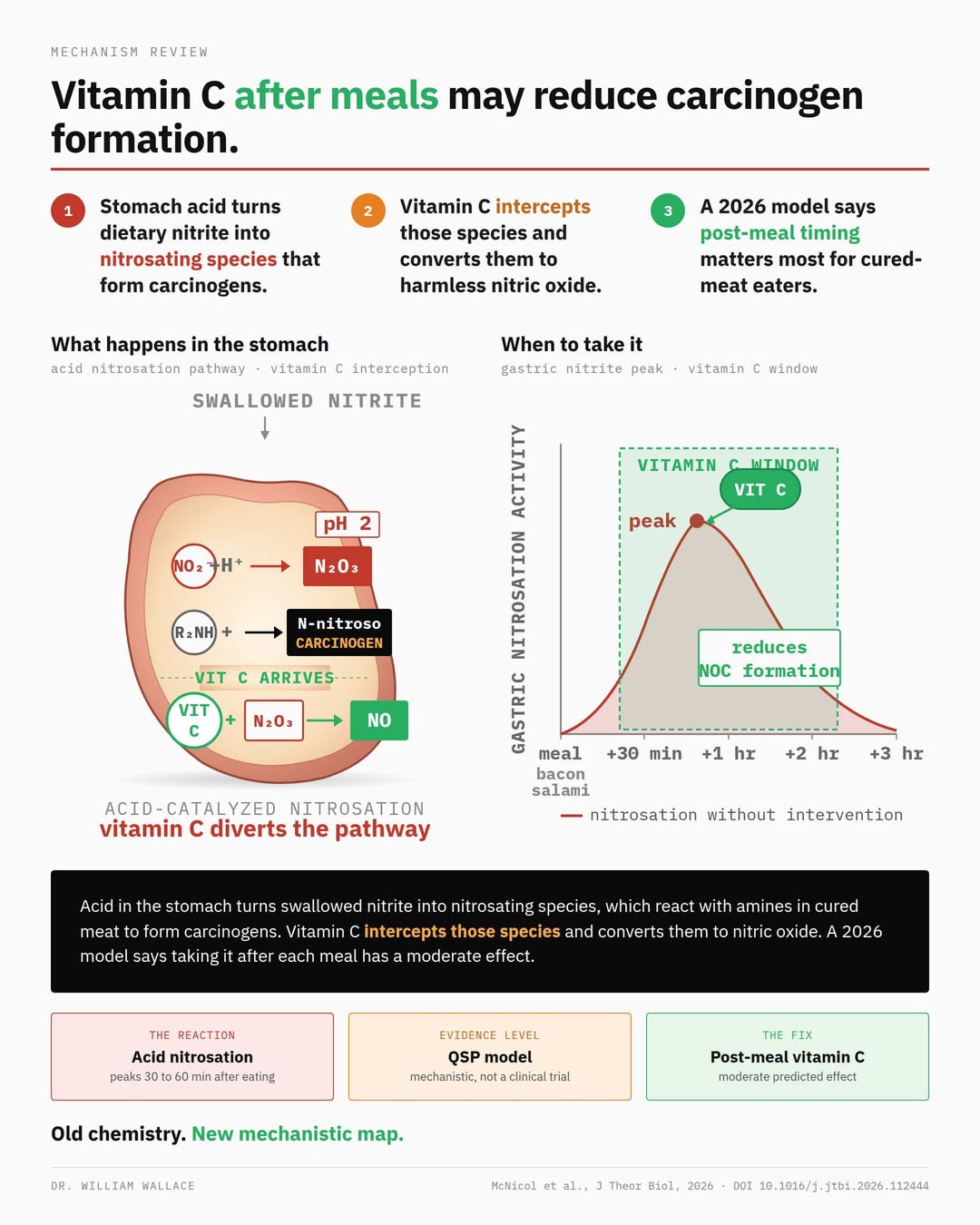
A shared dementia study found vegetable nitrates were associated with lower risk while nitrates from processed meat or drinking water were associated with higher risk, with vegetable antioxidants possibly steering nitrate toward nitric oxide rather than nitrosamines35. Gokhan makes the same distinction36.
Louis's stronger statements, that nitrosamines "directly cause" colon cancer and are also "atherogenic and diabetagenic" or that processed meat has the worst hazard ratio of any food except trans fats, are Louis's own interpretation of the cohort data333738. The more widely cited points are that the WHO classified processed meat as carcinogenic to humans in 2015 and that Harvard's Frank Hu said the evidence for harm from regular processed-meat consumption is quite convincing39.
The herbs at a glance
| Herb | Strongest data in the posts | What was measured | Main caveat |
|---|---|---|---|
| Aged garlic extract | Small placebo-controlled trials at about 1.2–2.4 g/day39 | Coronary calcium, soft plaque on CT angiography | Same brand throughout; two trials added other nutrients |
| Gotu kola (Centella) | Small studies at 60 mg three times daily6 | Plaque density and size, events | Summarized by a supplement company's magazine |
| Hibiscus tea | Summary of 17 randomized trials4 | Systolic blood pressure about 7 mmHg lower | Blood pressure only; no outcome data |
| Curcumin | 87-person fatty-liver trial; TNF-alpha data521 | Liver fat, inflammation markers | Cardiac meaning unclear |
| Nattokinase | 1,062-person clinical study at 10,800 FU/day28 | Carotid wall thickness, plaque, lipids | Not described as placebo-controlled |
| Nitrate-rich vegetables | Shared explainers7 | Nitric oxide, modest blood-pressure drops | A food, not a supplement |
Nuances and common misconceptions
- "Natural" does not mean proven. Even the supportive posts rest on small trials, short durations, surrogate markers or mixed formulations13.
- Combination products blur attribution. The 2009 and 2012 garlic trials added B vitamins, L-arginine or CoQ10, and the large Centella studies often used pine bark as well314.
- Garlic forms differ. AGE has trial data but no allicin; raw crushed garlic has allicin but short, mechanistic human data1213.
- Supplements are not a substitute for lipid control. Gokhan's ranking puts statins, PCSK9 inhibitors and ezetimibe at the top for plaque regression2.
- Anecdotes. A story of a 43-year-old who reportedly reversed plaque in 16 weeks with a six-food plate including raw garlic is a single case; Louis adds that randomized trials support plaque reversal with this kind of diet40.
What this means for you
- Aged garlic extract is the herb with the most imaging data. The group's admins describe it as promising and many members take it, usually on top of standard therapy; discussing dose (the trials used about 1.2 to 2.4 g/day) and interactions with your doctor is sensible3911.
- If you want allicin, Louis says it must be raw and crushed and eaten fairly soon afterward12.
- Gotu kola's reported results are impressive but unconfirmed; Louis wants larger, higher-quality trials before treating it as established6.
- Hibiscus tea is an inexpensive option with a randomized-trial summary showing a systolic drop of about 7 mmHg; people on blood-pressure medicine may want to ask their doctor how it fits4.
- Curcumin may lower TNF-alpha and liver fat, but Louis says the cardiac meaning is unclear521.
- Nitrate-rich vegetables such as beets, spinach and arugula are an easy food-based way to support nitric oxide7.
- None of these is a replacement for proven lipid-lowering treatment2.
Frequently asked questions
Does garlic actually shrink plaque?
Small trials show less progression of coronary calcium and a reduction in soft, low-attenuation plaque with aged garlic extract, but these studies were small, sometimes combined with other nutrients, and used imaging surrogates rather than counting heart attacks39.
Is raw garlic better than a garlic pill?
It depends on the claim. Only raw crushed garlic has allicin, and allicin is what the TMAO study examined; the plaque trials used aged garlic extract, which has none1213.
Can hibiscus tea replace blood-pressure medicine?
The posts do not say so. They cite a 17-trial summary with a roughly 7 mmHg systolic reduction, but the author drinks it as a daily habit, not as treatment4.
Is turmeric dangerous for the liver?
Louis argues a widely reported case involved a normal dose and probable contamination, and he regards traditional-size intakes as very unlikely to be harmful; the case report did involve severe liver injury, so people with liver problems may wish to ask their doctor2223.
Are beets and spinach the same as the nitrates in bacon?
The admins say no: vegetable nitrates come with antioxidants, while nitrosamines form when nitrite reacts with meat protein3236.