Sodium and potassium are two minerals that work against each other in the body, and blood pressure is where that tug of war matters most for the heart. Table salt is sodium chloride. The group's posts and the guidelines they quote consistently say that too much sodium is detrimental and that high potassium intake is beneficial, and that most people eat too much of the first and too little of the second.511
Practically, that translates into three ideas: eat less sodium (mainly from packaged and restaurant foods), eat more potassium-rich whole foods, and, for some people, swap part of the table salt for potassium chloride. A large randomized trial in stroke survivors supports that last step, but potassium is not harmless for everyone, particularly people with kidney disease or on certain blood pressure medicines.6910
This summary pulls together what the group has shared, including what is well supported, what is a personal habit of an admin and what is only a short video or a one-line claim. It is a summary of posts, not individual medical advice.
How sodium and potassium work together
A post Louis shared describes the two as opposing forces: sodium pulls water into the bloodstream and tightens vascular tone, while potassium signals the kidneys to excrete sodium and relaxes vascular smooth muscle.5 The American Heart Association (AHA) text Louis quoted says the same thing in simpler words: potassium reduces the effects of sodium, the more potassium you eat the more sodium you lose in urine, and potassium eases tension in blood vessel walls.4 A shared FoundMyFitness note adds that low potassium disrupts the sodium-potassium balance that regulates blood pressure, making excess sodium even more harmful.13 Louis summarizes the newer view as potassium being "just as important" as sodium for managing blood pressure.14
Other effects of high sodium appear in the group, mostly as short shares. Louis posted a news report that a high-salt diet triggered brain inflammation leading to higher blood pressure, which points to the brain's role in hypertension, especially in treatment-resistant cases.15 He also shared two videos, without written detail, on why excess sodium raises kidney stone risk and why it raises blood pressure.161718 On cancer, Louis says salt-preserved foods are associated with higher stomach cancer risk, and that the sodium rather than fermentation appears to be the culprit, though many fermented foods are also salty, which confounds studies.19
How much sodium?
The posts give a range rather than a single number:
- The American Society for Preventive Cardiology's food pyramid, summarized by Louis, sets a sodium limit of 2,300 mg, and lower for people at high risk, and advises avoiding salty packaged and restaurant foods.1
- A FoundMyFitness summary of a Harvard study says sodium should ideally be closer to 1,500 mg a day and not above about 2,300 mg a day.2
- Gokhan Can's summary of a Brad Stanfield video recommends salt of 1,500 mg a day or less, along with the DASH diet, exercise and weight control.3
Several broader dietary statements the group shared also point toward lower sodium. The European Society of Cardiology statement says high sodium intake is detrimental.11 The advisory committee behind the 2025 US Dietary Guidelines, as summarized by Louis, recommended reducing sodium alongside red and processed meat, saturated fat and added sugars.202122 The 2026 AHA dietary guidance lists "minimize excess salt" among its nine features, and the 2026 ACC statement lists excess sodium among things to limit.2324 In the Nurses' Health Study, lower sodium intake was one of the components of a Mediterranean-style diet score independently linked to lower frailty in older women.25
The dispute over "salt is fine"
Not everyone agrees that sodium is a problem. Louis addressed a country-level study in the European Heart Journal (2021) in which higher sodium intake correlated with longer life expectancy and lower all-cause mortality; its authors argued this goes against sodium being a culprit in premature death.26 Louis calls it an ecological study, meaning it compares whole countries rather than individuals, and says such studies sit at the bottom of the evidence hierarchy, produce hypotheses only, and should not be used to overturn randomized trials or prospective cohorts.26 He points out that these studies cannot say anything about individuals, because of the ecological fallacy.26 That is Louis's argument, and readers can weigh it with the paper's own caveat that its data are observational.
Where the sodium hides
The group's posts tend to focus on packaged foods rather than the salt shaker. A shared summary about deli ham says it is often loaded with sodium, sometimes four times more than unprocessed pork.27 Louis's definition of processed meat is meat chemically transformed by salting, curing, smoking or fermenting.28 Cheese is described as high in calories and salt even though its saturated fat behaves differently from butter's.29 Kimchi is high in sodium, yet a meta-analysis of nine studies, mostly in Korea, linked regular intake to lower systolic (3.48 mmHg) and diastolic (2.68 mmHg) blood pressure, which the summary attributes to its potassium and fermentation bacteria.30
In place of salt for flavor, the Mediterranean diet as described by Ancel and Margaret Keys uses herbs, garlic and spices, and the AHA highlights flavorful low-sodium spices and aromatics in Asian heritage food traditions.3132 Gokhan also uses no-salt sprouted bread and a low-sodium vegetable juice as practical swaps, and says the bread lowers his blood pressure.3334
Potassium: how much and from where
Targets
The sources disagree slightly on the number, so it helps to know where each comes from:
- The AHA recommends 3.5 g to 5 g of potassium per day, preferably from diet, for adults with elevated (120/80 or higher) or high (130/80 or higher) blood pressure who are otherwise healthy.4
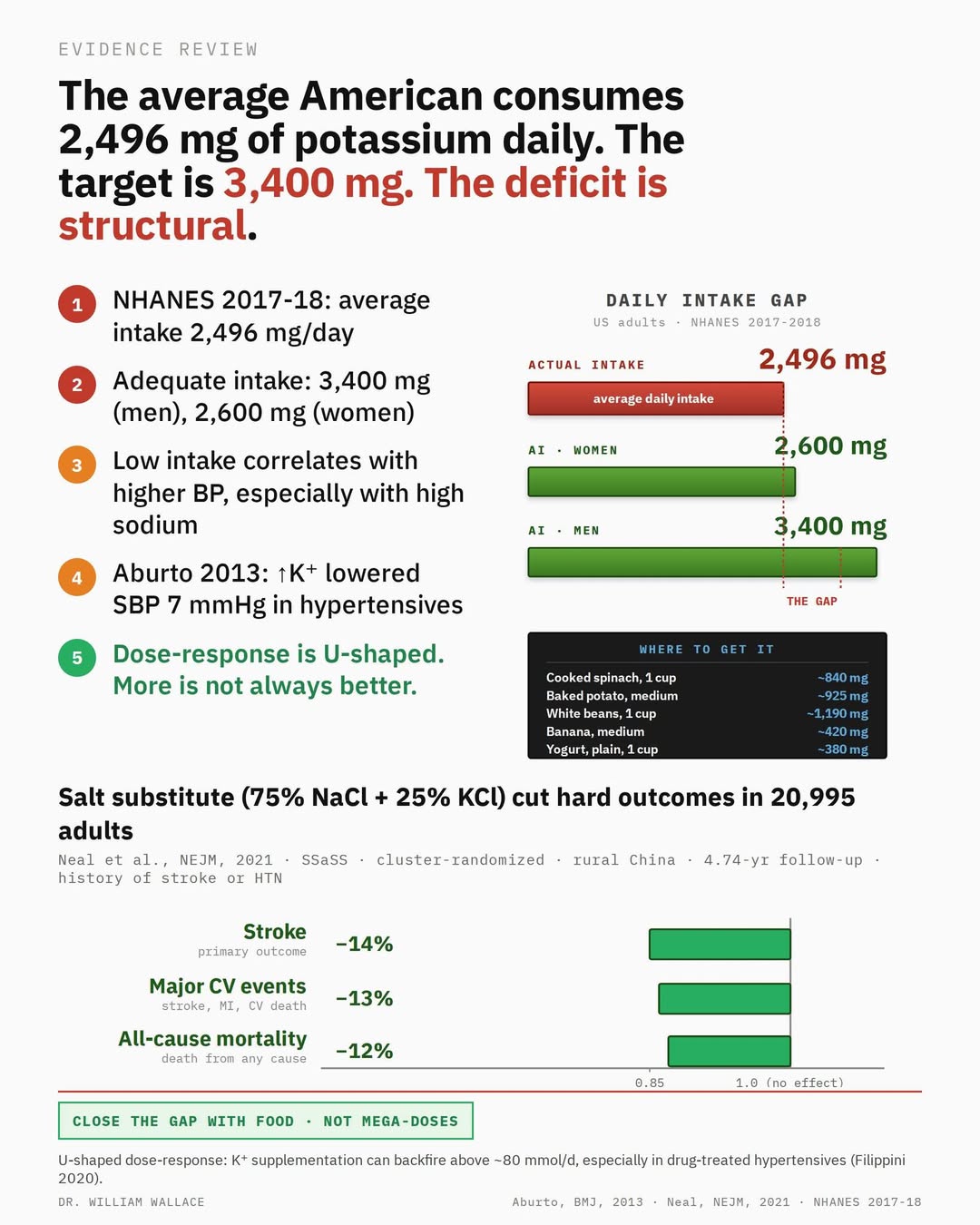
- The National Academies' Adequate Intake, quoted in a shared post, is 3,400 mg for men and 2,600 mg for women, while most Americans consume about 2,500 mg.5
- Louis wrote that the RDA is 5 g a day, and a shared note claims over 90% of people are deficient in potassium.13 That figure matches the top of the AHA range rather than the Adequate Intake, so the sources do not agree on a single number.
The ESC statement says high potassium intake is beneficial in healthy individuals.11
What the trials show
A post Louis shared summarizes a 2013 BMJ systematic review of 22 randomized trials: increased potassium lowered systolic blood pressure by about 3.5 mmHg on average and by roughly 7 mmHg at 90 to 120 mmol per day in people with hypertension.5 The same post cites 11 cohort studies covering 127,000 people in which higher potassium intake was associated with about 24% lower stroke risk, and says the effect was specific to people with elevated blood pressure, with normotensive adults not showing the same shift.5
Louis also shared a short note that raising potassium to high-normal levels lowers the risk of ventricular arrhythmias in high-risk heart patients. The linked item was a brief summary, so this concerns supervised treatment of patients, not something to try at home.36
Food sources
Foods named in the group include bananas, pistachios and avocados.13 Louis shared a video listing five foods with more potassium than a banana: white beans, baked potatoes with skin, Swiss chard, cooked spinach and avocado, and added tomato sauce, tomato juice and sweet potatoes (not as high as white potatoes).12 Gokhan's routine includes low-sodium V8 vegetable juice.34 Plant-heavy patterns such as the Mediterranean and DASH diets are the ones the guidelines describe as lowering blood pressure and cardiovascular risk.1124
Potassium-enriched salt substitutes
The most direct evidence in the group is the Salt Substitute and Stroke Study (SSaSS) in stroke survivors. In a cluster randomized trial of 15,249 stroke patients in northern China, a low-sodium, potassium-enriched salt substitute produced a 14% lower risk of recurrent stroke, a 12% lower risk of death (21% lower stroke-related death), a small drop in blood pressure and no increased hyperkalemia.6 Gokhan's earlier post on a subgroup analysis of a larger trial describes the substitute as containing 25% potassium chloride and reports 14% fewer recurrent strokes, 30% fewer hemorrhagic strokes and 21% fewer stroke-related deaths.7 Both descriptions cite the benefit coming from a cheap, scalable swap, especially where sodium intake is high.67 Note that this was a trial in people who had already had a stroke in a particular region, so applying it to everyone is an extrapolation.
For home use, Louis uses Morton Lite Salt, a 50:50 mixture of regular salt and potassium chloride that he says tastes almost the same as regular salt.68 It is also iodized: each quarter teaspoon has 60 mcg of iodine, or 40% of the RDA.8 Joel Kahn made a similar point in a one-line share: "Potassium chloride in place of standard salt", and Brad Stanfield's video notes that a salt substitute is a good option.337 Louis also says you can buy "healthier versions of iodized salt" that replace some sodium chloride with potassium chloride.38
Who should be careful
The same posts carry clear warnings. Louis states that if you have kidney problems, you should not take potassium salts like Lite Salt, because the kidneys regulate blood potassium and too much can cause fatal cardiac arrest.8 A later post explains that as kidney function declines potassium can accumulate, and severe hyperkalemia can disrupt the heart's rhythm and lead to life-threatening arrhythmias.9 A pharmacy-exam review shared by Louis notes that ACE inhibitors can cause hyperkalemia, and the risk rises with potassium-rich foods or other potassium-raising drugs.10 People on such drugs, or who have kidney disease, may want to ask their doctor before using potassium salt substitutes or potassium supplements. The SSaSS "no increased hyperkalemia" finding applies to the trial conditions and population.6
Potassium supplements and other claims
Gokhan reports that after he began supplementing with potassium his systolic pressure was 107 at a doctor visit, versus mid-120s before and about 140 five years earlier. This is a personal anecdote, not a trial.39 Some other claims in the group are more tentative:
- Gokhan suggests potassium or magnesium citrate and a base-forming diet of fruits, vegetables, nuts and legumes for mild metabolic acidosis (low CO2 on labs), but cites no studies.40
- A 24-week randomized trial in healthy older adults found neither whey protein nor a potassium bicarbonate supplement improved muscle power, performance or mass, though IGF-1 rose with the whey.4142
- A two-month randomized, single-blind trial in adults with type 2 diabetes and insomnia gave 250 mg magnesium plus 250 mg potassium daily and reported the biggest improvements in sleep hormones and insomnia severity compared with either alone. It enrolled 320 people (290 completed) and addressed sleep, not heart outcomes.43
- A shared Gokhan post on hibiscus tea cites a meta-analysis of 17 randomized trials with a 7.10 mmHg greater systolic reduction versus placebo, an additional food-based blood pressure option.35
Blood pressure targets and why they matter
Diet is one tool for blood pressure. Gokhan summarized the SPRINT trial, in which a systolic target below 120 mmHg rather than 140 was linked to fewer heart attacks, strokes and deaths, with 25-27% lower mortality in a Stanfield video summary.344 A follow-up analysis projected 2.9 more years of survival from age 50 with intensive control, along with fewer white-matter lesions.45 Another video summary says ideal systolic pressure is now under 120 while drug therapy targets under 130.39 Home monitoring, a potassium-rich low-sodium diet, exercise and sleep are the lifestyle levers named, with medication when those fall short.44
Salt and iodine
One reason not to abandon salt entirely is iodine. Louis argues the problem is excess sodium overall and not iodized salt itself, which is sodium chloride with tiny amounts of calcium silicate, dextrose and potassium iodide.38 He cites a New Scientist column warning that iodine deficiency is rising in the UK, US and Australia as people drop iodized salt, and lists seafood, dairy, seaweed, potatoes with skin and lima beans as sources, suggesting a multivitamin with iodine as insurance.46 Another share says sea, Himalayan, smoked and kosher salts contain no meaningful iodine, and that 46% of pregnant women in the US have insufficient iodine.47
What this means for you
- Aim to keep sodium to no more than about 2,300 mg a day, with lower targets (1,500 mg) suggested for people at high risk or wanting an ideal level; it is worth discussing a personal target with your doctor.123
- Cut sodium where it is concentrated: packaged and restaurant foods, processed meats and salty preserved foods, and use herbs and spices for flavor.1192731
- Eat potassium-rich whole foods such as beans, potatoes with skin, leafy greens, tomatoes, avocados and sweet potatoes.1213
- Consider a potassium-containing salt substitute only if your doctor agrees, especially if you have kidney disease or take ACE inhibitors.810
- Do not drop iodized salt without replacing iodine. Seafood, dairy or a multivitamin are the options Louis mentions.46
- Treat anecdotes and short videos as leads. The strongest items here are the BMJ review of 22 trials and the SSaSS trial.56
Frequently asked questions
Is potassium chloride salt safe for everyone?
No. Louis warns that people with kidney problems should not use potassium salts, since excess potassium can cause fatal cardiac arrest, and the group shared notes that hyperkalemia can stop the heart and that ACE inhibitors raise potassium.8910
Does the potassium salt substitute lower blood pressure or only strokes?
In SSaSS the reported effects were fewer recurrent strokes and deaths and a small drop in blood pressure.6 The BMJ review summary reports about a 3.5 mmHg average systolic reduction from higher potassium intake, and roughly 7 mmHg at 90 to 120 mmol a day in adults with hypertension.5
Does salt really raise blood pressure, given studies saying otherwise?
The posts present sodium as detrimental, and Louis dismisses the contrary ecological analysis as hypothesis-generating only.1126 The salt-versus-life-expectancy paper concluded the opposite and describes its own data as observational.26
How much potassium do I actually need?
The AHA suggests 3.5 g to 5 g a day, preferably from food, for adults with raised blood pressure who are otherwise healthy. The Adequate Intake is 3,400 mg for men and 2,600 mg for women.45
Is iodized salt bad for me?
Louis says no: in reasonable amounts it provides needed iodine, and the real issue is too much sodium overall.38