Health claims on social media are often confident, vivid and wrong in a specific, recognizable way. The group's admins, Louis Nervegna and Gokhan Can, have posted dozens of examples, and the same few patterns keep appearing: a real fact stretched too far, one study standing in for a whole literature, a correlation sold as a cause, a personal story presented as proof, and a financial incentive that nobody mentions. This summary collects those patterns into a checklist and illustrates each with the cases discussed in the group.
A caution before starting. Much of what the group posts about influencers is opinion, and some of it is strongly worded. Where this summary describes a person's claims or motives, it is attributing the view to the poster, not stating settled fact. The more useful lesson is the method: the checks below can be applied to any claim, whoever makes it, including to the group's own posts.12
Why misinformation is persuasive
Dr. Daniel Chong, in a post Louis shared, says the claims he is challenged on almost always have "a grain of accuracy" that has been exaggerated, misinterpreted or over-interpreted, delivered by a storyteller who is certain and who picks only the evidence that fits.1 That description fits most of the examples below.
Gokhan adds a sympathetic point from the other side. When someone follows official dietary advice, still feels unwell, and then feels much better after doing the opposite, that personal experience is powerful and naturally erodes trust in guidelines. He also argues that observational nutrition studies can be distorted by reverse causation (people with insulin resistance may prefer fat and protein) and socioeconomic confounding (foods labelled "unhealthy" tend to be cheaper and more convenient), and that intervention trials are the real test. The post is one-sided, since it is framed to defend low-carbohydrate diets, but it shows why skepticism of official advice can be reasonable even when a specific claim fails.8
The group also offers a reminder that honest scientists hedge: a shared clip notes that credible researchers such as Walter Willett use words like "may", "could" and "likely", and that uncertainty is part of the process. Absolute certainty from a presenter is therefore itself worth noticing.2
The checks at a glance:
| Check | Red flag | Example from the group |
|---|---|---|
| 1. Evidence hierarchy | Low-tier studies used to refute trials and cohorts | Country-level sodium and life expectancy9 |
| 2. Totality of evidence | One study or one image out of many | A single CT image from a keto plaque study10 |
| 3. Correlation and denominators | Totals or ratios read as causes | Cancer death counts versus age-standardized rates11 |
| 4. Half-truths | A real fact bent into a wrong conclusion | "Only carbohydrates raise insulin"12 |
| 5. Quoting the source | The cited paper or expert does not say it | A UK Biobank HDL paper described inaccurately13 |
| 6. Anecdotes | Stories of people who "cured" themselves | Survivors tell stories; the dead do not3 |
| 7. Money | A seller or sponsor behind the claim | An influencer co-owning the jerky company he promotes14 |
| 8. Authority | Credentials or certainty instead of evidence | Doctors downplaying carnivore-diet risks15 |
Check 1: Where does the study sit on the evidence hierarchy?
Louis's most repeated advice is to ask, whenever someone posts a study, where it falls on the hierarchy of evidence. He says a common technique of "quacks and charlatans", or of people who simply do not know the field, is to cite studies from the bottom of the hierarchy to try to refute studies at the top.7 He also asks group members to keep discussions, including about plant-based diets, focused on high-quality studies; he notes there is plenty of legitimate evidence for plant-based diets and criticizes vegan influencers who exaggerate.7
Ecological studies
Louis's worked example is a country-level analysis in the European Heart Journal (2021) linking higher sodium intake with longer life expectancy. He explains that ecological studies compare group-level data, sit at the bottom of the hierarchy, and are used only to generate hypotheses to be tested later. They suffer from the ecological fallacy: the study shows that a country lives longer as a whole, not that individuals who eat more salt live longer. He argues they should not be used to overturn randomized trials or prospective cohorts.9
Post-hoc analyses presented as trials
Another trick Louis describes is citing what sounds like a randomized controlled trial but is really an observational analysis done after the trial ended. Such analyses cannot prove causality, like any observational study, and have to be judged alongside all the other observational research.6 A related red flag in the same post: if someone can cite only studies from the 1960s and 1970s, they are ignoring 50 years of later research.6
Using the hierarchy honestly
The point of the hierarchy is not that observational evidence is worthless. Louis himself relies on cohorts, for example a 2019 pooled analysis of 30 prospective cohorts linking higher blood omega-6 (linoleic acid) to lower risk of heart disease and diabetes over 2.5 to 30 years.16 The check is whether a claim is being supported by the best available type of evidence, and whether weaker evidence is being used to knock down stronger evidence.
Check 2: Is this one study, or all the evidence?
Louis writes that science considers the totality of the evidence. He describes videos in which a presenter picks one study out of 100 that fits a pet theory while ignoring the 99 that show the opposite.3 He also says influencers like to cite single studies, often opinion pieces or biased reviews that they call studies.17
Two examples from the group show the difference between selecting and surveying:
- A complete literature search. On whether canola oil is inflammatory, a researcher searched for all controlled human feeding studies and found eight, listing them in full. Louis read them, reports no sign of inflammation, and stresses this was the full list the researcher could find rather than a selection.4 (Louis does not use canola oil himself; his point is about the claim.)18
- A single image. Louis argues that a keto influencer cherry-picked one CT image that looked like plaque regression, when the study as a whole showed more plaque progression than a standard American diet. He adds that a single image can look like regression within the test's own error range, for example from repositioning in the scanner, which is why software should analyze all images. He contrasts this with the Disco-CT trial, where a DASH diet plus statins produced regression in all participants, on average the equivalent of 8 years of progression reversed in one year.10
Louis also suggests using AI tools such as Claude to summarize the totality of evidence on a question as a quick first fact check; his example was whether Paleolithic humans were carnivores. He notes the AI summary cited no specific papers, so it is a starting point rather than a source.17 He also urges members to fact-check viral claims with AI, for example a viral video claiming oatmeal spikes adrenaline "like being chased by a tiger".19
Check 3: Correlation is not causation, and denominators matter
Louis's illustration is deliberately absurd: 90% of heart attacks occur in right-handed people. That is true, but it reflects the fact that most people are right-handed, and does not suggest that training yourself to be left-handed would lower your risk. He says that understanding what is wrong with this explains why many health influencers misinterpret research.5
Related examples:
- Reverse causality. The group repeatedly makes the case that illness can lower cholesterol, BMI or blood pressure, creating a false appearance that low values are harmful. This is the basis of the popular "low cholesterol is deadly" myth, which a nine-minute video the group shared takes apart with three other common cholesterol myths.820
- Raw numbers versus rates. Our World in Data, shared by Louis, shows total cancer deaths worldwide up about 120% since the 1980s, but the crude death rate is up only about 20% because the population grew, and the age-standardized rate has fallen by about 25% because the population is older. Louis calls this an example of how influencers misrepresent data to make it look worse.11
- Ratios hide what changed. A critique Louis agreed with notes that VO2 max is oxygen consumption divided by body weight, so it can rise by losing weight with no change in oxygen consumption. The correlation of higher VO2 max with lower cardiovascular mortality in observational studies is real, the critique says, but correlation is not a prescription. Louis also notes American Heart Association and American College of Cardiology statements recognizing that intense exercise performed in high volumes can have downsides.21
Check 4: Is the claim a half-truth?
A claim can be technically correct and still misleading. The insulin index is a good example, repeated across several group posts. Louis cites a 1997 study (American Journal of Clinical Nutrition) that compared 1000-kJ (240 kcal) portions of 38 common foods and found beef raised insulin more than an equal-calorie portion of white pasta or oatmeal, and a 2012 study (Nutrition & Metabolism) in which whey protein raised insulin more than glucose or white bread. He uses this to challenge influencers who say only carbohydrates raise insulin, and recommends learning the insulin index instead of assuming.1222
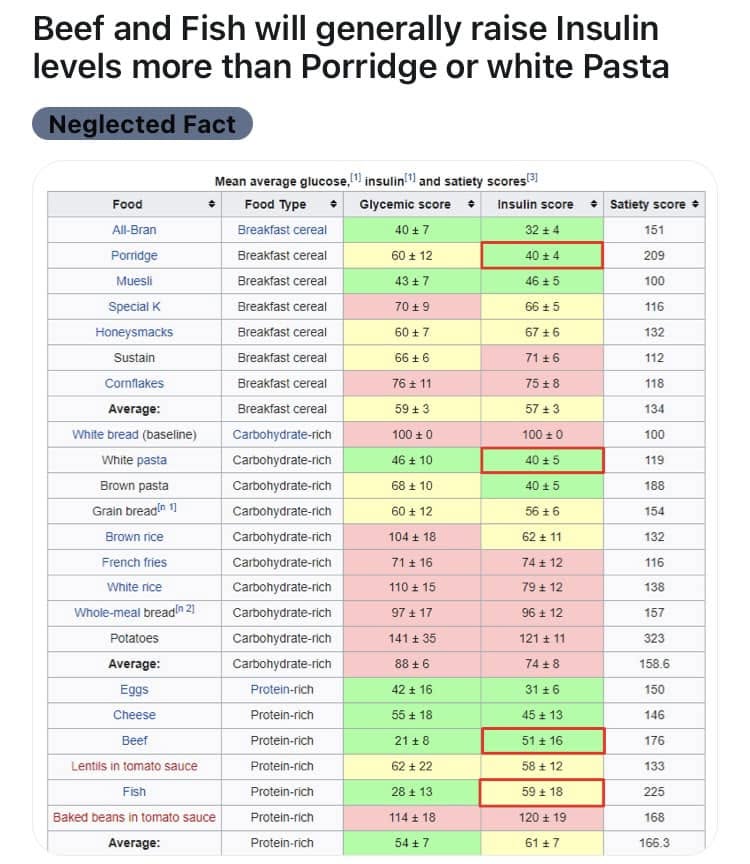
His fuller statement is that all macronutrients cause insulin secretion, that carbohydrate usually produces the largest and fastest response, and that fat usually provokes much less.23 On this basis he argues that a glucose-spike hack, adding whey protein to fruit, lowers the glucose spike by forcing a bigger insulin response, so a continuous glucose monitor reading can mislead.24 He credits one influencer who acknowledged that many proteins raise insulin more than carbohydrate.25
Other half-truths the group discusses:
- Blended fruit. Louis says blending fruit does not cause a bigger glucose spike than eating it whole, and may lower it. A response he shared describes a randomized trial in which a smoothie of apples and blackberries produced a slightly smaller glucose rise than the whole fruit, and notes that the fibre is still present in a blend.2627
- Oats. Louis rejects the claim that oats are "the same as eating sugar" and points to a small randomized trial in 19 healthy adults in which 4 g of oat beta-glucan cut the breakfast glucose peak by 28% and the lunch response by 24%. The limitations listed in the post include the small size, short duration and use of a liquid format in healthy young adults, so it is not proof for everyone.28
- Vitamin D from the sun versus pills. Louis explains that sun-made vitamin D has a negative feedback mechanism, whereas supplements do not, so taking 20,000 IU of D3 daily for months or years risks hypercalcemia. The practical lesson is that a claim that is safe in one form may not be safe in another.29
- Processed meat. Louis cites the WHO estimate that each 50 g of cured meat per day raises colon cancer risk by 18% and calculates that a longevity influencer eating up to ten 28 g jerky sticks a day takes in over 5 times the average American's processed red meat, which would roughly double colon cancer risk from the jerky alone. This is his own arithmetic.14 He also argues that "natural" celery-cured meats still contain nitrosamines and that "uncured" products contain more, though the evidence for the latter is in a separate post.3031
- Seed oils. Louis cites a 2019 pooled analysis of 30 cohorts, a Johns Hopkins explainer, and his own claim that dozens of randomized trials show omega-6 oils do not raise inflammation,1632 along with a critique arguing that research on adipose-tissue linoleic acid (associated with lower cardiovascular and all-cause mortality) was dismissed using lower-quality contrary evidence.33 A Stanford nutrition scientist is quoted as saying decades of research show replacing saturated fat with omega-6 polyunsaturated fat can improve cardiovascular outcomes.34
Check 5: Is the expert being quoted correctly?
The group often asks members to go to the source. Louis says an influencer's description of a UK Biobank HDL paper had virtually nothing from the actual study, which he says is an observational analysis associating higher HDL with lower risk at any given LDL/ApoB, something dozens of earlier studies showed.13 In another post he argues that influencers misquote exercise scientist Stuart Phillips, who says that for most people the difference between 1.2 and 1.6 g/kg of protein is only 15-25 g a day and that 2.2 g/kg (1 g/lb) has no evidence behind it.35
Internal consistency is another test. Louis points out that influencers who deny that LDL and ApoB are causal but accept that Lp(a) and triglycerides are causal contradict themselves, because Lp(a) and VLDL (measured as triglycerides) are also ApoB-carrying particles.36 He makes a similar argument about statins and keto: both lower insulin sensitivity temporarily, statins by a much smaller amount, so someone alarmed by the statin effect should be more alarmed by keto's.37
A subtler example is that a mechanism can be misrepresented. Louis argues that "statins are toxic to mitochondria" ignores the idea of hormesis, where a mild stress at normal doses can be beneficial and only high doses are toxic. He adds that if someone has no genuine side effect such as myopathy, worrying about mitochondria is unfounded. This is Louis's reading of the literature.38
Check 6: Anecdotes and survivorship
Louis's rule is that anecdotes cannot be trusted when high-quality studies show the opposite, summarized as "the plural of anecdote is misinformation".39 He warns that people hear occasional stories of high-risk people who experimented and "cured" themselves, but not the many who experimented and died: dead people do not tell their stories.3
The group cuts both ways here, and members should notice it:
- A case report of a patient on 10 mg atorvastatin whose severe left anterior descending artery narrowing became mild over 4 years is cited by Louis against influencers who claim statins cannot reverse plaque. He calls the patient an outlier and points to six randomized trials showing average total plaque volume reductions of 5% to 17% on statins.40
- Louis keeps a list of carnivore influencers with heart attacks, strokes or open-heart surgery (five as of a March 2025 post) and tallies the ages at which more than 100 deceased health influencers died.414243 He describes the finding that meat-heavy, low-"healthy-carb" influencers rarely lived long, and says Richard Bernstein, who died at 90, was the only exception he found.44 The summaries of these posts themselves note that such tallies are anecdotal and not controlled research, which means they are subject to the same limits as any other anecdote.
- Stories of influencers coming to terms with high ApoB, Lp(a) and plaque, or an orthopedic surgeon on a carnivore diet urging followers not to ignore LDL ("we just don't know"), are similarly anecdotal.1545 A shared story of a man who followed carnivore influencers and developed heart disease also noted a family history and high LDL-C before the diet.46

Check 7: Follow the money
The group's posts frequently point to conflicts of interest, again mostly as Louis's opinion.
- A Viva Longevity video Louis shared argues that influencers get rich spreading misinformation while scientists are too busy to become social media stars.47
- Louis criticizes AG1 (Athletic Greens): he says its 75 ingredients appear in tiny doses compared with those used in studies, it costs about $100 per pouch, it relies on paid influencer sponsorships and the company has never funded a scientific study. This is opinion without cited research in the post. He later shared a video on the product's science that he called junk.4849
- Louis notes that an influencer eating up to ten jerky sticks a day co-owns the company that sells them.14
- Gokhan shares a Nutrition Made Simple video alleging that a popular podcast's producers attached research PDFs or footnotes contradicting guests' claims while still promoting those claims for views and profit, including keto curing cancer, discouraging fibre and fear of normal glucose spikes. This is the video's allegation, not an independent finding.50
A fair reading is that financial interest does not make a claim false, but it is a reason to ask what evidence supports it independent of the seller.
Check 8: Authority is not enough
Louis tends to treat training and consensus as relevant. He highlights that an NYT explainer on added sugar quotes professors and researchers rather than influencers.51 He shares a National Geographic piece on statins as an "internet villain" and a video fact-checking Dr. Aseem Malhotra, both framed as evidence that influential voices can mislead.5253 He shares an infographic from Dr. Spencer Nadolsky rebutting repeated GLP-1 drug claims with three referenced papers.54 In a post on the presidential health memo, Louis argues that a person's own medical report (LDL of 53 mg/dL on rosuvastatin plus ezetimibe) shows them following their cardiologists regardless of what they say publicly, and asks that politics be kept out of the discussion.55
Credentials alone do not settle things, though. The orthopedic surgeon in a video Louis shared complains that some influencers who downplay carnivore-diet risks are other doctors, and the useful question remains whether a claim matches the totality of high-quality evidence.1517
What this means for you
These are discussion points from the group, not medical advice. The group's admins suggest the following, which you may want to talk through with your own doctor.
- When you see a study cited, find its design: randomized trial, prospective cohort, ecological or post-hoc analysis.679
- Look for the whole body of research, not the single study or image.3410
- Actually open the references. Louis says half the time the cited paper does not say what is claimed, and that most people never check.613
- Be careful with graphs of totals and ratios; ask about the denominator and the age structure.1121
- Treat testimonials, lists of famous people and your own good or bad experience as hypotheses, not proof.339
- Ask who profits if you believe the claim.4850
- If you are at high risk of a heart attack, Louis's Rule #1 is to find a good cardiologist and listen to them, and to add natural or alternative approaches on top of treatment rather than in place of it. If your risk improves markedly, he notes, medication can be reduced with the cardiologist's help.3 A statement Louis quoted makes a similar point: lifestyle and drug therapy have additive benefits, and prevention frameworks integrate both.56
- Know the emergency basics: the American Heart Association piece Louis shared debunks "cough CPR", and Louis adds that someone having a heart attack should chew a full-strength aspirin and call 911.57
Frequently asked questions
Does a claim with a "grain of truth" count as accurate?
Not necessarily. Chong's description is that such claims are usually exaggerated or misinterpreted. The insulin index and blended-fruit examples show how a real fact can be bent into a wrong conclusion.11227
Is observational research always unreliable?
No. Gokhan notes it can mislead through reverse causation and socioeconomic confounding, and trials control confounding better. Louis argues observational data should be read alongside all the other observational research, and prospective cohorts rank high in his hierarchy.689
Can I use AI to fact-check a claim?
Louis encourages it as a first step and as a way to summarize the totality of evidence, while noting that the Paleolithic summary he shared cited no specific papers. Treat it as a starting point and verify the primary sources.1719
Are the group's own lists of influencer deaths and strokes good evidence?
They are better described as illustrations. The posts themselves are anecdotal tallies rather than controlled studies.4142
What if my own experience contradicts the guidelines?
Gokhan acknowledges that personal improvement can legitimately undermine trust, and Louis says anecdotes cannot overturn high-quality studies. Both suggest the approach is to test ideas carefully, ideally with your clinician, rather than abandon proven treatment.3839